Tuesday, May 15, 2007

Sermon - Easter 6 - John 16:23-33


Easter 6C
May 13th, 2007
John 16:23-33
“I Have Overcome the World”

Are you a fan of the Olympics? Seems like most people have at least a casual interest, at least in some of the events. Most of us would like to see the U.S.A. do well in the competition.

Though it hasn’t been decided yet, I understand that Chicago is in the running to host the Summer Olympics in 2016. If that happens, not only will Racine probably see an economic boost even in our area, but people like us will be able to go and see, in person, world class competitors in all sorts of different sports.

I’ve always wondered, though I will never know, what it’s like to be a world champion – of anything. To be the best runner, or gymnast, or weightlifter. To wear that gold medal around your neck and know that at least for a moment – you are the best of the best. I think we all have a certain respect for someone who can achieve such a rare status as “world champion”.

Jesus concludes his remarks to the disciples today with the words, “take heart; I have overcome the world.” But what he wins is not for himself, but for us. What he wins is not a gold medal, but forgiveness, life and salvation. He overcomes the world by dying, rising, ascending and reigning for all eternity.

“The World” is a theme running through our readings today. The nations of the world, anyway, have come into focus in this late Easter season. The book of Acts has been detailing the inclusion of the Gentiles into God’s people. Today we read about Paul going to preach in Macedonia. We see also, the holy city of Jerusalem, a picture of the Christian Church in her glory – and into that city the “kings of the earth will bring their glory”. And we already know the inhabitants of heaven are “from every tribe, nation, people and tongue.” There is a missionary undercurrent and backdrop – the message of Christ crucified and risen is a message that must be shared with the world!

But “The World” can also mean (and usually does in John’s Gospel) all that which is opposed to God. Being “in the world but not of it” is this same idea – that though we Christians must live in this hostile territory – behind enemy lines – our true citizenship is in heaven. And we are on our way home. But we must deal with the world. We must face it, for we live here, in the world. And the world, Jesus says, hates his disciples. This can be a problem.

It can be a problem when we are persecuted for our faith. I just saw another story this week about persecution of Christians – this time in Iraq, where radical Muslims are trying to force Christians to convert to Islam or suffer the consequences. We don’t face that kind of persecution where we live- but it could happen some day.

The hatred of the world works on us in more subtle ways. Our world hates God’s ways, and fills our heads with lies and temptations. Pastor mentioned last week the dangers of materialism – a message we all need to hear. But the world around us also seeks to shake our faith in the truth of God’s word, to make us doubt the perfect standard of his law, and in our me-first culture, to elevate our own needs and wants above everyone else’s. By our sinful nature we are selfish, greedy, petty, insincere, gossip-mongering, self-aggrandizing, fearful, disrespectful, and many things worse. And the world would cultivate all these things within us. The world would have us, too, be enemies of Christ and of his word and his way.

But Christ has overcome the world. And in Christ, so do we.

Christ has overcome the world by his death. A funny way to fight a battle, by laying down your life. A strange way to win the ultimate victory, by counting all as loss. But God’s power is made perfect in weakness. So instead of climbing the pedestal to the tune of a national anthem with a gold medal around his neck, Christ’s victory over the World is seen hung on a cross with thorns around his head, for all the world to see his shame and agony. But he declares the contest over with those powerful words, “it is finished”.

And though the price of our redemption was paid, and the work of our salvation was finished at the cross… Jesus’ work as our savior would go on. He would rise for us, appear for us, ascend for us, and reign in heaven for us. There, on his divine throne, at the right hand of the Father, with everything under his feet, Jesus has surely overcome the world, and rules it for us in love.

When Jesus was speaking to his disciples in our reading today, he had not yet gone to the cross. But he knew he would, and that by it he would conquer all his enemies. He speaks of his victory as a present reality, even though it hadn’t been fulfilled just yet.

We too know Christ’s victory over the world as a now-and-not-yet reality. For the cross and the empty tomb are accomplished and stand behind us. And yet, his return in glory is still on the horizon. We are the victorious people of God, but when we look around us we see defeat at every turn. The world seems to have its way with us. Sometimes it all seems hopeless.

“But take heart; I have overcome the world” Jesus says.

We get a glimpse of our future as we read Revelation and see the glories of our heavenly home. Our imaginations run wild at the promise of the resurrection of the dead and the life of the world to come. So that even in the darkest moments of life, even in the valley of the shadow of death, we can and do “take heart” for Christ has “overcome the world”.

He does it not for himself, but for us. We couldn’t have done it ourselves. When it comes to the world, we win some, we lose some. We have our ups and downs. But we could never be free of worldliness, were it not for someone “out of this world”, namely Jesus Christ. He who “came from God” and has returned to God, also came to bring us back to God.

His victory is not a moment in time, or 15 minutes of fame. He will not be defeated by the next challenger. He has overcome the world. His victory wasn’t a narrow one, just barely winning the day. This contest was decided long before it started. He has overcome the world. His victory over the sin-filled and sin-scarred world brings wholeness and restoration, as he makes all things new. He has overcome the world. And in him, so do we.
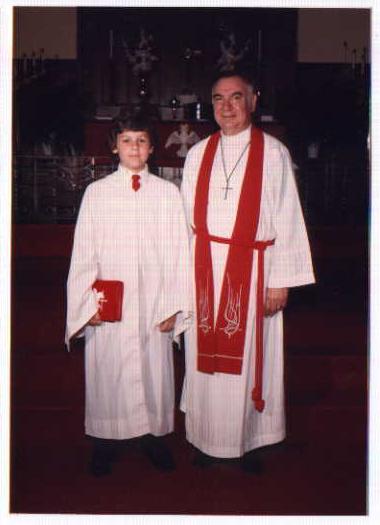
Wednesday, May 09, 2007

THUMP!

That's the sound of the LCMS 2007 Convention Workbook arriving at my front door.  This hefty 427 page volume, and its sidecar documents appeared at my home the other day.  Since then I have been taking in the fine print of the many reports, overtures, and appendices.

With the reports: I can't help but observe what a HUGE bureaucracy our synod is.  Something about that seems not so healthy to me.

With the overtures: Some good, some bad, some ugly.  

One particular church in California has submitted overtures asking for:  Full fellowship with the ELCA, Full communion between LCMS and ELCA in the military, Open Communion in general, and immediate Women's Ordination.

One overture also asks that delegates present from congregations that practice Open Communion would simply raise their hands.

Lots of overtures to reaffirm or rescind what we did in 2004.

I think the biggie at this convention will be the "Specific Ministry Pastor" proposal, which seeks to create a second-tier pastor (with less training), who serves under a traditional M.Div. type pastor, and who cannot take a call anywhere else.  First blush - do we really want to "dumb down" our clergy?  On the other hand - is it better to have that, than "certified lay ministers" and all the other funny business currently going on in violation of ACXIV?

Sunday, April 29, 2007

HerChurch Commentary

A bitingly sarcastic take on the ELCA ultra-feminist haven, "HerChurch"

Mike S. Adams writes, "My Conversion to the Lutheran Feminist Faith"

Monday, April 23, 2007

Unity and Truth in John 17

The Source of Our Unity

In John 17, Jesus’ great “high priestly prayer,” Jesus prays three times that His disciples and those who believe in Him through their word would “be one.” The model for that unity is not a scrupulous keeping of law or even point-by-point doctrinal agreement, but the unity which Jesus and His Father share. “I in them and you in me, that they may be completely one, so that the world may know that you have sent me and have loved them even as you have loved me.” To argue, as some do, that we cannot have unity in our Synod until we reach precise doctrinal agreement on all matters of faith and life not only exceeds confessional boundaries, but makes a mockery of Jesus’ prayer. It is God who gives unity to the church! It is the church’s task to celebrate and maintain that unity. Why? Not because, (in the immortal words of Major Frank Burns on M*A*S*H) “It’s nice to be nice to the nice.” Not so that we can all get along, and nobody has their feelings hurt, but according to our High Priest, “so that the world may know we are one...so that the world may know you have sent me and have loved them...” (John 17:22,23).


So writes Rev. Donald F. Hinchey
in the latest edition of the Jesus First newsletter
.

What I find interesting is that Rev. Hinchey passes over verse 17, "Sanctify them by the truth; your word is truth." Before Jesus prays for their unity, he prays that they would be sanctified by the truth of God's word. That's doctrine.

It seems Rev. Hinchey is suggesting we can be united (just like Jesus and the Father are), but NOT be united also in the truth. That's odd.

I would think that Jesus and the Father would agree on the truth. I would think that
Jesus and the Father would want Christians also to agree on the truth, and be united in it.

We in the LCMS certainly have our disagreements. But we also have quite a bit of doctrinal agreement. Conflicted as we are, if it were not for the doctrinal agreement we DO have, many would have walked a long time ago.

Doctrine is what unites us. Not the Concordia Health Plan. Not the burgundy cross logo. Not even a love for "missions".

But there is room for improvement. And the way to improve is not simply to "be nice and have a beer together". We should strive for unity in the truth.

To me, the whole thrust of Hinchey's argument is a wrong-headed diminuation of the importance of doctrine as the basis of unity. All this, it seems, is intended to once again subjugate doctrine to "mission", a regular refrain from some in our synod.


May Newsletter Article: Confirmation


For our May Church Newsletter:

Most of us remember a day long ago when we underwent a rite of passage called, “Confirmation”. I remember my own confirmation day mostly because in our family it was traditional to throw a huge party, and for the confirmand to receive huge sums of cash and prizes. Confirmation was, so I thought, a time in which I had “earned” my “full membership” in the church, by suffering through years of classes with the pastor. I figured I had finally jumped through the hoops necessary to deserve the Lord’s Supper. Boy, was I wrong.

Now as a pastor, I am on the other side of the confirmation equation. And I find many children and adults think the same about this churchly practice as I used to. But since confirmation day is just around the corner, here’s some reminders for those of us who are being confirmed and for those of us who have already been confirmed:

Confirmation is:
  • Connected to Baptism. In fact, that’s what is really being “confirmed”. God’s promises made to us in the water and the word are recalled and reiterated through the rite of Confirmation.
  • The conclusion of formal training, which is connected with that baptism. Jesus said, “Go and make disciples… baptizing… and teaching them” (Matthew 28). The Rite of Confirmation recognizes this instruction.
  • A churchly tradition with a long history, but it is just that, a tradition. There is nothing that says we must have Confirmation a certain way, or even have it at all.
  • An opportunity for our young people to publicly confess their faith, both in renewing baptismal vows, and in a personal statement they have prepared.

Confirmation is NOT:
  • “Graduation” from church. If anything, it’s a new beginning, a new phase of even greater participation in the life of the church.
  • A Sacrament. Confirmation does not offer any special blessings to the confirmands that are not already ours in Baptism. But it does powerfully recall those Baptismal blessings.
  • A hoop to jump through to qualify for Holy Communion. While it is important that communicants are instructed, Confirmation classes usually teach much more than the bare minimum necessary for one to receive the Lord’s Supper. But none of us can earn or deserve such a gift. Instruction about Holy Communion is really more about appropriate preparation to receive the gift. (Some Lutheran churches even separate “First Communion” and “Confirmation”. However, most of us do combine both events into one.)
  • The end of our learning in the church. Much of the academic world today encourages “lifelong learning”. And the church has always done the same. We have never studied enough, learned enough, or heard enough of what our Lord has to say to us.

Please pray for our young people who recall their baptism and confirm their baptismal vows this May 27th (Pentecost Sunday). Pray that God would continue strengthening them in their faith, through his word, and by his sacrament. Pray that they would remain strong and steadfast in Christ, and in his church, and grow to lead godly lives to his praise and glory.

Yes, I'm still here...

After a busy Holy Week and Easter, I was in St. Louis for a week, and you know how the week after you get back is always a catch-up time.  So hopefully now things will settle down a bit.

Seems like the Lutheran Blogosphere has been quiet lately, witness the slender new Lutheran Carnival.  I wonder if people aren't recovering from Easter like I am, or maybe it's that the nice weather has finally come.  

I did get a chance to do some bike riding this weekend.  My daughter likes to ride in that caboose-thing behind my bike and go down big hills.  Only problem is, dad is out of shape, and a 5 year old creates additional drag going back up the hill!

Confirmation comes on Pentecost Sunday, with 10 young people participating in the rite.  This has been a good class, lots of good discussion, including one last week which started with "what's the difference between Lutherans and Baptists?" and ended up with paedo-communion.

This summer will be a typical one, with Pastor Poppe and I trading vacation weeks like crazy.  In July I go to Houston for the Synodical Convention.  I can only wonder what will happen this time.  Let's keep our synod in prayers!

Oh, and we're moving (just to the other side of town).  Somewhere near the end of July or in August we hope to have our new house ready. Somewhere before that we hope to have the old one sold.  

Then in November I am taking a small group from church on a trip to the Holy Land (not St. Louis...).  That should make for some interesting blogging.

Looking forward to call day this week, and finding out where some of our bloggers like St. James and Winters will be going.  Winters' blog comments mentioned the "Around the Tower" student newspaper (with a link posted).  First of all, too bad they never had anything like this when I was a student.  Second, it was some interesting reading.  Take a look.

And man, did you see what the ELCA pastor said (or rather, DIDN'T say) at the V-Tech memorial service?  HT to Necessary Roughness who pointed out a conservative (non-Lutheran) blog site taking the man to task for his squishy message.  McCain has some good comments on it too.

Sermon - Easter 3 - John 21:1-14

Easter 3C
April 22, 2007
John 21:1-14
“The Same but Different”

Two meals. One in the upper room. One on the beach. One in Jerusalem, the other in Galilee. One of bread and wine, the other of bread and fish. Both hosted by the Savior. Both providing just what he means to give.

Much had happened between these two meals… Jesus took them to the garden to pray. Then Judas came with the armed men. Jesus was arrested, tried, mocked and beaten. Peter denied him that night in the courtyard, even calling down curses, “I DO NOT KNOW THE MAN!” Then the rooster crowed.

Early on Friday the trial went to Pilate, then to Herod, then to Pilate again. Finally to Golgotha, and to the cross, where Jesus was hung and where he suffered and died. They took him down, laid him in the tomb, and rested on the Sabbath. Sunday morning, angelic greeters told the good news, “He is not here. He has risen!”

Then he appeared. He appeared to Mary and the women. He appeared to the disciples on the way to Emmaus. He appeared to the disciples in the locked upper room. And a week later to Thomas as well. Jesus had not fled the scene. He was alive, and he showed it.

Now they had gone from Jerusalem, gone back to Galilee. The angel said Jesus would meet them there. So now another promise is fulfilled. As Jesus appears and once again eats with his disciples. He hosts the meal. He provides and prepares the food. He bestows the blessings, just as he did in the upper room, so he does now on the beach. It’s like before, only different.

Something else is like before. The disciples had returned to their previous way of life – fishing. And like one day about three years earlier, they spent the whole night laboring and the fish weren’t biting. And like that day, a strange man gave strange instructions that they should cast the net just one more time. And like that day, a miraculous catch filled their nets. This was all too familiar.

Only this time, it was a little different, too. The last time, the nets started to rip and tear – but not now. The last time, Peter fell on his face in fear in the presence of the Holy One – “Depart from me,” he said then, “I am a sinful man”. This time, he leapt into the water to approach his risen Lord.

Jesus is different too. He’s still the same Jesus. He even has the marks of his wounds to prove it. But he is also different. Now he is taking back his majesty and glory. He will soon be fully exalted to his rightful heavenly throne. Yet in his mercy he appears, makes himself known and recognizable to his beloved, bewildered disciples.

They had gone through a lot between that last supper and this first breakfast after Easter. They had seen the lows of Calvary and the highs of the abandoned grave. They had seen Jesus, heard him, touched him. Now again, they would eat with him, and he would give them blessings.

In a sense, we’ve gone with them. As we have followed these events in the course of our church observances, we too have experienced Maundy Thursday, Good Friday, and Easter Sunday. We too have seen the lows and the highs. And now, for us, things are back to normal again, too. It’s the same as it’s always been. It’s as nothing has changed.

But Easter does change things. It changes things for every Christian.

It may not look like it on the outside. You see the statistics… Christians are just as likely as anyone else to get divorced, to struggle with alcoholism and other social problems. We see our churches divided and squabbling, in the congregations and even on the national level. You look at your own life, and you know full well your sins – that you are no angel.

So much of who we are and what we do is tied up in our sinful human nature – which really is the root of all our problems and struggles. Imperfect people in an imperfect world. So what’s different about Christians? What difference does Easter make? A lot.

It may not always look that way on the outside, but Christians are people of Resurrection. That is, we have been raised to life in Jesus Christ. Just as he died and rose, so our sinful selves were buried with him in baptism, and the new creation, the child of God is raised from those same waters. We are, like Jesus, back from the dead. And though we don’t always see ourselves this way, what’s important is that God does.

And this isn’t to say that Easter makes no visible difference in our lives. It should. It does. Never perfectly, but we do show Christian love and serve our neighbor for Jesus’ sake. The Spirit does move us to good works which exercise our faith. And God accepts this imperfect works of love which are also purified through Jesus Christ.

There’s one more difference that Easter makes. There’s one more resurrection to come. We who have been reborn in the waters will still die. Yet even though we die, yet shall we live. And we who live and believe in him will never die. Oh, our bodies will fail and be buried. But our spirits will rest with the Lord. And then the final resurrection will come, when Christ returns, with sound of trumpet and the dead rise again. When Christ, the firstborn of the dead, welcomes us – resurrected body and soul together – into our eternal home with him.

Easter gives us this hope. And it’s a hope that makes us different. It’s a hope that shapes our lives and gives us direction and purpose. It’s a hope that brings great comfort and peace. It’s a promise that makes all the difference in the world.

And that promise is renewed here today, for us. Where just like usual, we receive the blessings of Christ in a meal. Just like his earliest disciples did, we too gather for a meal, hosted by the risen Christ. We’re not in an upper room, or on a beach, but at a rail around an altar. But we still join in blessed communion with God and with others who share our faith. We still receive all the blessings and promises of God in Jesus Christ. Our sins are forgiven. And that means we get to live – now, and forever.

Sunday, April 08, 2007

This Grave For Rent


Christ Is Risen.  Alleluia!

Thursday, April 05, 2007

Sermon - Maundy Thursday - Mark 14:12-26

"Surely, Not I?"
Mark 14:12-26
April 5th, 2007

How could you, Judas? How could you betray Jesus? Of all the people that were out to get him, you'd think he could trust his own disciples. You'd think he could especially rely on the 12. You were one of them. But you had your own ideas.How could you do it with a kiss? As if you were there for a friendly reunion.

How could you bring them to that garden where you shared so many times of prayer together? How could you bring a bunch of men with clubs and swords and torches, as if the Lord was some dangerous criminal? It just goes to show how you didn't know him well after all.

And how could you sit there and eat this meal with him? How could you dip your hand in the same bowl, knowing... knowing what you had in mind? Truly, Satan somehow had hold of you, Judas. Surely, as Jesus said, it would be better for you never to have been born.

Jesus knew. He always seemed to know. He knew what you were up to. The others were clueless. When he said someone would betray him, they even thought it might be them. Each one in turn, asking, "Surely, not I, Lord?" But were they any better?

When the Shepherd was struck the sheep were scattered. They all ran away. All but John and Peter. Faith so feeble, fear so strong. Oh and then Peter, the apostle's apostle. Remember when he made that big scene - making a point about how he would never, everforsake Jesus? But Jesus knew. He knew Peter would deny him 3 full times before dawn. And when their eyes met in the courtyard, Peter also deserted the one he had denied.

"Surely, not I?" was the question. But surely it was them. Surely it was also you, here today. And surely it is all of us. We, the people of Grace Lutheran Church. We who know the Lord and follow him daily. We who talk to him in prayer, and gather with other disciples to pray. We who share the meal with him here at his altar. "Surely, not us?" Surely, so. We have forsaken. We have denied. We have betrayed.

"Surely, not I?" you might say. "Surely, I pay my taxes. Surely, I don't beat my wife. Surely, I listen to the sermon. Surely, I do as well as the next guy." Only the next guy doesn't do all that well. And you don't listen so well. And you may not beat your wife, but you don't love her like you should. And you may pay your taxes, but what about how you spend the rest of your money?

And what goes on in your head, and your heart? How many times do you forsake and deny and betray your Lord? How could you? After all that he has done for you? How can you sit here in his house, in his presence? How can you bring such filth into this holy place?

Out there in the world, when you act like you're not a Christian. It's like you're denying him. When you go your own way, you forsake him. And when you do what you know is wrong but you do it anyway, you betray him all over again. You make your excuses and rationalizations. But none of it can explain away your sin. None of it canjustify the unjustifiable. We are without excuse, and left only with blame.

"Surely not I?" No. Surely you, too, have forsaken and denied and betrayed. But back to ancient Jerusalem.... where Jesus' disciples weren't the only ones to forsake him. They weren't the only ones to turn their back on him. Someone even closer: His own Father. His heavenly Father, who could have stepped in to stop all the nonsense. Who could have taken the cup of suffering away.

But that was not his will. His will was for his own beloved Son to shed his holy precious blood. His will was for him to suffer, and be crucified, and forsaken by friend and foe alike. And God himself turned his back on Jesus. "My God,why have you forsaken me?" was the cry of the anguished Christ. "How could you?" How could he not? This is his power made perfect in weakness. This is the depth of his love for us.

Surely, not you or I would want such a fate. Surely we wouldn't want to die for our own sins, much less the sins of someone else. Surely not you or I could earn God's favor, even with such a noble sacrifice. But surely he has born our griefs and carried our sorrows, and with his stripes we are healed.

Surely, truly, he gives his own body to suffering and sheds his own blood even to death, for you. Surely, he gives his own body as bread, and his own blood as wine, for you, for the sure and certain forgiveness of your sins.

After his resurrection, Jesus once again forgave those who had forsaken him. He met with them, showed them his wounds, called them to believe. He gave them His Spirit and charged them with his message, and the authority to forgive sins. He sent them out to make disciples and to baptize and teach the nations.

He even restored the one who had denied him. Though Peter had denied Jesus three times, Jesus restored Peter three times. "Peter do you love me? Then feed my lambs."

Only Judas, in sorrow but not repentance, had sealed his own doom. When he hung himself he showed hiscomplete loss of faith in the only one who could have forgiven such a sin as his.

But for the other disciples, and for the disciples here today, Jesus has a word of forgiveness. Surely, for you, too. His promises in Holy Baptism and in Holy Communion are just as surely for us, gathered in his name. Where else can we meet God so surely as in his Word and in his sacraments? Where else can we see and hearand touch and taste his grace, than in those means he has provided?

Today we come forward to receive this ancient meal of promise which Christ has provided. We come, like the disciples, bearing sin and guilt, for we have forsaken and denied and betrayed him. But we also come in faith, knowing that this forgiveness is for us. That this body and blood, given and shed on the cross, risen from the dead, is also for us. Surely for us, each of us. And we go in peace, knowing all is well with our souls, in Jesus Christ our Lord. Amen.

Typical Easter Hit-Piece on Jesus

From USA Today:

Theologian urges a new way of looking at Jesus

(This fluff piece about Marcus J. Borg is clipped part-way through, along with my own commentary added)

Borg sees Jesus differently. TC: "Different" is always a red flag.

As a historian and biblical scholar, Borg was a member of the Jesus Seminar, a scholarly group that spent years evaluating historical evidence of Jesus' life and sayings. Borg emerged from the process with deeper faith in Jesus and a different understanding of Scripture. TC: "Jesus Seminar" is an even bigger flag. This group didn't evaluate the historical evidence in light of scripture, they evaluated scripture in light of evidence and their own opinions.

Borg interprets the Bible and its descriptions of Jesus as a mixture of memory and metaphor, better suited to preserving meaning than as a list of beliefs fashioned by Jesus' followers that Christians must believe. TC: Sounds like "goulash"

"For me, to believe a set of statements is impossible," Borg says. What is possible, he argues, is to "belove" Jesus and walk in his path. TC: Impossible because it would imply absolute truth, which is anathema to these postmodernist types (absolutely, of course!). Instead we get to hear all about this "belove" term, which is really just a new way of saying - works righteousness.

"For the past 300 years," Borg says, "faith was a matter of believing a list of beliefs about Jesus. The list varied among Christians — that Jesus was the son of God, that he was born of a virgin, that the tomb was empty on Easter morning. TC: You know, everything Scripture teaches.

"But in the pre-modern world, before about 1600, the object of belief was never a statement," he says. "It was always a person. To believe meant to 'belove' a person. To 'belove' Jesus means more than simply loving Jesus. It means to love what Jesus loved. That is at the heart of Christianity." TC: It's true, Jesus is the object of our faith. But this sounds more like a dressed up, "What Would Jesus Do?"

Faith, Borg says, is a matter of living in relationship with Jesus and working politically, first for justice and then for peace. TC: And here is the bottom line. Faith=leftist politics.

Borg has taught religion at Oregon State for 28 years. He'll retire this spring and continue his writing and speaking, but says he knows already that he'll miss his weekly encounters with undergraduates.

"There is something wonderful about their openness," he says in his cluttered office on the Corvallis campus. TC: Young people who are easily led astray being every wind of false teaching.

His fans, the ones who read his books and fill church halls as he travels the country talking about Jesus, express their admiration with a sense of humor. They wear T-shirts proclaiming themselves "Borg Again Christians" and, borrowing from Star Wars, "May the 'phors (as in "metaphors") be with you." TC: Ok. Funny. But since when do theologians have cult followings? Something's "funny" about that.

"There is a hunger for something other than a fundamentalist, literal understanding of the Bible," says the Rev. Tom Tate, pastor of Portland's Rose City Park United Methodist Church. He says he doesn't always buy traditional views, and "Borg has given me the courage to come out and say certain things." TC: Itching ears love to hear what they love to hear. The Old Adam wants the law - to be convinced he can save himself. Then we don't need the Jesus of the Bible because we have the Jesus of lefty politics.

...

Paul Metzger, a theology professor at Multnomah Biblical Seminary, is very clear about where he disagrees with Borg.

"I appreciate Professor Borg's emphasis on Jesus having been crucified for his identification with the poor and oppressed, a point often lost on many conservatives," Metzger says. "But there is more: Jesus' suffering was part and parcel of his dying for the sins of the world. Jesus was also raised bodily from the dead to bring new life." TC: That's not just bonus material, that's the main thing! Concern for the poor and oppressed flows out of a right understanding of what Jesus was about in the first place.

That said, Metzger appreciates the serious and civil debate that Borg encourages. The alternatives to that are dangerous, he says.

"If people don't dialogue because they think that only their ideas matter, or if we put all the ideas to the side and just go for some neutral frame of reference, neither is meaningful."
And meaning, Borg would say, is the point of the Bible, of Jesus and of Christianity. TC: I'm sure the serpent in the garden was quite civil when he beguiled Eve. Imagine if she dismissed his "new ideas"? WOw... that wouldn't be very meaningful would it?

Jesus "is for us the decisive revelation of God — of what can be seen of God's character and passion in human life," Borg says. "But for followers of Jesus, the unending conversation about Jesus is the conversation that matters most." TC: Jesus the example, and now Jesus the conversation. Pray that people will ignore these lies and see Jesus instead as the Lamb of God who takes away the sin of the world.

A Blessed Holy Weekend to All


Monday, April 02, 2007

Sermon - Passion Sunday - Luke 23:19-25

Palm/Passion Sunday – April 1st, 2007
Luke 23:19-25
“In Place of Barabbas”

One of the fundamental basics of our concept of justice is getting what you deserve. If you upset the hornets’ nest, you deserve to get stung. If you tease the dog while he’s eating, you should expect to get bitten. If you cheat on your spouse, you deserve it when they divorce you. It’s only fair.

On the other hand, our sense of justice is bothered when someone gets something they don’t deserve – for good or bad. Some incompetent employee gets the promotion ahead of you, when you’ve put in so many more years. It’s not fair. Another person’s children turn out just fine when they weren’t the best parents, but you do everything right and still your children go astray. It’s not fair. You go to church, you pray and give offerings, you try to be nice and kind to everyone, and you find yourself on the receiving end of trouble and suffering, and you think, “it’s not fair!” But is it?

Today, Palm Sunday is also designated the Sunday of the Passion. Today we consider Jesus’ arrest and trial and suffering and execution. And there is much we could say about all this. One observation we might make is this: that none of this was very fair.

It was a miscarriage of justice, that the Pharisees arrested Jesus and tried him at night. Trials were to happen during daylight hours, according to the law. It wasn’t right that so many false witnesses testified against him. It wasn’t fair that Herod judged him only on whether he would do a miracle or not. It wasn’t just or right or fair that Pilate had him mocked, and flogged, and killed.

So Jesus stands humbly before the Roman governor and says very little. Only when pressed does Jesus admit he is, in fact, a king, though not of an earthly kingdom. If Pilate only knew that before him stood the King of all creation – he would know just how unfair it was for him to render a sentence on Jesus. Judging the one who will come to judge the living and the dead.
Pilate’s corruption of justice is also seen in that he knew Jesus was innocent, but sent him to death anyway. He didn’t want a riot to break out, after all. It may not have been fair, but it was expedient.

It wasn’t fair that Jesus, an innocent man, completely free from sin, was tried and convicted and sentenced to death – when a murderer named Barrabas got off scott-free. Perhaps this is the height of the irony here.

What a contrast between Jesus and Barabbas. Barabbas was part of the armed rebellion against the Roman occupiers. He was a fighting man who wanted freedom for his people. . Barabbas was a take-charge kind of guy - a man of action. He would get things done, no matter what the cost. Even if it meant murder. Yes, Barabbas had committed the ultimate sin, and truly deserved the ultimate punishment.

Jesus was humble and soft-spoken, like silent lamb being led to the slaughter. He told his disciples to put away their swords. They were to turn the other cheek. He said to render to Caesar what is Caesar’s, and to God what is God’s. He even did miracles for some of these Roman invaders – rather than killing them in rebellion. He was a man of peace. Loving, kind, compassionate. We know from scripture that Jesus was fully without sin. And so he deserved no punishment.

Barrabas was what so many wanted Jesus to be. So many wanted a Jesus who would do the same as Barrabas, only bigger and better – a military deliverer who would lead them to triumph over the Roman foes. So they called out for Barrabas to be freed and Jesus to be crucified. It was the ultimate injustice. But… it was also God’s plan.

As a Christian who reads this account, you can quite naturally put yourself in the shoes of Barrabas. For in God’s cosmic courtroom, you stand condemned by your sin. You are a thief, a liar, a rebel and a murderer. A criminal, not against Rome or the United States, but against the King of the universe himself. And the sentence you would face is clear- only death will do. You are Barabbas. We all are.

And Jesus does the same for us that he does for Barabbas. He takes our place. He the innocent man takes the place of the sinner. The Lord goes to the cross, and to punishment, and to suffering and to death. And you and I go free. We are cleared of the charges against us and released from the bonds of sin’s prison. We are given a clean slate, a new beginning, an overturned verdict… all on account of our substitute, Jesus Christ.

And it’s not fair. We should be the ones condemned, not him. Fair would be for him to be judged innocent and us to be guilty. But in this divine plan, God’s justice and his mercy are both satisfied. Sin is paid for – that is his justice. But we are shown mercy for the sake of Christ. Our human sense of fairness falls short in the face of such a divine mystery.

Finally, just as Jesus takes our place on the cross, so he takes our place in the tomb, and so also he leads the way out of the tomb. Next Sunday we celebrate the Resurrection of our Lord. Easter Sunday is the highest holy day we Christians observe. Because on it, Jesus Christ who took our place in death, secures our place in life. He goes to the grave for us… and conquers it! He takes our place in death and then takes death itself away. As the firstborn of the dead, he shows what we who trust in him can also expect for ourselves – a resurrection from the dead, and an eternal victory.

In this Holy Week, as we listen and pray and sing and reflect, consider God’s justice, and his mercy. Consider your place, and what you deserve. But remember also that Christ took your place in death, and that he now makes a new place for you in life.

In His Name, Amen.

Wednesday, March 28, 2007

Sermon - Lent Midweek - 1 Corinthians 11:23-26


“This Is… For You”
1 Corinthians 11:23-26
March 28, 2007

So we come now to the final section, or chief part of Luther’s Small Catechism. We’ve covered the Commandments, the Creed and the Lord’s Prayer, Baptism, Confession and now The Lord’s Supper.

Let’s admit right off the bat that it’s a little strange to be speaking of Holy Communion during a midweek Lenten service in which we are not receiving the Lord’s Supper. It would seem natural that we should not only talk about it, but also receive it. However we still have many opportunities to receive this gift. Every Sunday, on the Lord’s Day, we receive the body and blood of the Lord. In fact, a week from tomorrow is Maundy Thursday, on which we remember Christ’s institution of this sacrament. A solemn and holy day indeed.

So let’s take our time today to meditate on it carefully. We consider the Sacrament of the Altar today in light of our Catechism questions, and especially in view of Christ’s own words of institution – which are the main thing in this holy meal.

First, what is it? We Lutherans take Christ at his word. “This IS my body. This IS my blood.” And as simple as that sounds, it has tripped up many Christians for hundreds of years. Christ says it is, and so we believe it is His body and His blood. We don’t know how. We don’t try to explain how. But because our understanding is limited doesn’t mean Christ’s power or his word is. As he says, so it is. It’s always been that way.

He says, “let there be light”, and there is. He says, “Lazarus, come out” and he does. He says, “The Son of Man will rise on the third day” and he did, “just as he told you”. Jesus speaks the truth, and his word creates reality. So when he says, “This is my Body… This is my blood” these are no insignificant words. Those words mean something and those words DO something.

Do we believe his words? We should. But we don’t always. We put our own ideas before them. We try to make his word fit into our framework, rather than submitting our framework to his Word. We want our word to be the final word, rather than his. We take his words lightly – we take them for granted.

Ever since Adam and Eve took his first words of Law lightly – perhaps not believing, “in the day that you eat of it you shall die”. And thus by eating and not listening sin came into the world. But now by both hearing and eating and drinking do we receive the antidote to such sin. For God’s word creates a new reality in this Sacrament of the Altar.

The bread and wine are what he says they are, by the power of his word that says it. We are what he says we are – according to His law – we are sinners who stand condemned by our actions. But according to His gospel, we are forgiven, clean and new. We are righteous and holy. We are alive and will live forever. Because his words have said so.

This is all understood by Luther when he asks the question, “Where is this written?” He then quotes those words of Jesus as drawn from Matthew, Mark, Luke and St. Paul.

But this sacrament is not just Christ’s body and blood. It’s Christ’s body and blood given and shed FOR YOU.

It’s not his body and blood to be put in a box for safekeeping. It’s not his body and blood given for God’s benefit and pleasure. It’s not his body and blood given as a testimony against us or to accuse us by his perfect example of love which we will never live up to. It’s his body and blood given FOR YOU – for the forgiveness of your sins. There’s the benefit.

Holy Communion is so misunderstood by so many. Some Christians think of it as a sacrifice we offer to God, when it is a sacrament Christ offers to us. It’s not a good work that earns you a thing, but it is a good gift that gives you all good things (for where there is forgiveness of sins there is also life and salvation).

Some Christians think of the Supper as a memorial meal or some sort of symbol. But it is not simply a reminder of inner spiritual truth. This holy meal actually does something – it is given for a purpose – and that purpose is for the forgiveness of your sins. So that, “whoever believes these words has exactly what they say, forgiveness of sins”.

A Christian once told me, “Pastor, I won’t be going to communion this week. I’ve been particularly naughty all week and I just don’t think I deserve it”. What? For this very reason you SHOULD be at the rail, receiving the forgiveness Christ won at the cross. None of us deserve such a gift, but all of us need it. Those of us who feel and know our sin acutely need it all the more. Otherwise, it’s like saying, “I’m too sick to take my medicine – the only medicine that will heal my disease”.

And so Luther suggests we should be “worthy” and “prepared”. I’ve often said that the worthiness here mentioned is not one of righteousness but of appropriateness. Perhaps worthy isn’t even the best English word. The point is that for some the sacrament is a great benefit and gain, and for others, it can actually be a harm.

There are those who should not partake. Those who don’t believe what Jesus says, “This is my body. This is my blood” should not receive it. Those who don’t believe it does what he says, “for the forgiveness of your sins”, should not receive it. For if they treat this precious gift as anything less than it is, they sin against the very body and blood of Christ, and trample a precious jewel. In 1 Corinthians 11 Paul warns sternly against inappropriate reception of Christ’s body and blood, and says some can even “drink judgment on themselves” by communing unworthily, May this never be us, O Lord!

For those who believe in the Words of Christ – those who recognize his body and blood, seeing this holy meal for what it truly is – and who know that his body and blood are for us and are for the forgiveness of our sins – those are truly the ones who should be receiving and benefiting from this gift. May this always be us, O Lord!

What a blessing it is that God makes his word of promise available to us, not only in spoken and written, but also visible form. Just as Baptism attaches that word to simple water, so does Holy Communion see the Word along with simple bread and wine – and these humble, earthly vessels – everyday things – become vehicles for the grace of God. So we hear his word and read it, but we can also feel the water, and even taste the bread and wine. “O taste and see that the Lord is Good”. God’s miraculous blessings, won by Christ, given to us in such common forms.

It’s like Christ himself – who though he was Almighty God from eternity – humbled himself to become a man, in order to procure God’s blessings for mankind. He took on common, everyday, human flesh. He came not as a king, but a poor man, with no room at the inn and nowhere to lay his head. He had no great beauty that we should regard him. He was arrested as a common criminal, and hung to die a shameful death between two thieves. He didn’t even have his own grave. But in all this humility, shrouded by it and hidden behind it, was the very God of very God himself, working out our salvation.

Isn’t it just like Christ, then, to give himself, his body and blood, to us also in simple form? To take humble bread and wine, and through them offer rich, eternal, heavenly blessings untold? Communion with God himself and our fellow man. Forgiveness of ALL our sins. Eternal life. Power over sin for daily living. Assurance and peace. All these are ours when we receive the bread and wine, that is his body and blood. All this is ours when we believe and trust in his words of promise, “This is my body… This is my blood…. Given and shed for you for the forgiveness of sins.” Believe it for Jesus’ sake. Amen.

Tuesday, March 27, 2007

Sermon - 2 Samuel 2:1-10, 13 - Lent Midweek 5

“The 2 Parts of Confession”
2 Samuel 12:1-10,13
March 21, 2007

So far on these Wednesdays we have covered the 10 commandments, the Apostles' Creed, the Lord's Prayer and Holy Baptism. Today, perhaps the least known of the 6 chief parts of the Catechism: Confession.

As we said when we came to the Apostles' Creed, the word “confession” really means “same-saying”. That is, when we confess the Creed we are same-saying what God has already said about himself.

But mostly, when we think about the word “confession”, we think about confessing sin. As in, admitting or honing up to some deep dark secret. “I have a confession to make” is usually a warning to brace yourself before someone bears his soul. “True confessions” implies people divulging little-known and often embarrassing facts about themselves.

In the Church, we speak of the confession of sin, mostly as that part of the public worship service in which we recite a liturgical paragraph outlining our sin and guilt. And this is a very good thing. We need to say, and say publicly, that we are sinful and unclean. We need to confess that we are sinful in thought, word and deed. That we sin by what we do, and what we leave undone. That we sin against God and against our neighbor. Sin, sin, sin, and more sin.

When we make such a confession, we are also same-saying. But instead of same-saying about God what he says of himself, when we confess sins, we are same-saying about ourselves what God has said about us. “Yes, God, I am a sinner, as your word clearly shows”.

Confession of this type is no small matter. Some people are quite offended by the idea that the Church asks them to say they are “poor miserable sinners”. Perhaps others chafe at the temporal (or present) and eternal punishment such confession admits we deserve. It's never easy to admit you are a sinner. Take David, for example.

King David was a man's man. A veteran of many battles, who had ascended to the throne of Israel at last. But David was also a ladies' man, and when he fell into sin with Bathsheba she turned up pregnant by him. David had her husband Uriah put to death in a cover-up attempt. But you can't cover-up your sins from God. The Lord sent the prophet Nathan to call David out for this sin.

Nathan craftily told David a parable about a man who stole another man's beloved lamb. David, the king and final court of appeal in that land, thinking the story was for real, prescribed in his righteous anger the death penalty for such a sinner. And when Nathan boldly turned the accusing finger at David, “You are the man”, we can only imagine the gasps in the royal court. Nathan had dared to say what many probably knew but knew better than to say. But now the king's sin was out there on the table, publicly for all to see. And David had a choice again.

He could have responded with a harsh rebuke of his own, even putting the prophet to death. “How dare you insinuate such a thing against me, the king! Take him away! To the dungeon!” Nathan knew this was a possibility.

But David was a man after God's own heart. So instead, David went the route of confession. Nathan said, “David, you sinned” and David said the same. “I have sinned against the Lord,” he confessed. And implicit in that was the admission that he deserved the punishment of death he just prescribed.

But now we come to the second part of confession. For as our Catechism says, “Confession has two parts”. Only the first part is the admitting of sin. The second part is the Absolution. That is, the declaration of forgiveness.

Upon David's confession, Nathan said (and said immediately), “The Lord has taken away your sin. You are not going to die.”

Nathan functions much like the pastor does, who announces God's forgiveness in Christ. “As a called and ordained servant of Christ, I forgive you all your sins”. Those words, those beautiful words of absolution really say the same thing, “even though you are a sinner, you will not die.” You will not die. For the one who won forgiveness has died in your place, and as he now lives so too shall you.

David was forgiven, and we are forgiven, only for the sake of Christ. Jesus Christ who as the Lamb of God sacrificed himself to take away the sins of the world. Jesus Christ, who won God's forgiveness for David's sheep-stealing, and who won God's forgiveness for all us sheep who have gone astray.

Confession – Christian confession assumes both the confession of sin, and the forgiveness that is God's response. It couldn't be any other way. In fact, the whole point of confession is getting to the forgiveness. “If we confess our sins, God who is faithful and just, will forgive our sins”. That’s his plan.

The point of confessing is certainly NOT to catalogue every single solitary sin we have ever committed. This was Luther’s burden as a monk, when he spent hours trying to pin down every sin in his life – but the more sin he confessed, the more sin he found to confess. God’s forgiveness in Christ is certainly bigger than our catalogue of sins – complete or not.

However, as the Catechism states, we should confess before God all sins (even those we are not aware of). But before the pastor we should confess only those sins which we know and feel in our hearts. That means, if a particular sin is troubling you – your pastor’s door is always open to hear that confession. But remember that confession has two parts. Your pastor stands ready to – publicly OR privately – offer and announce to you Christ’s own forgiveness. That’s our job.

We’ve really gotten away from private confession in our Lutheran churches, and it’s a great loss. Some people don’t even know that we Lutherans have private confession available. Still, we would never command or demand it, thus making a new law - but we offer it as another gift from God by which sinners may find the consolation of the Gospel.

And know also that your pastor is bound by solemn ordination vows to never divulge the sins confessed to him. As with God, they are gone – as far as the east is from the west. Another has said that when it comes to confession of sins, the pastor’s ear is a tomb. The sin that is confessed dies and is left behind there. You may even be surprised to know that there is an order for individual confession and absolution found in the hymnal, on page 292. Check it out sometime.

Confession has two parts. First we confess our sins, and second, that we receive absolution, that is, forgiveness. All this is for the sake of Christ. What a powerful gift of God. Let us treasure and use it always. Amen.

Thursday, March 22, 2007

Because you can never have too many blogs...

Shameless self-promotion:

Check out my newest blogging endeavor, "Render Unto Caesar...".

The theme of the blog is Lutheran "Two Kingdom" theology.

Thursday, March 15, 2007

Sermon - Lent Midweek 4 - John 3:1-7


Sermon
Midweek Lent 4
John 3:1-7
“Not Just Plain Water”

So far in our Lenten midweek series on the Catechism, we have covered the 10 Commandments, the Apostles’ Creed, and the Lord’s Prayer. Today we come to the Sacrament of Holy Baptism.

While Baptism is recognized by most Christians somehow or another, We Lutherans have a particular emphasis on this gift of God. We see it as the great blessing it is, not only for the moment it happens, but for our entire life. Your baptism is a “gift that keeps on giving”.

In our reading, Jesus is talking to Nicodemus about the importance of being born again- being born of water and the Spirit. Throughout the New Testament this washing of rebirth and renewal is explained as a precious gift. There are many ways we could approach the topic. But let’s take our cue from the Small Catechism, and its four questions:
What is Baptism? What benefits does Baptism give? How can water do such great things? And What does such baptizing with water indicate?

What is Baptism?

It’s water, but it’s not JUST water. It’s water AND the word. The word of Jesus, that is, that commands us to go and make disciples by baptizing and teaching. Baptism is not our idea. It’s not our work. It is the work and gift of a God who wants to make disciples out of us sinners. It is not just a symbol of something else, but it is a reality.

And what word of God is connected to this sacrament? God’s own name. Not just, “Oh, by the way, I baptize you” but, “I baptize you in the NAME of the Father, Son and Holy Spirit”. God’s name has a power of its own, as it is part and parcel of his very self. When his name is upon us – we belong to him. When his name is upon us – we are incorporated into his kingdom, yes even his family. And his name IS upon us, in Holy Baptism.

What benefits does Baptism give?

The chief blessing of baptism, is of course, forgiveness of sins. And that’s something we all need. You don’t have to look to far to see sin in this world. You can look right in the mirror. You can see it in your own life. Anyone who thinks he doesn’t have sins or thinks he commits no sins – what a deluded person that is. We need what baptism gives. We come filthy and in need of a good cleansing.

And so God forgives our sins, for the sake of Jesus’ death and resurrection. But God forgives our sins through Baptism. It is a means of grace. It is a way that God gets his gifts to us.

And where there is forgiveness of sins, other benefits naturally flow. People who are forgiven are free from the penalties of sin – and therefore death is defeated. People who are forgiven are no longer under the power of the devil. Forgiven people are also saved people – saved for eternity and being saved even now – as the Holy Spirit works to make our lives conform to Christ.

How can water do such great things?

Forgiveness, life, salvation, rescue from the devil….Sounds like a great deal, huh? Sound too good to be true? Your dad always said if it sounds too good to be true, it probably is. But, no, baptism is the exception to that rule.

It is great, and baptism does great things. But not just the water alone. We don’t have some fountain of holy water sitting locked in the back closet of the church somewhere. The water is – just water. Nor is it some special magical power of the pastor, a holy hocus pocus that makes baptism so powerful. There is nothing added or nothing taken away from this plain, ordinary, everyday water… except… God’s word.

It’s the word of God that makes this special, that gives baptism power and effect. And what a powerful word that is! The word of God – the same word that created the world – creates us anew in baptism. The same word that ordered all things – re-orders us in baptism. The same word of the same Christ who said, “neither do I condemn you” and “son, your sins are forgiven” – is the same powerful, mighty word that is the engine of his gift of Holy Baptism. Water by itself is just water. But with God’s word, this water becomes a life-giving flood of grace and mercy. It is the very river of life, the stream of salvation, the fountain of forgiveness. Overflowing, gushing with great things – blessings from God for you.

What does such baptizing with water indicate?

As I said, it’s not a one-time thing, this baptism. It’s not a historical trivia from when you were a baby. Like your first tooth. Your first haircut. When you learned to walk. No.

Holy Baptism is a daily benefit to the Christian. God’s forgiving word of promise, once given when the water was applied – that word still stands long after the head is dried off. His word lasts forever. His promise is for all time, and for every day.

And we return to those waters every day in contrition and repentance. Each day, as we remember our sin and sorrow over it, we remember our baptism. As we remember who God has made us to be, we turn from our sin and toward Him in faith.

And the Old Adam, our old sinful nature, is drowned and destroyed once again. And each day, out of that baptismal water, the New Adam arises to live for God in Christ.

Or to put it another way, Baptism is a gift given once by God with benefits to be drawn every day. For as his children, we stand in his forgiveness. As we bear the sign of the cross on foreheads and hearts, we live in the shadow of Christ’s cross and the forgiveness won there. As we hear God’s promises once made but lasting forever, we take comfort in the blessings of this miraculous washing, this flood of forgiveness that has been lavished on us.

Thank God for the gift of Holy Baptism. Not just plain water, but water with His word – which brings boatloads of blessings each and every day.

"God’s own child, I gladly say it, I am baptized into Christ!"

Amen.

Friday, March 09, 2007

Sermon - Matthew 6:5-13 - Midweek Lent 3

Sermon
Midweek Lent 3
Matthew 6:5-13
“Pray This Way”

I’ve never been a fan of “How-to” sermons. “How to raise a healthy teenager” or “How to affair-proof your marriage”. Sermons are about what Jesus does for you, not how you can do something for him (or worse) for yourself.

But here in our Lenten series on the catechism, we come do the Lord’s Prayer. And in the Sermon on the Mount, when Jesus gives us this prayer of prayers, he gives it as a “how to”. Odd.

“Don’t pray like this. And don’t pray like that. But here’s how to pray…” he says. Is Jesus simply giving us a new law? A new set of commands about how we must approach God in prayer? Is this a school lesson in the how-to’s of proper prayer etiquette?

Is it all about me and what I should do or must do or fail to do?
Or is there actually Gospel here, good news for you and me? Consider the Lord’s Prayer today, also with the help of Dr. Luther, and see how Jesus is giving much more than a practicum on prayer.

Jesus does give instructions, though. He addresses two poor patterns of prayer. One is the “prayer to be seen” and the other the “prayer to be heard”. The “prayer to be seen” is the kind of prayer that isn’t really a prayer but is a public show. So that everyone can see how pious you really are. I don’t know how many of us make a scene of our prayers like those ancient Pharisees did, but pride is always lurking. Do you ever feel puffed up about your church attendance? Do you ever feel better than so-and-so because, well, “I live out my faith. I give money and time and I help with this-and-that at church” And if you mention it to someone in conversation, well, we don’t mind if they think better of us. Because after all, we are good Christians, right? Can you hear the voice of pride squeaking and squawking?

Then there are the “prayers to be heard”. Like the Gentiles, Jesus said, who rattled on and on expecting their many words would have the desired effect. Maybe this isn’t exactly us either. But they were praying hard, and we can pray hard too. And maybe we think if we just pray hard enough or long enough or use the right words, then God will have to do what we want. He’ll have to give me what I want. After all, doesn’t it say, “ask and ye shall receive”? But this kind of prayer turns God into a butler at best. Or an eager bellhop who stands ready to do our selfish bidding. Jesus says, “don’t heap up empty phrases”. So what should our phrases be filled with?

Jesus gives the model prayer. The Lord’s Prayer. “Pray like this”. But it’s more than an instruction manual or even an outline or a lesson on prayer (though it is all those things). The Lord’s Prayer shows us a Lord who wants to give us good things. A Lord who knows what we need better than we do. A Lord who brings daily bread and daily forgiveness. A powerful prayer. A perfect prayer.

Our Father, who art in heaven – Jesus shows that God is our loving Father, not our angry ruler. He is a heavenly Father, whose power to give us good things exceeds all earthly fathers.

Hallowed is his name – God’s name is holy whether we pray or not. But here we pray that we too might keep it holy in our lives.

Let your kingdom come – God’s reign and rule in the hearts of man comes – when and where he wants it. But we want it to come and to increase among us too.

Thy will be done – Again, this happens whether we pray or not. But we do pray that God’s will would be done in our lives. That I, personally, would live as God would have me. And that I, personally would receive his forgiveness when I fail to.

God’s name, God’s kingdom, and God’s will. First we seek the things of God in prayer. The rest of what we ask flows from these three.

Daily Bread – Daily, that is, today’s portion. Don’t worry about tomorrow, Jesus says. God will provide for our needs. “Give us bread” Lord, means that even when we think we are earning it ourselves, everything we have is still from his generous hand.

Forgive us our trespasses, as we forgive those who trespass against us. We love because we’ve been loved. We are merciful because we’ve been shown mercy. We forgive because we are forgiven.

A trespass is “going where you shouldn’t go”. And we do that all the time when we sin. We go where God forbids. But Jesus went where he didn’t have to go – to the cross – to forgive such trespassing. His love has no boundaries – it is wide enough to include all boundary-breakers. But it’s also powerful enough to make us forgiving too.

Lead us not into temptation, but deliver us from evil. Our enemies abound. Sin, death and the devil. Temptations and sufferings meet us at every turn. But fear not. Jesus wouldn’t tell you to pray for deliverance if he didn’t think God would answer yes. God does guard us from temptation. He does deliver us from evil.

He delivers us from the accusations of the Devil by forgiving all our offenses. He delivers us from our own sinful nature – by washing us with his baptism. And he delivers us from the final evil – death itself – with the new life, now and eternal, that he gives.

Our Father in heaven would hear our prayer. Jesus tells us to ask for those good gifts – God’s name, God’s kingdom, God’s will – our daily bread, our forgiveness, and our deliverance. And God grants all this and more only for the sake of Christ – the only begotten Son who by his cross has made the Father, Our Father.

Pray like this. Pray to the good and gracious God who would give you such blessings in His Son. Pray as Jesus taught, assisted by His Spirit.

The Lord’s Prayer, in as much as it is a “how-to”, tells us much and more about the “who” and the “what” of prayer. The who is the gracious Father, who welcomes our prayers in the name of his Son. The what is everything for which we pray – and more – good gifts he wants to give, and for which we look to him in faith.

Our Father in heaven, grant all these things for Jesus’ sake. Amen.

Monday, March 05, 2007

Sermon - Lent Midweek - Romans 10:8-17

Sermon
Midweek Lent 2
Romans 10:8-17
“Confessing the Creed”

Romans 10 is one of the many passages which highlight the importance of the Christian’s confession. To confess means, literally, to “same-say”, or to repeat together, what has already been said. In confession of our sins, we are same-saying what God has already said of us – that we fall short of his law. In confessing our faith – we are same saying those truths of Holy Scripture on which our faith is founded. So a confession is a restatement or a rewording or a summary of, very simply, the Word of God.

We Lutherans like to confess. Lutherans are, traditionally, a “confessional” church. The historical documents which first identified Lutheran teaching are called the Lutheran Confessions. In those writings, which we still hold to today, and which your pastors have vowed to uphold…. In those writings are laid out a true and faithful exposition of Christian teaching. The Confessions are: The Augsburg Confession, the Smalcald Articles, the Treatise on the Power and the Primacy of the Pope, and the Formula of Concord, along with the Large and Small Catechism.

But we Lutherans also confess a continuity with the ancient church. And so we also include, in our confessions, the three great creeds of the church – the Athanasian, the Nicene, and the Apostles’ Creed. The Apostles’ Creed which we come to today in our series on the Catechism.

The Apostles’ Creed is a very old summary statement of what the Apostles taught. It has been confessed by the church for most of our 2000 year history. It is a Trinitarian statement about our Triune God, and what he does for us. And it sets forth in orderly fashion, just who God is – Father, Son, and Holy Spirit – And just what each person of the Godhead does for you and me.

God the Father Almighty – is the maker of Heaven and Earth. This means that he has created everything that exists and still sustains it. Everything that exists includes you, too! Everything that you are and have is a gift of the Creator. As Luther says, “All this his does without any merit or worthiness in me”. We don’t deserve to exist, or to receive food, clothing, shelter, family, friends, possessions etc… But God is good and he provides for us abundantly, even for the wicked.

Likewise, we deserve nothing given by the Son. But, He, Jesus Christ, purchases and wins us from sin, death and the devil, not with silver or Gold, but with his holy precious blood and his innocent suffering and death. The creed restates the major steps in Christ’s work for us: his conception, birth, suffering, death, resurrection, ascension, reign and return in judgment. Each of these a subject worthy of many sermons.

And in the same way, the Spirit does his work for us, calling us to faith and giving us gifts of forgiveness and life. And he does it without any of our reason or strength. He does it for us, and for the whole Christian church – the communion of saints. And at the last day he will raise all believers to eternal life with Christ.

Our Creator, our Redeemer and our Sanctifier. Our three-in-one God who does many and wonderful things for us, though we sinners don’t deserve it. This is what we confess when we say the Apostles’ Creed.

It’s also a Baptismal creed. The Apostles’ Creed has long been the confession of faith associated with the baptismal rite. When a person was baptized, they confessed the faith into which they were being baptized, in the words of the Apostles’ Creed. We do the same today, even as we say that creed on behalf of infants who are receiving the gift of Baptism. And as we repeat that confession throughout our lives, we are reminded of our own baptismal washing, confession, and vows.

We are baptized into the name of God – the Father, the Son, and the Holy Spirit – and all that that entails. We are children of the Father, by baptism. We are redeemed by the Son, Jesus, through baptism. And the Spirit makes and keeps us holy, through our baptism.

Paul says, in Romans 10, “if you confess with your mouth, "Jesus is Lord," and believe in your heart that God raised him from the dead, you will be saved. For it is with your heart that you believe and are justified, and it is with your mouth that you confess and are saved.”

Believing and confessing go together. Faith is the foundation for our confession. And our faith is always in Jesus Christ and his work for us. That he is Lord, and that God raised him from the dead. This is the heart of the Apostles’ teaching, and the lynchpin of the Apostles’ Creed too. Without Jesus, we have no access to the Father. Without Jesus, the Spirit would have no Savior to point to. Without Jesus and his resurrection, our faith would be in vain, and our confession pointless.

So what if God made the world? How is God disposed toward me? That’s the question. And the only true and happy answer to that is in Christ, who makes us holy and righteous children of God. Who sends his Spirit to call us to faith in him, and to help us hold fast to his promises, and confess them.

The Apostles’ Creed is more than just something we say in church, to take up a few minutes between the readings and the sermon. It’s an expression of the faith that has been handed down to us in Christ’s church, and the faith the Spirit has enlivened in our hearts. It is same-saying what God has said. That he has created, redeemed, and sanctified us. And he still provides for all our needs of body and soul. It’s a statement of our belief, based on the eternal truth his word. God speaks, therefore, I believe, and therefore I confess:

I believe in God the Father Almighty, and in Jesus Christ his only Son, and in the Holy Spirit. In that triune name, Amen.

Wednesday, February 28, 2007

If Kindgom of God is a Theatre...

What do you think about this analogy?


If Kindgom of God is a Theatre...

God the Father is the owner.... founder....

God the Holy Spirit is the.... stage hand.... the usher.... operator of the spotlight....

Jesus Christ is the star of the show.

(obviously all human analogies break down somewhere... )

Monday, February 26, 2007

Sermon - Lent 1 - Luke 4:1-13

Sermon
First Sunday in Lent
Luke 4:1-13
“IF and IS”

Our bulletin cover today highlights a small but key word from today’s Holy Gospel reading. “IF”. It is a word the devil used in the wilderness temptation of Jesus. But Jesus counters the devil at every turn, and defeats him with words of His own. Today we see the antidote to the devil’s “IF” is the Savior’s “IS”. Another small word with lots of meaning and punch – a Gospel word connected to Christ and his work. Consider this morning, “IF and IS”, as we join Jesus in the wilderness…

“If you are the Son of God” do thus and so… “If you worship me” I will give you this and that. It’s a little word that makes a big difference. “IF” is a word of instability and uncertainty. “IF” means “maybe; maybe not”. “If” can also be a word of doubt, which goes along with another favorite word of Satan’s, “really”. “IF you REALLY are the Son of God…”

Remember when Satan tempted Eve and Adam to eat the forbidden fruit? “Did God REALLY say, you shall not eat of it?” He suggested that the truth was not truth. He planted the seeds of his lie with a seemingly harmless question. Those seeds didn’t take long to mature into full-fledged deception, as he lied to Eve, “you will not die…” And the fruit of that sin in the garden turned our entire world into a wilderness, a wasteland of death.

But it is there in the desert that Jesus defeats the devil and fights back his temptations. It only took one attempt to deceive the first Adam. But the Second Adam frustrates the foe three full times. That’s because Jesus has a better 2-letter word than “IF”. Jesus has “IS”.

Each time the devil assailed our Lord with an “IF”, Jesus answered with an “IS”. “It IS written”. He quotes the scriptures. Those words of God which ARE a greater reality than the tempter’s twisted attempts. “IS” and the other forms of the verb, “to be” like “ARE” and “AM”. These seem to be some of God’s favorite words. These words express a reality. And when God speaks, his word does what it says.

Let there “BE” light. And light was. The very creation and providence of this world rests on God’s word which calls it to be so.

God’s personal name, “Yahweh”, which means, “I AM”. He is the ultimate ground of existence. Nothing is without him. Nothing happens apart from his will. He always was, always IS, and always will be.

And even though Lent has begun, we have those Epiphany words ringing in our ears, “This IS my son”. The disciples and many others confessed, as we also do of Jesus, “You ARE the Christ”.

And what does that mean? That Jesus came not only to defeat Satan’s temptations for his own sake, but to bring a new reality for sinners like you and me. When Jesus gave up his life on the cross, and when all was accomplished, he declared, “It IS finished”. And in those three small words – really just one word in the Greek – all history finds a pivot point, all creation sees it fulcrum, all reality is turned upside down. And sin is finished. Death is finished. The Devil is finished. No IF’s, ands, or buts about it.

And though defeated, our adversary still prowls around looking for someone to devour, deceive, or draw into doubt. Satan loves to bring a sense of “iffyness” to our relationship with God – and make us doubt God’s word – whether command or promise. “Did God really say?”

“Does God really expect you to be perfect? It’s such a high standard. Don’t you think God’s more reasonable? He knows you’re not perfect. He’ll make some allowances. Just try not to be TOO bad, and I’m sure he’ll wink at those little sins. Really. If God is so loving and powerful, I mean, Come on! He’s gotta let you get away with a little bit of fun” and so the lies might go… so the law of God is undermined and minimized. But the truth IS that God expects, even demands perfection. And no law-breaking goes without punishment.

Of course, we know, that Jesus IS the Lamb of God, who takes away the sin of the world. That means that he is our substitute. He takes our place and our punishment. He does what we can’t do, in defeating the devil, living a perfect life, and paying his own innocent blood for our bloodguilt. But Satan wants to make all that iffy too.

“IF Jesus even existed… IF he really was the Son of God. IF he died for sin. What makes you think he died for yours? And what makes you think that’s enough? Do you REALLY believe God can forgive a sinner as bad as you? I mean, imagine if the people here in church knew what you do when no one is looking, or what you think in the dark recesses of your thoughts. IF that got out… well. Then everyone would see what a sinner you are and why God can’t possibly forgive you, and…” Enough! Enough of the lies, Satan! Enough of your “Ifs” and “Really?”

For it IS written… “God so loved the world, that he sent his only Son, that whoever believes in him will not perish but have eternal life.”

It IS written, “As far as the East is from the West, so far has he separated our sins from us.”

And it IS written, “neither angels nor demons,[m] neither the present nor the future, nor any powers, neither height nor depth, nor anything else in all creation…” (and that would include you, Satan) “will be able to separate us from the love of God that IS in Christ Jesus our Lord.”

Martin Luther knew all this when he wrote that favorite hymn of the Reformation, “A Mighty Fortress”. “This world’s prince may still scowl fierce as he will… he can harm us none, he’s judged the deed is done. One little word can fell him” Luther doesn’t say what that little word is. Some have said the word is, “Liar!”. Others say the word is “Jesus”. Perhaps even a smaller word can fell him: “IS”. Actually, any word of God will do. For Satan IS already defeated.

And now, dear Christians, come near for one more blessed assurance. For there is one final “IS” we haven’t mentioned. There is one further reality God creates for our blessing today. Jesus once said, “this IS my body. This IS my blood.” And here in his Holy Sacrament, we find once again this promise. “Man does not live by bread alone, but by every word that comes from the mouth of God”. We receive with our mouths more than “bread alone”. We are nourished with the Bread of Life, according to the promise of the Living Word. And with our sins thus forgiven, we put away the IF. And we rest assured in the IS. In Jesus’ Name, Amen.

Friday, February 23, 2007

Sermon - Ash Wednesday - Exodus 20:1-17

Sermon
Ash Wednesday
Exodus 20:1-17
“10 Laws and 1 Law-Keeper”

A blessed Ash Wednesday to you, as we begin our annual 40-day pilgrimage to Calvary. This year, we will spend each of our 6 Lenten Wednesdays meditating on one of the 6 chief parts of Luther’s Small Catechism. The Ten Commandments, the Apostles’ Creed, the Lord’s Prayer, Baptism, Holy Communion, and Confession. These 6 topics, Luther suggested, form the basic teachings of the Christian faith.

The church’s ancient observance of Lent provides a time for us to reflect seriously on our sin and guilt and shame, and the consequences thereof. Particularly on Ash Wednesday, we come into the presence of the Lord in great repentance (as ashes symbolize such sorrow over sin). It seems a fitting time, then, to take up our first topic from the catechism: The Ten Commandments.

We would surely all agree to the importance of the Ten Commandments. Christians nod in agreement when someone extols the virtues of the 10 Commandments. And we are rightly offended when someone attacks these holy laws of God or marginalizes their significance.

The Ten Commandments have become a political football as of late. There was the judge in Alabama who lost his job in a controversy surrounding the monument of the Commandments. The Supreme Court has even heard arguments about how and when the commandments may be displayed (and don’t ask me to explain the nuances of their decision). Some want the Commandments posted everywhere for all to see – I even know of one home in our area which has them displayed in the front lawn.

But what do we Christians do with these commandments? Besides using them as a symbol in the culture wars, do we use them in our lives? Do we try to live by them? Do we apply them to our own lives? Do we even know them, by heart, and in order, as every Christian should?

I suspect most of us would say we generally try to live by them. And that would be a kind of pious lie. Our Old Adam, anyway, our sinful nature, HATES these laws of God. We don’t like being told what to do and not do. In fact, we despise it. We want our own way. We want to be the captain of our ship, the master of our fate. We want to set the rules for ourselves, our own personal commandments.

But for the sake of appearances, perhaps, or from fear of punishment, let’s just say we generally try to obey God’s rules. Generally. Mostly. Kinda sorta.

But God doesn’t say, “Thou shalt mostly have no other gods” or “Thou shalt not have too many other gods.” He doesn’t say, “Thou shalt not steal – unless you really want the thing or think you deserve it.” He does not command, “Remember the Sabbath Day, whenever you get around to it”. There is no “generally” or “mostly” or even “try” about the commandments. They are commands. That’s how God’s law works. He commands, he demands perfect obedience.

And we fall so short. We don’t keep them when we try. We don’t even really want to try, by our nature. And so like our parents in paradise, who broke God’s first command, we too fall under the curse of the law. We too earn the wages of sin, and pay the price of death. Because we break the spirit of every one of God’s commands every day.

We deserve to be consumed by the fire of God’s wrath. And so today, Ash Wednesday, we sit in ashes (metaphorically, of course). We put on, in our minds, the sackcloth of repentance. We confess our sin. And we beg for mercy before the righteous law-giver and judge.

And he is merciful. He shows mercy, because of His Son. Jesus Christ did what we have not done and cannot do. He fulfilled the law. He kept the commandments. He was like us, in every way, yet without sin. He pleased the Father by his perfect life. He had no other gods. He always remembered the Sabbath. He didn’t ever kill or steal or bear false witness or covet or lust. He kept God’s name holy. And he honored his Father perfectly.

Christ’s perfect life of law-keeping is part of his work for us sinners. Just as important as his death for us, so is his life for us. His death takes away our sin. But his holy life makes us holy. His righteousness becomes ours. So that, in Christ, we can stand before the Father’s throne without fear of judgment. We can say, “I have not kept those commands, but my Savior and Substitute Jesus Christ has kept them without stumbling a step. And I lean on his promises and on the salvation he offers freely to me.”

So what are the 10 commandments for us, Christians? They are useful in summarizing God’s law. That law is useful in showing us our sin, and need for our Savior. But those commands bring us nothing without Christ – who fulfills the law and pays for our infractions with his blood.

Forgiven and recreated as we are, the commandments of God become a model for the new life in Christ. They guide us in Christian living. What a blessing to be shown the way God would have us live. For the new man within me wants to please him. The Holy Spirit leads us in the way of these commands.

That we would not only refrain from murder, but help our neighbor in every bodily need. That we would not commit adultery, but live in purity and decency and love our spouse rightly. That we would not despise the preaching of God’s word on the Sabbath day, but gladly hear and learn it. The commandments become a privilege for us in fulfilling the law of Love.

Jesus summarized the entire law this way, “Love the Lord your God with all your heart, and with all your soul and with all your mind. And love your neighbor as yourself”. For those of us who know the love God first showed us in Christ – the law of love becomes the rule and norm for our daily life. Strengthened by the Holy Spirit, growing in our faith, we also grow in adherence to God’s commands.

And so this Ash Wednesday, we dwell on our sins, reflecting on how we break God’s commands and commandments. But we look, in faith, to the one perfect law-keeper, who gives us his own righteousness. And by His Spirit, we look forward to living the law of love, and in accord with his commands. Always in his grace, and to his glory, not ours. A blessed Ash Wednesday, and a blessed Lenten season to you, in Jesus Christ our Lord, Amen.

Tuesday, February 20, 2007

Sermon - Transfiguration - Luke 9:28-36

Sermon
Transfiguration
Luke 9:28-36
“Going Out in a Blaze of Glory”

“Going out in a blaze of glory”. What do you think of when you hear that phrase? A race car driver, crashing his car on the final lap? A soldier, charging into the fight, shouting his battle-cry? An astronaut whose rocket explodes shortly after lift-off? Maybe you think of Elijah or Moses, or even Jesus! Maybe, or maybe not.

Today is Transfiguration Day. It is the climax of the Epiphany season – the season of revealing light – in which the spotlight has been shining on the babe of Bethlehem, and our readings have been shedding light on just who this God-man Jesus Christ really is.

From his Baptism, when God declared, “This is my son”
to the visit of the wise men who confessed him as king,
to the wedding at Cana where he showed his power as the true bridegroom, to the many healings and miracles that were signs of his power….
All this leads up to his transfiguration,
up to the mountain where his glory shone like flashes of lightning,
where the great men of old came to testify and “hold converse high” and where God confirmed again, “This is my Son”.
And once Jesus gets to the mount of transfiguration, it’s all downhill from there. Downhill to Jerusalem, to arrest, to suffering, to the cross, to death.

The Transfiguration of our Lord is an important event.
Transfiguration Sunday puts us, liturgically speaking, halfway between Christmas and Good Friday. Here we are at the mountaintop, so to speak. And after this, it’s all down hill to Jerusalem, and to the other hill where Jesus would be crucified.

The mountains are in the background today, as Moses stood on Mt. Sinai to receive God’s law, and on Mt. Nebo to view the promised land. Elijah’s great competition with the prophets of Baal took place on a mountain (Carmel), and he too heard God’s voice on Mt. Sianai (Horeb). Now, both great men of old appear on the mountain again, this time with Jesus Christ in glorified form, once again to hear the voice of the Lord.

Glory. That’s another important idea today. We sinners, who so like to glorify ourselves, we wouldn’t mind being the center of all things. That’s what we do when we put ourselves before the Lord and before others. We imagine our own little mountain with ourselves as “king of the hill”. As if it’s all about me and my wants and my great qualities, and my glorious glory. What a sham. What a farce. We sinners are the furthest thing from God’s holiness. We deserve a pit, not a mountain.

But God glories in dealing with us sinners, according to his mercy in Christ. Just as Peter and the others, fools that they were, sinful men in the presence of glory – so too we find our pitiful selves at the top of the mountain today. And just as Jesus didn’t zap Peter for even being there, but had purposefully brought him to see such glory, so too Jesus’ glory is made know to us and for us today.

The Transfiguration account appears in 3 of the 4 gospels. And while Mark and Matthew don’t disagree with Luke, our reading today adds a few extra details. One of those is the content of the conversation Jesus had with Moses and Elijah. He was talking about his departure. Literally, his “going out”.

The Greek word for “going out” is actually “exodus”. It seems appropriate, then, to have both Moses and Elijah there with him on the mount. Each o them knew something about “exodus”.

Moses lived through THE Exodus. When God’s people got to “go out” of Egypt, “in a blaze of glory”. Well, more water than fire, actually, as “Israel’s host triumphant go, through the wave that drowned the foe”. Moses led the people to the promised land… out of bondage, and into glory, so to speak.
But Moses himself was not allowed to set foot inside the boundaries of that land – until he meets Jesus here on the mount.

Elijah knew something about going out in a blaze of glory too. His departure from this world was unique in all of history, as God sent a fiery chariot down to take Elijah heavenward. Elijah’s “exodus” was perhaps one of the most spectacular of all time. But it was surely less impressive than standing in the presence of the transfigured Christ himself.

Jesus’ own departure was at hand. He had an exodus to face, and it would not be in a blaze of glory. It would be in the shame of a cross. Christ, here glorified on the Transfiguration Mountaintop would soon face ultimate humiliation on the Hill of Calvary. He who shined and flashed like lightning itself would soon see the very sun darkened as he faced his last hours.

And yet in the humility of the cross, we see God’s true glory. His power which is made perfect in weakness. His justice meets his mercy. Life won by death. There as Jesus “goes out”, he brings us in to his Father’s arms. Exiled sinners bound to be cast out of his presence become sons and daughters, and are given a place in the Father’s house. His “exodus” from life is our “exodus” from sin, and our entrance into eternal bliss.

What will be your exodus? How will you go out from this world? While most of us would like to die peacefully in our sleep, some wouldn’t mind “going out in a blaze of glory”. Perhaps it’s best that we don’t get to choose how and when we go. But it’s not as important how or when we go as where and to whom. We’re going out from this vale of tears, into the arms of our Savior. We’re going out from this poor reflection, as in a mirror, to see our Lord face to face. We’re going to the heavenly Jerusalem, where God will wipe every tear from our eyes. That’s the promised land that makes our exodus a joyful one, no matter when and where and how it happens.

The Transfiguration of our Lord, Jesus Christ, is a powerful witness to those three disciples, and to all of us, about who Jesus is, and what he’s come to do. If we “Listen to Him” as the voice of the Father commands, we will hear great and good news. Listen to him speak with Moses and Elijah about his departure, which makes our departure so different. Listen to him as he goes to Jerusalem for that final blaze of glory in the shame of the cross.

Listen to him as he gives his own body and blood with simple bread and wine. Listen to those words – “for the forgiveness of your sins”. Those words spoken long ago but still echoing with the same power and authority. Listen to him. And then, make your exodus from this place, from his house, from his presence. Go forth in peace knowing that your sins truly are forgiven in Jesus Christ.

Tuesday, February 13, 2007

Transfiguration Ruminations

I was thinking today, that the Transfiguration (according to Luke's account) is in a way, the "anti-Gethsemane" event. Notice the similarities/contrasts:

1. Peter, James and John go with Jesus

2. They are sleepy

3. Jesus is praying

4. At the Transfiguration: light like crazy. At Gethsemane: "the hour of the power of darkness"

5. The 2 ancient messengers of God (Moses and Elijah) converse with Jesus, while in Gethsemane, angelic messengers minister to him.

6. In both cases, Jesus is specifically concerned with the events of Good Friday - "his departure" and "this cup"

7. At the Mt. the Father speaks. In the Garden, Jesus specifically adresses the Father.

Am I on to something here?

Monday, February 12, 2007

The Temple was Where?

Fellow Racine resident Texas Hold'em Blogger points out an interesting story about the archaeology of Solomon's Temple:
___

This is interesting, especially if you are into End Times prophecy.

An Israeli professor believes he has found the actual location of Solomon’s temple and it isn’t where tradition has it: where the current Dome of the Rock stands.

Using maps created in 1866 by a British explorer and passages from the Jewish Mishnah, an Israeli archaeologist and professor at Hebrew University says he has pinpointed the location of the sacred Jewish Temple, twice built and twice destroyed in ancient times.

While popular consensus places the Temple, built by King Solomon in the 10th century B.C. and rebuilt by Jews who returned from Babylon in the 5th century B.C., on the site of the present Muslim Dome of the Rock, Prof. Joseph Patrich says archaeological remains show its exact location – and the consensus is wrong.

According to Patrich, the Temple, its corresponding courtyards, chambers and gates were oriented in a more southeasterly direction, sitting diagonally on what is the modern Temple Mount. The difference in orientation and the placement further eastward varies from the east-facing orientation of other scholars who believe the Temple was closer to today’s Western Wall.


Many Christians believe that the Temple must be rebuilt before the Second Coming of Christ.

Here is some
information on the building of the Third Temple. The Temple Institute is a group dedicated to the rebuilding of the Temple. The Institute’s webpage is an interesting look at Jewish tradition and the group’s preparation for the day the Temple is rebuilt.
___

Of course we Lutherans know the True Temple was rebuilt on Easter Sunday (just as He promised). And therefore, while historically of interest, it doesn't really matter where the bricks-and-mortar temple is or was.

Saturday, February 10, 2007

False Alternatives in the LCMS

I heard about a bunch of LCMS students the other day discussing some terms which have become common lingo in certain quarters of our synod. The phrases are "Mission Outpost" and "Maintenance Station".

I don't know where these terms come from, but they are embraced by many in the LCMS today even though they present a false alternative. The idea is this - that every church should think of itself as less a "Maintenance Station" and more of a "Mission Outpost". That "Maintenance Stations" are dead, cold, boring, dying, stodgy, traditional types of congregations, while "Mission Outposts" are growing, thriving, innovative, contemporary, responsive, loving, and just about every other complimentary adjective to boot.

At one of our pastors' circuit meetings last year we were asked to rate our own congregations on a "scale of one to ten", with "Maintenance Station" being 1, of course, and "Mission Outpost" being 10. Subtle, huh?

My problem is not with the terms, per se, but with the false alternative they present. It's a simple flaw of logic that a congregation can't be concerned both about "maintaining" and also about "mission". In fact it works best, I believe, when a congregation does BOTH. When they are concerned about BOTH.

I contend that a church CANNOT be a "mission outpost" WITHOUT being also a "maintenance station". The two are inseparable. If we don't "maintain" (our own members, the Gospel, our doctrine), then what are we offering when we "do missions"? If we only seek to "maintain" (well, I don't know of any congregation that purposely eschews missions), then how are we actually being faithful to the Christ who calls us to share the Gospel?

A very similar false alternative is suggested by a certain group who dubs some in the LCMS as "missionaries" and some as "guardians" (though if I recall, that distinction was a little kinder to the "guardians").

Other dubious terms are the phrases, "mission-minded" or "having a heart for mission". I find this kind of thing is often used to contrast some who think of themselves as "more mission-minded than that other guy".

I think the best term to encompass all of this - maintenance and mission, guarding and reaching out, mission-mindedness and doctrinally-sound - the best term is simply "faithful". Is your church faithful? Is your pastor faithful? If they are, and if he is, everything else falls into place.

Of course none of us is perfectly faithful. Yet we live under the Gospel. But I think you get my drift here.

Tuesday, February 06, 2007

"Preaching is an Assault"

At Christ Lutheran Acadamey's 2007 Pre-Lenten Retreat, the keynote speaker was Pastor Peter Berg. His paper was very helpful - some good ruminations on Lutheran preaching. For a teaser, here were his section headings:
  • Preaching is not a Bible Class; It's an Assault
  • It's all about Jesus, Stupid!
  • In Spite of what the Defectors are saying, the Law/Gospel Nexus Must be Maintained
  • Don't Be Afraid to Say, 'You'
  • It's No Laughing Matter
  • Children, Don't Try This at Home
You can find the full text of the keynote in various formats, as well as some other good stuff, at Christ Lutheran Acadamey's website, under the Resource page.

Sunday, February 04, 2007

Dungy Superbowl Comments

Tony Dungy, coach of the Super Bowl winning Colts, during the post-game ceremonies, was asked about the "social significance" of his winning today.

Understanding the question, he said he was proud to represent African Americans, and that it was a great day for America. But then he said, that for him and for Lovie Smith (his counterpart) that it was "more significant" that they were both Christian coaches.

Good show, Tony.

Friday, February 02, 2007

Good News for Packers Fans

Brett Farve has seen his shadow, and thus will play at least one more season. And there was much rejoicing in cheeseland.

Amen.