Monday, November 06, 2006

Sermon - All Saints - Rev. 21:9-11; 21:22-27; 22:1-5

Stewardship Series 2006
All Saints’ Day
Revelation 21:9-11; Revelation 21:22-27; Revelation 22:1-5
"The Riches of Heaven"


[Though fascinated by earthly treasures, we get a glimpse of the greater treasures to come in the Heavenly Jerusalem. There, the greatest treasure is to dwell with God in Christ. Even now, we have that treasure! ]

John’s many visions that compose the book of Revelation drive the imagination wild. We can picture the heavenly throne room, the great sea of glass, the angels upon angels singing his praises. We can see the four horsemen and their plagues, or the Dragon being chained and cast into the Abyss. What Jesus revealed to John must have been quite a collection of sights.

But perhaps the most spectacular vision John saw is recorded in our reading from Revelation 21 and 22. It is the picture of the church in glory – the holy city of Jerusalem – the bride of Christ – decked out for the great celebration at the bridegroom’s return. Adorned with precious jewels, streets paved with gold, and bright and shining with the very glory of God himself. What a vision that must have been.

We humans like bright and shiny things. A brand new car – with that unique “new car smell”. A fancy techno-gadget, cutting-edge, state-of-the-art. A giant Plasma wall-mount TV with a gazillion channels. Diamonds are girl’s best friend, don’t you know, and what engagement is complete without a nice-sized “rock”? Then there’s the anniversaries, birthdays, valentines… Jewelry is always a good option. Shiny things. Valuable things. Treasures.


Yes, it’s November, and that means it’s time for another stewardship emphasis. Today and next Sunday, we will consider the appointed readings in light of the principles of Christian stewardship. But don’t worry, we’ll talk about more than just money.

Still, let’s start out with our Stewardship reminder that everything we have – from our bodies and souls, to our health, family, to all of our material things, and yes, our money – everything is a gift from God, and belongs, ultimately to him. We are just the managers.

That doesn’t stop us from thinking all this “stuff” is ours, though. From the shiny treasures, to the mundane trappings of everyday life – sinners are selfish, and we want it all to be ours!

Who doesn’t get a tinge of jealousy when the next person is better off than we are? Why should they have more than me? I work just as hard, or harder. I’m as nice, or nicer. I go to church, I don’t beat my wife. I’m a good guy. Where’s my piece of the pie? No, I want a bigger piece!


Who would refuse a little lap of luxury here and there, after all, don’t we deserve it? A little time at the spa. An exclusive getaway. Fast cars, nice clothes, good food, some pretty things. You know, the shiny treasures of life. And the money it takes to buy them. Why shouldn’t we have nice things?

Scripture tells us why. As sinners, we are deserving of only one thing: God’s wrath. Death and punishment that are justly ours. We don’t deserve to be rich. We don’t deserve to be middle class. We don’t even really deserve to live. We are scummy sinners, unworthy of even these earthly treasures we try to surround ourselves with.

And maybe that’s part of the reason we do chase after such treasures – because we know somewhere, deep down, that we lack worth and value in ourselves. Maybe all these “things” can provide a false sense of our own worth. But no, it’s never enough. Even the super-wealthy have their sinful problems and struggles. All the world’s riches won’t come close to even making us paupers before God.

And then we read Revelation. And we see this majestic view of heaven. And that sounds like the place to be! O that we were there! Ah… but we are, AND we will be.

That vision of the Bride of Christ, the Holy City of Jerusalem is a picture of the church. In other words, that’s us! We are the ones decked out in the glory of God himself. We are the ones adorned with gold and jewels and bright shiny things. It’s both who we will be one day, and who we are now, today! But how? How can it be? How does it happen? Who has done this?

Jesus Christ. He has prepared his bride for the wedding feast. He has adorned her with glory, dressed her in the robe of his own righteousness, bought and paid for her with his own holy, precious blood, and his innocent suffering and death.


There on the filthy garbage heap called Golgatha, between two scummy criminals, on the old rugged cross of the cruel Romans – there in the dirt and muck of a darkened Friday afternoon – the greatest Treasure of all the universes gave his life as a ransom for us. He gave his life to save us from death. He suffered to spare us the suffering. He became poor to make us rich – for eternity.

Not rich with earthly riches, mind you (though some misguided Christians embrace a prosperity Gospel). Time Magazine recently ran an article, “Does God Want You to be Rich?” No. Earthly wealth or earthly poverty are quite beside the point. At the cross, Jesus wins for us all the riches of heaven – spiritual treasures which far surpass even the best this world has to offer. These are ours in Christ!

Forgiveness of all our sins. A restored relationship with God. The confidence of knowing he hears our every prayer. The joy of knowing that the sufferings of this world will end and God himself will wipe every tear from our eye. The hope of eternal life in a resurrected body like unto Christ’s own resurrected body. These are just some of the treasures of heaven – which far surpass our earthly trinkets.

But let’s get back to those. It is a Stewardship sermon, after all. Knowing what we truly deserve and don’t deserve…Knowing that we will inherit the riches of heaven, and that we enjoy them even now, how does that change our view of earthly riches?

We see them for what they are. Nice things, yes. Gifts from God. But not nearly worth what we have for free in Christ. Compared to the glory of God, the righteousness of Christ, and all other spiritual blessings, we see the shiny treasures of this world through a different lens. And we use them to his glory!

We keep our perspective. We don’t make the lesser gifts more than the greater gifts. And we use the lesser gifts properly. We prioritize differently. We give first to the Lord a portion of what he has given us, to further the work of his kingdom, and to support the distribution of his true riches to all. We give joyfully, in grateful thanksgiving for all our earthly and spiritual blessings. If we are given much, we give much. If we are given little, we give in other ways. All this we do, never perfectly, but always under his cross and strengthened daily by his spirit.

So in all our dealings with the shiny things of this world, we keep an eye on the eternal treasures, bought and paid for by the blood of Christ – graciously ours through faith in his promises.

And so, in this stewardship sermon, I simply remind you of what you already know. What we have, we don’t deserve. What we have is not ours, not our time, not our talents or treasures. Not even our own bodies. We belong to Christ. We are simply managers of all these things. And as his treasured people for whom he died, as his stewards – we manage all that he gives us, by his power, for his purposes, in grateful thanksgiving every day, with an eye on the true prize in eternity.

For he has treasured us, adorned us, and in him we shine, and will shine forever.

The "Second Part" of the Gay Marriage Amendment

"...only a marriage between one man and one woman shall be valid or recognized as a marriage in this state and that a legal status identical or substantially similar to that of marriage for unmarried individuals shall not be valid or recognized in this state?"

The gay lobby seems to suggest that this second half of the proposed amendment goes too far, in actually jeopardizing benefits/rights already afforded to cohabitating heterosexual couples. I read it differently.

The wording here doesn't suggest that a private company would be prohibited from granting benefits to anyone. It simply states that such individuals will have no "legal status" similar to marriage. So if S.C. Johnson wants to offer health benefits to gay domestic partners, or heterosexual live-in boyfriends/girlfriends, it would be up to SCJ. But the amendment would seem to mean that the state government can't mandate such benefits. They don't mandate them right now, do they?

Likewise, a recent Journal-Times opinion piece thinly disguised as news, suggests that domestic abusers will be able to "get away with it" if the amendment passes. This seems like fear-mongering to me. What reasonable person would interpret the above wording to that effect? Even the JT article suggests more laws will be needed to "flesh out" the meaning of the amendment. Why would we expect those laws to encourage domestic violence?

One moral issue that I haven't heard discussed much in this context is what Christians believe about illiciat cohabitation. "Living together before marriage" is a violation of the 6th commandment. But sadly, this arrangement has become so common in our culture that hardly anyone even thinks of it as wrong. I fear for the day when the same is true of homosexuality.

At least with heterosexual cohabitation there is the possibility to "go legitimate" and actually get married, correcting the wrong.

Sunday, November 05, 2006

Luther Chicken Dance

I knew Elmo was into it, but not the great reformer too!


(Thanks to Charles Lehmann for pointing out this gem)

Lutheran Carnival XXXVI

The latest carnie is a busy one. Thanks to Ryan at The Markel Family for doing the dirty work.

Thursday, November 02, 2006

"The Burr" Coming to Kenosha

For my local readers especially:

"Why We Hurt"
A Retreat on Suffering and the Cross in the Life of Christ
and in the Lives of Christians

With Rev. Scott Stiegemeyer
Director of Admission
Concordia Theological Seminary, Fort Wayne, Indiana

From time immemorial, human beings have questioned why they suffer. One popular book put it recently, Why Do Bad Things Happen to Good People? This seminar will examine the biblical approach to this question. It will also explore whether God has a plan for us when we suffer? Does suffering have a purpose? What are the causes or sources of human suffering? And perhaps most importantly, where can we find help, safety and comfort when we undergo hard experiences? We will discover the significance of our sorrows specifically in the light of the God who suffers on the cross.

Co-sponsored by
Lamb of God Lutheran Church
Messiah Lutheran Church
Christ Lutheran Academy

Saturday, November 18, 2006
12:30-6:00 p.m.
at Lamb of God Lutheran Church
8411 Old Green Bay Rd.
Pleasant Prairie, WI 53158

Look for a signup sheet at your church or email Secretary@messiahkenosha.org to let us know you are coming. You may also call the church office at 262-551-8182 and leave a message that you are coming.

COST: Free-will offering (suggested donation: $20)

Wednesday, November 01, 2006

Suggestion for Synodical Nominations

Fellow LCMS'ers...

Our congregation just received our nomination forms for the offices of Synodical President and Vice-Presidents. I am assuming many of you received yours too, or will shortly.

I would like to suggest a nominee for your consideration:

Rev. Paul T. McCain.

Now that Paul's time as Interim President of Concordia Publishing House has come to a close, I honestly don't know what he is doing next. What I do know about his service there at CPH was that I was personally impressed with the work he did.

  • Under his watch, there was a marked improvement of overall quality resources, especially noting the publication of the "Concordia: Reader's edition."
  • It was also under Paul's guidance that CPH was able to not only run in the black, but earn such great profits that seven figure checks were cut, returning funds to the work of the synod as a whole. This type of leadership could be a real boon for the synod as a whole during times of tight budgets and shrinking funds.
  • Don't forget that prior to his work at CPH, Paul served as assitant to the late synodical president Al Barry. So he has great experience with the workings of the synod.
  • Anyone who has read his writing knows that he is always balanced between a firm and faithful Lutheran concern on the one hand, but he also knows well when to hold his tongue. I have never heard or seen from him the kind of acerbic comments that sometimes emmanate from Lutherans who are concerned about our synod. Paul seems to speak the truth in love (Ephesians 4).
Paul would be a credit to the office, and bring great resources to a task which may be one of the toughest jobs in the world. I encourage you and your congregation to nominate Paul T. McCain for the offices of Synodical President and First Vice-President.

(And it doesn't hurt that he also runs a fine Lutheran blog - Cyberbrethren)

Tuesday, October 31, 2006

WELS Candidate and the Antichrist

A WELS member and candidate for public office in Minnesota has fallen under criticism for the Lutheran understanding of the papacy as "antichrist". Check out the article here.

Reformation Day

A happy and blessed Reformation Day to all.

Sorry... nothing fancier than that right now as I am running late to get to our pastors' conference. More on that later....

Friday, October 27, 2006

Lutheran Survivor

Just in time for Reformation Day, my latest blog endeavor:

LUTHERAN SURVIVOR!

Add your vote and comments to the mix. Just for fun. Check it out.

More on Religion and Politics

Interesting article: "Clergy warned on partisan preaching"

Thursday, October 26, 2006

ELCA Pastor opines poorly

A local ELCA pastor is on record in our local paper, speaking against both the "Gay Marriage" ban and the proposal to reinstate the death penalty.

(For the record, I take no public position on either of these particular measures. My comments are on what the Bible says about these moral issues, not whether the particular legislation is God's will or not. See here for more of my take on all that.)

Rev. Hermans seems to think God is just fine with homosexuality and that those of us who have a problem with it are somehow choosing "fear" over "love". Sadly, it is he who is choosing a false love over the clear word of God on the matter. Love and truth go hand in hand, even when love is tough because the truth hurts.

Ironically, one of the clearest New Testament passages which condemns homosexuality is Romans 1, where we read that these "perversions" and "unnatural passions" are the result of God handing men over to their sin after they have turned away from him. In other words, homosexuality is the result of idolatry. Instead, Hermans accuses those against "gay marriage" of turning marriage itself into an idol.

Likewise, God is so loving, says Hermans, that he would never have a criminal executed. Anyone with a seminary education should know better. Anyone who has read the Bible even casually should know better. Throughout the Old Testament God commands capital punishment. Even in the New Testament he authorizes governments with the "power of the sword" as "agents of his wrath" to "bring punishment to the wrongdoer". These are simply the words of Romans 13. God is loving. But he is also just. And he exercises that judgment in this world through earthly government.

I could go on with this rant, but let me once again express my disapponitment with the voices of the ELCA in this community, and point out again why there is a wide gulf between the ELCA and those of us in the Missouri Synod. It all goes back to God's Word.

Wednesday, October 25, 2006

Day-Star Should Take its Own Advice

The recent issue of the "Day-Star Journal" is out. For those who don't know about this group, they are a forum of voices from the "left wing" of the Missouri Synod. I don't often find much to agree with in their articles, but I do like to read what they say anyway.

This month's "Reformation" issue
had little to do with the Reformation, but contains three articles relating to Christian citizenship. One of my pet areas of theology too, if you haven't noticed. (See my recent post on the "Gay Marriage Amendment")

I was surprised to find myself agreeing (in principle) with Art Simon's article, "Thoughts for Pastors regarding the Elections" (click for the entire article).

Simon articulates three different approaches to the intersection of faith and politics, and advocates the third:

1. "Faith is a private affair and has nothing to do with political matters."

2. "Politics should be based on God’s will, and we can identify that will in specific legislation and candidates."

3. "Although the will of God should inform our political thinking, God does not give specific instructions on legislation or candidates."
The first approach seems that of the typical ACLU/Secularist crowd, and the second that of the Fundamentalist Evangelicals from the right wing of American politics. I agree with Simon that the third approach is the only thoroughly Lutheran (and thus, biblical) way for Christians to think about faith and politics.

However, per the title of this post, I have these criticisms of Day-Star:

1. Simon's explanation of his points shows his own political bias. While he clearly has a heart for the widow and orphan, and goes to great lengths to speak of our responsibility to feed the hungry, he does not mention Abortion as a politcal issue in ANY capacity - and this "political issue" is surely one that is informed by our faith. Other important moral issues, typically emphasized by Republicans and Conservatives are simply not mentioned. But his criticism of the war in Iraq and his nod to environmentalism all betray a sympathy for Democrat and Liberal politics. He should have been more careful to follow his own advice.

2. The other two articles included in this issue similarly violate the principles Simon has articulated:

In "The Call to Good Citizenship", Robert Schmidt calls out an article written in a recent issue of our professional church workers' newspaper, "The Reporter". In that article, Uwe Siemon-Netto clearly espouses a position on the Iraq war which is supportive of the Republican administration. But rather than simply point out Siemon-Netto's bias, Schmidt goes further by putting forth the typical anti-Bush case.

"This War", a piece by Chaplain J. L. Precup, similarly criticizes the Bush administration regarding Iraq. As a chaplain, I am sure Precup has hard-won experience on which to base his opinions, but he should, as a pastor, more clearly delineate his personal opinions on the handling of the war from the clear Word of God.

Now, I am not saying that either of these pieces is off the mark, or on the mark for that matter regarding the war in Iraq and the Bush administration's policies. What I do suggest is that Day-Star follow the advice of Art Simon's third principle, and check its political argumentation and concentrate on issues in which God DOES speak clearly. Instead, we have here a barely-veiled endorsement of the Democratic Party's positions.

I suppose a para-church group like Day-Star isn't the same thing as a parish pastor like me endorsing or criticizing a particular political issue or candidate. They do, however, speak primarily as churchmen, and should, in my opinion, exercise their politics in a different venue.

Each is always entitled to his own opinion, but those of us who speak publicly in the Right Hand Kingdom must exercise extreme caution lest we muddy the waters, and present the opinions of man as the will of God.

After all, as Simon says in the closing of his article, "We are talking about civic righteousness and competence, not saving faith" and "Good people will disagree."

Monday, October 23, 2006

Sermon - Genesis 2:18-24 - Pentecost 20

Pentecost 20 – (October 22nd, 2006)
Genesis 2:18-24
“A Marriage Made in Heaven”

The joining together of a man and a woman, before God and their fellow man – marriage – is a blessed estate established by God himself.

We read in Genesis how God created man from the dust. And though everything else he created God called “good”. He said it was “not good” for man to be alone. So God created woman from the man’s rib. And only when he had made Adam such a suitable companion did God pronounce his creation to be “very good”.

Yet, as we know, creation didn’t stay “very good” for long. When man and woman sinned, they brought the effects of sin down on themselves, the creation under them, and even upon their own marriage. Not only that, but upon all the fruits of their marriage – their children, their children’s children, and all the marriages that would ever be – are now tainted by the same stain of sin. Fruit of the poisoned tree, if you will.

One old joke says that Adam and Eve had the perfect marriage because he didn’t have to hear about her old boyfriends, and she didn’t have to hear about his mother’s cooking. But in reality, there is only one marriage made in heaven. As we consider the estate of marriage today, we find good news in the heavenly union of Christ the bridegroom, and his church the bride. And in this blessed union, we find the promise that God in Christ is restoring his creation, and each of us, to “very good” status for eternity.


Today, many people are talking about marriage. And there doesn’t seem to be much good news. The oft-quoted rate of divorce is a sad fact of the day. Broken homes and families in discord provide obvious evidence of the sin that we’ve inherited, and the sin that we embrace. God’s strong words against the sin of divorce don’t stop people from justifying in their own minds why “this marriage just isn’t working”. Why vows can be broken, and why what God has joined together can be put asunder.

It’s much like in Jesus’ day, when the Pharisees tested Jesus on the law of Moses regarding divorce. But here Jesus is showing how Moses’ concession to divorce in the civil laws of ancient Israel does not trump the moral principle set up at creation. One commentator says about these certificates of divorce: “for without this regulation a harsh man might be inclined to dismiss his wife even without giving her any written evidence that she was now no longer married. But Jesus shows that it was because of sinful, hardened hearts that such a law was even conceivable.
And I am sure many of us have in mind the push for the recognition of so-called “gay marriage”. How some would allow a re-definition of what God has established, and give a societal stamp of approval to this manifest sin of homosexuality. As your pastor, I can point you to the clear words of scripture concerning marriage, and the sin of homosexuality, and leave it to each of you to decide how to enact these values at the polls.

Whatever assaults there are on marriage today, we need to see how our own sin relates to the matter. Perhaps you aren’t married yet, or perhaps your spouse has gone to be with the Lord already. Perhaps you are married with no thoughts of divorce. But let this sermon draw each of us to see our own sin regarding marriage.

You married: Do you treat your spouse with all the love, honor, and cherishing you promised on your wedding day? How well do you keep those vows? Do you commit adultery in your heart? Do you submit to your husband as to Christ? Do you love your wife as Christ loved his church, and died for her?

You unmarried: Do you support the institution of marriage as well as individual marriages and families? Do you speak highly of this gift of God? Do you fall into a sinful complacency - resigned to how things aren’t like they used to be?

Do you who are yet to be married keep yourselves pure in deed and thought? Do you buy into the great lies of our day that sex is ok if you love the person, and that you need to test it out before you make the big commitment anyway?

Or are you divorced, and carrying around the burden of guilt when you read Scriptures like these? Have you justified the unjustifiable in your mind? Even if you were the victim, how did you contribute to the marriage’s demise? No one handles these things perfectly in a sinful world.
When it comes to God’s gracious gift of marriage, there is plenty of sin to go around. We can piously stand and point the finger at those “out there” who are assaulting marriage, but we must first and foremost see God’s law pointing at our own sins and failings in the matter.

As I said there seems little good news when it comes to marriage today, and that is true even when we look at ourselves. But there is a marriage made in heaven. And it is good news for all of us.

There are two human relationships God uses throughout the scriptures to describe his relationship to us. One is parent-child, that he is our “Heavenly Father” and we are his children. This is the one we’re most familiar with. But the other is that of marriage.

God is the husband to his people. In the Old Testament he laments how his people engaged in spiritual adultery by worshipping other gods, even though he “was a husband to them”.

And in the New Testament, the comparison to marriage is emphasized as Christ is seen to be the bridegroom, the husband to his people, the church.

This union of Jesus Christ to his people is the marriage made in heaven. For our bridegroom pursued us. He came from heaven to where we are. He wooed us and loved us with a love that exceeds all earthly romance.

Often love stories describe what the lovers give up in order to be together. Family, wealth, even a royal throne. Jesus makes the ultimate sacrifice to win his beloved church. He leaves his heavenly throne. He humbles himself – taking on our human flesh and putting aside his divine glory. He undergoes the temptations common to us all. And finally he goes to the cross to pay the dowry for this mystical marriage.

But all this was not just to give us an example of perfect love. Better, we are united with him in a mystical one-flesh union, in which we too die (to sin) and rise to newness of life. Having become the bride of Christ, the church takes on a new name – the name of our beloved – the triune name of God given us in baptism.

And our heavenly husband provides for our every need. He certainly blesses us with earthly things, but even more with every spiritual blessing. For in this heavenly marriage it’s not “until death do us part”, but it is “death cannot even part us” from his love.

For all our sins, relating to marriage or anything else for that matter, we have forgiveness in Christ the loving bridegroom. And because of that forgiveness, we are blessed beyond belief.

Finally, no earthly marriage seems complete these days without a celebration. One pastor jokes that he simply charges couples 10% of whatever they spend on the reception as a fee for getting married in the church. We have all seen the lavish and outlandish receptions thrown by some couples who spend thousands and thousands on that one special day.

In the heavenly marriage, there is also a feast of celebration. It is the promised consummation of the Lamb (Jesus) and his bride the church. And we look forward to that day when we all join to celebrate at the heavenly banquet table. When Christ comes again, what has been promised will be fulfilled.

Until then, we enjoy a foretaste of the feast to come. As we gather at the altar, we are receiving a down payment on the eternity we will share with the bridegroom. Here at his altar, our bread-winner provides for us a miraculous meal of his own body and blood. Here we receive forgiveness of sins, new life, and salvation. Here he pledges his eternal love to us anew each time. For today, and forever.

Earthly marriage is a blessing from God. But even though (because of our sin) it’s not always what it’s cracked up to be, it points to the greater marriage – the heavenly union of Christ to his people. All praise and thanks and honor be to the bridegroom, Jesus Christ our Lord. Who has loved and honored, cherished and kept us, and always will.

In His Name. Amen.

Lutheran Carnival

Lutheran Carnival 35 is posted at Theomony.

Friday, October 20, 2006

Vote Yes? Or Vote No? The Gay Marriage Ammendment.

November 7th our state will include on its ballot a proposed constitutional amendment. The language will read as follows:

“Marriage. Shall section 13 of article XIII of the constitution be created to provide that only a marriage between one man and one woman shall be valid or recognized as a marriage in this state and that a legal status identical or substantially similar to that of marriage for unmarried individuals shall not be valid or recognized in this state?”
Obviously this has been a topic of hot debate in our state. But I would like to suggest a differnt take on the matter than many LCMS Lutherans I have heard.

For example: Recently a representative from the South Wisconsin District emailed a link to its pastors directing us to the pro-amendment website: The Family Research Institute of Wisconsin This is a conservative political think-tank which offers all sorts of pamphlets, brochurse, and pledges in support of the amendment.

I have heard other LCMS pastors encouraging the distribution of similar materials at our congregations. I haven't heard it yet, but I wouldn't be surprised if some LCMS pastors even publicly endorse the amendment. Especially this coming Sunday in the three-year series, in which we have readings from Genesis and Mark relating directly to the topic of marriage.

I think all who do this mean well. But I think it is inappropriate for a pastor to specifically encourage his flock to vote yes - even on a matter such as this. Let me explain.

The pastor's job is to teach and preach what the Word of God says. He is not supposed to go further than this. The pastor should, even must speak what God speaks about homosexuality (that it is sinful - Romans 1), and about God's design for marriage (Genesis and Mark,this Sunday). Scripture leaves no doubt as to where the Lord stands on these issues.

But that is a different matter from a political measure such as a constitutional amendment. Though Scripture tells us which actions and attitudes are sinful, and which are honorable, it does not give us guidance on the details of implementing these values in our secular governments.

Therefore, many Christians who are convinced from Scripture that traditional marriage is the only God-pleasing marriage may disagree on HOW to enact laws which support this reality. Many will, doubtless, see the constitutional amendment as the appropriate measure to take at this time.

But some Christians, just as convinced of what the Word says, may take a different route. Is a constitutional amendment necessary, or would a simple law suffice? Are the current laws adequate, as they already prohibit "gay marriage"? Is it better to work through the court system, or in some other way, to enact laws which reflect moral decency in our government? Some might argue so, and be just as Biblically grounded, just as Christian, just as Lutheran.

I am not saying how I will vote, personally, though I have made up my mind. The reason I will not publicy say is because as a public servant of the Word, I know my role. It is to preach and teach the word. How the word is applied in the Left-Hand kingdom of secular government is for the individual Christian to decide, not for the pastor to tell them.

Feel free to share your thoughts...

Sunday, October 15, 2006

Hymnal Approved

When I returned to church today after our Confirmation retreat, I learned that Grace has approved the purchase and implementation of the Lutheran Service Book by a unanimous vote! Thanks be to God.

Tuesday, October 10, 2006

On the Radio

"Issues, Etc." is coming to the Milwaukee area in the next few days, and I have been invited to participate in a round-table discussion on "The Doctrine of Justification". The program will air live on Monday, October 16th (our portion being from 4-5pm Central). Also on the panel: Rev. Peter Bender, Rev. Karl Fabrizius, and Rev. Joseph Fisher. Tune in and see (hear) what happens!

EDIT: The audio is now posted. You can listen to the entire hour by clicking here.

Thursday, October 05, 2006

St. James Ev. Lutheran Church

St. James Evangelical Lutheran Church, of Overlea, Maryland, is the congregation in which I was confirmed (see this post).

St. James now has a website! Check out this fine congregation, especially if you are ever in the Baltimore area.

"I am not a youth pastor"

I have often said these words. I am a young pastor who happens to have responsibility, among other things, as advisor to the Board of Youth. I am a pastor to the youth, but also to the children, and also to the adults.

What got me thinking about this was John Ledetroit's excellent post, "Youth Pastors Anonymous" at Beggars All. Check it out.

I will say, in addition, that because so many in the LCMS assign the title "youth pastor" or "minister of youth" to the Associate or Assistant pastor, I get the feeling some perceive me as such.

Tuesday, October 03, 2006

"Friday Night Lights" Prayer?

My wife said she caught the last few minutes of the new NBC show, "Friday Night Lights" (about high school football). Half-watching, she said it looked like the show portrayed the players huddling for prayer after a player was injured, and that the prayer concluded "in Jesus' Name".

Did anyone see this show? What did you think of it? Better yet, do you have a web link to more info? I did a quick google or two and came up short. Thanks!

Monday, October 02, 2006

Sermon - Pentecost 17 - Mark 8:27-35

Pentecost 17 – (October 1st, 2006)
Mark 8:27-35
“Good Answer”


Questions and Answers. The basics of communication. Asking for information and giving it. There are good questions and there are better questions, but there are no dumb questions. Or are there? Often the student asks the teacher questions, but sometimes the teacher asks the pupil.

Here, Jesus the teacher, asks his students a poignant question. And it’s such a good question that it has been asked (and answered) for thousands of years. Jesus asks, “Who do people say I am?” Today let’s consider the question, the answer, and Jesus’ expanded answer. What a good question. What a good answer.

Important Questions
Have you ever pondered the really important questions of life? Most of us do at some point or another. What is the meaning of life? What was I put here to do? When will I die? How will I die? How will I be remembered when I am gone? How do I raise my children right? What do I do about my rocky relationship? Why is there so much suffering in the world, and in particular, in my life? Why does it seem like the most important questions are the hardest to answer?

And here’s a question: What is the most important question? Perhaps, “What must I do to be saved?” or some variation. Scripture tells us that answer, “Believe in the Lord Jesus Christ”. Which might lead us right to Jesus’ question, “Who do people say I am?” Or, less formally, “who is this Jesus, anyway?” It’s a good question. It is, perhaps, the most important.

They all had their answers. The people, that is. Some say John the Baptist come back to haunt them…. Or maybe someone from further back, Elijah! A great man reincarnated or reappearing to do something great! It seemed rather foggy though. They knew he was someone important, someone special… but just who was he? No one seemed sure.

People are still confused about Jesus today. Everyone has heard of him. Most believe he existed. But how many see him for who he is? Was he a great teacher? A good example? A regular guy who’s been made into much more? How many see him as the Son of God, the Divine man, the Christ?

“Who do people say I am?” But that wasn’t the only good question Jesus had. He wanted to know more, more personally, who do YOU, my disciples, say that I am? This is not an opinion poll. This is not just to test the waters of Jesus’ popularity and reputation. He was putting his own students on the spot. What had they learned? What was their answer? Would it be the right one? What was their confession?

A Good Answer
And after what I imagine was a long pause, with the disciples looking uncomfortably at one another, hoping someone else would be the first to speak, finally Peter is bold to say, “You are the Christ.” And perhaps Jesus paused for another uncomfortable moment before he answered. We know from Matthew’s Gospel that Jesus said, “
“Blessed are you, Simon son of Jonah, for this was not revealed to you by man, but by my Father in heaven. And I tell you that you are Peter, and on this rock I will build my church,”

Good answer, Peter. But it wasn’t Peter’s answer. He was just repeating (confessing) what he had been given. And we confess the same:

That Jesus is the Christ is the only answer. He is not John the Baptist, or Elijah, or any other great man. He alone is true God AND true man. He alone is the one whose coming was promised for thousands of years. He is no mere teacher, no simple miracle worker. He is not just some moral example or ideal for holy living. He is the Christ, the Son of the Living God.

But who Jesus is – his person – is connected with what he does – his work. So the next question: “What does it mean to be the Christ?”

Unpacking the Answer
Many would have had a Christ who would lead them in battle against the Romans. Some looked for a political Christ who would save them from foreign rule some other way. Some saw Jesus as a dispenser of healing, a giver of bread. But being the Christ is not about these things.


Jesus tells us what it means that he is the Christ. He unpacks and expands on Peter’s answer. He is the Christ, yes. But a Christ of the cross. He spoke plainly about his work, what they could expect from him. They would go to Jerusalem. He would be rejected, he must suffer, he would be killed, AND he would rise again. This is what the Christ does. This is the meaning of Peter’s good answer, whether Peter liked it or not.

Who do you say that Jesus is? Of course, he is the Christ. But what does that mean to you? Do you want a Jesus for anything other than what he is? Are you looking for Jesus the healer? Who will always cure your diseases? Are you looking for Jesus the therapist? Who will help you work out all your “issues”? Are you seeking Jesus the job-provider, Jesus the child-rearing-advice-giver, Jesus the marriage counselor, a Jesus who comes to simply solve your problems and answer your questions? Then you will not find him.

But in his word, and in his sacraments, you will find Jesus who is the Christ. And a Christ of the cross. A Jesus who suffered and died, for your forgiveness, a Jesus who rose from death to guarantee you life, a Jesus who ascended to heaven to rule for you there, and a Jesus who will come again to bring final victory and peace. A Jesus on his terms, not ours. A Jesus who deals with sin, the root of all our other problems. A Christ that we need, not that we think we want.

Nor do we come to this answer on our own. It is God who shows us, leads us, brings us to faith by his Spirit. He gives the answer that we confess. We confess, like Peter, in our words, who Jesus is and what he has done. “Jesus Christ, God’s only Son our Lord… who was conceived by the Holy Spirit, born of the virgin Mary, suffered under Pontius Pilate, crucified, died, was buried, descended into Hell, rose on the third day, ascended into heaven, sits at God’s right hand, and one day will come again to judge the living and the dead”.

Asking the right question is important. So is getting the right answer.
“Who is Jesus?” “He is the Christ.” “What kind of Christ?” “A Christ of the Cross – a Savior from sin – your savior and mine.” Good questions, and good answers – all given by God.

Thursday, September 28, 2006

Luther Pics

Here is my collection of Martin Luther pictures - just a bunch of different images of the great reformer I have found across the web:


Monday, September 25, 2006

Back from Vacation

It's good to be back in the office again. Lots of catching up to do. Just thought I would throw out a few thoughts as I sort through my "stacks of stuff":

- Looking forward to using the new hymnal. Spent some time this morning paging through it, and I LIKE what I see. Favorite fun little improvement: The triangles that tell you when to stand for a doxological verse! (It's the little things that make me happy).

- I've been out of the loop for a while, so catching up still on the major news stories. But what's up with the pope? I see today a story about his continued amellioration of over-reactive muslims. What he said was in quotation of someone else, anyway! (Even though it was basically true). I find it ironic that critics of Islam receive death threats for simply pointing out Islam is not a "peaceful" religion.

- Rosie O'Donnel bashing Christians again. What a surprise.

- The Lord has called home a good and faithful servant in Dr. Kurt Marquardt. I've never had him as a professor, but always appreciated what he wrote and said.

- Somehow I missed "talk like a pirate day"! Drat.

- Lutheran Carnival 32 is up at Be Strong in the Grace. You find the link, I don't have time right now. Sorry.

- More updates to the Lutheran Blog Directory are coming soon. I have about half a dozen to make but need to get some stuff done around here first. So I better stop blogging too.

Hopefully that catches me up a little. Now, back to "the stack"!

Tuesday, September 12, 2006

Sermon - Pentecost 14 - John 6:60-69

Pentecost 14
(September 10th, 2006)
John 6:60-69
“To Whom Shall We Go?”


Today we conclude our series of readings from John 6, in which Jesus expounds on his role as the Bread of Life. But now something strange happens. Some of those who had been listening to him and following him decide they just can’t take it. His teaching is too hard to accept. And they desert him. Many, we are told, turned back and no longer followed him.

I have to admit that as a preacher, it’s nice to know that even Jesus’ sermons weren’t always what we might call “well received”. It’s a reminder to be faithful to the word, and leave the results to God. Let’s meditate today on the reaction of the crowd and of Jesus’ disciples, and answer the pivotal question, “Lord, to whom shall we go?”

Not everything about Christianity is easy to swallow. There are always those “hard teachings”. As a pastor, I am often challenged to explain those things that people don’t like or don’t understand. There are lots of “hard teachings” about our faith, and some people struggle with some more than others.

Does the Bible really say that only men may serve as pastors? Why does your church practice closed communion? How or how much money should I give in my offerings? Hard teachings. And I don’t think it’s any accident that today’s Epistle is the one where Paul says, “Wives, submit to your husbands as to the Lord”.

And yet as important as these things are, they are not the hard teaching that Jesus was speaking about. None of these caused Jesus’ followers to stumble and forsake him. It was his teaching concerning himself, his role, and his work for them. The idea that he was the only source of life. That he was sent from heaven and that no one could come to the Father or have eternal life without him, Jesus.

Today this is a hard teaching too. The idea that there is only one way. And that way is Jesus. It’s hard for us Americans because our culture and society repeat the lies that “all roads lead to God” and that “we all worship the same God” and that doctrinal differences don’t matter, as long as you have “the basics”. But Jesus doesn’t call people to generic faith in a generic God. This is his scandal.

He is exclusive. Only he gives life. There is no other. Not the Greek gods or the Roman gods. Not Allah or Mohammed. Not even Moses and Elijah. Only Jesus saves. You can’t just “be good”. You can’t just “try hard”. You can’t just “believe in yourself”. “Unless you eat the flesh of the Son of Man, you have no life in you.” He says. He alone, Jesus, is the savior.

But that doesn’t stop people, even believers, from trying to go elsewhere. From turning away from the Lord and turning in sinful directions.

Would we turn to another religion? We may not think so, but the influences are all around us. From new age to secular humanism to false teaching Christians, I’ve heard many good Lutherans deceived at times by the winds of false teaching. Does this happen because we are negligent in our study? Does it happen because we are attracted to easy teachings, and challenged by hard teachings? To whom shall we go? Where shall we turn?

Shall we go to Hedonism? An unthinking pursuit of our own pleasure? Living for the moment, for our stomach, for our urges? To whom shall we go? Where shall we turn for comfort?

To Science? Modern medicine is amazing, but it has its limits. Technology promises much but cannot save us from death. Science cannot free us from guilt, or restore our spiritual brokenness. Where shall we turn? To whom shall we go?

To Ourselves? “Believe in yourself” we are told, “Learn to love yourself”. But ourselves are the problem. We make our own misery. We are our own worst enemies. And we certainly don’t have the answers. Where shall we turn?

Shall we rely on the Flesh, or on the Spirit? To whom shall we go?

I love Peter’s answer here. It’s one of his shining moments. “You have the words of eternal life.” YES! Peter was listening! We recall and repeat these very words of Peter often when we are about to hear Jesus’ “Words of eternal life” written in the Holy Gospel reading.

For where Jesus speaks, there are the words of eternal life. NO one else has those words. Nowhere else can we find them.

Not another religion. Not in living for the moment. Not in science. Not in ourselves. Only Jesus has the words, those precious words, of eternal life.

“I forgive you your sins”. “I baptize you in the name of the Father, Son and Holy Spirit”. Those precious words, “This is my Body, This is my blood, given and shed for you for the forgiveness of your sins”. The words of eternal life, “I am the way and the truth and the life.” “I am the resurrection and the life” “He who believes in me will live, even though he dies. And he who lives and believes in me will never die”.

In Jesus Christ, we have the words of eternal life. Words that can be found or heard nowhere else, from no one else but him. He alone died for the sins of the world, and rose to give hope for eternal life. He alone can always be trusted in everything he says, never deceiving, never equivocating, never revoking his promises. Always there with his word of Gospel – that life-giving treasure to our ears and music to our heart.

This too is a hard teaching. That we get to live forever, simply by believing the words of a man who lived far away and long ago. That someone we’ve never seen, never met, but only heard of – has promised us something we can’t imagine. It’s hard to believe. Faith is not easy.

And it would be impossible. We, too, would turn like the crowd away from Jesus – were we not enabled by the Father. Were we not granted faith by His Spirit. We turn away in little ways every time we sin. Every time we turn somewhere else for hope, comfort, or well-being. But the Spirit keeps calling us back – to repentance and faith. He keeps turning us back, so that we do not forsake Jesus too. So that we too believe and know that Jesus is the Holy One of God. The one who has the words of eternal life.

Lord, to whom shall we go? No where else. No one else but you, Lord Jesus. Amen.

Luther on "God's Immanence in Creation"

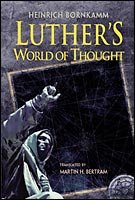
On vacation I am reading the Issues, Etc. Book of the Month, "Luther's World of Thought" by Heinrich Bornkamm (translated by Martin H. Bertram). Anywho, there's a nice summary of Luther's life in the opening chapter, complete with many details I had not known or had forgotten. Not to mention many pertinent Luther quotes, like the one here from a chapter about, "The Hidden and the Revealed God":

God sends forth no magistrates or angels when He creates, fashions, or preserves something, but in all this is the peculiar work of His divine power. But if He is to create and preserve it, He must necessarily be present and create and preserve his creation both in its innermost and outermost particles, around it and about it, through and through, below and above, in front and behind, so that nothing can be present or within all creatures byt God Himself with His power.

His divine being can be entirely in all creatures and in each individually, deeper, more intimately, more present than the creature itself, and yet again be encompassed nowhere and by none, so that He, to be sure, encompasses all things and is in all things, but without having any creature in Him and without being encompassed by any. (Bornkamm pp. 53-54)


Read this quote carefully and you will see not an Oriental Mystic or a Christian Scientist or New Age Guru, but a thoroughly Christian (and, of course, Lutheran) understanding of God's "Omnipresence". Lots more could be said here - lots of connections to Luther's thinking about the Sacraments, the Incarnation etc... but I am not done with this excellent book yet either!

"Even This Shall Pass Away"

While in the midst of our Sunday Bible Study of Daniel, we of course covered the important decree made by the Persian king Cyrus, creatively named, "The Decree of Cyrus". This is the proclamation that effectively ended the Babylonian Captivity of the ancient Israelites, and allowed them to return to the promised land and rebuild the temple.

Sidenote: What a pleasure to read the Sunday School story of Daniel in the Lion's Den with the eyes of Typology. What a total foreshadowing of our Lord's brief sojourn in the tomb, complete with large stone rolled away and all!

Alert reader of poetry and avid parishioner Diana brought forth the following poem by Theodore Tilton, which "rang some bells" with her regarding our study. It's also a really groovy poem, too.

________________________________________________

EVEN THIS SHALL PASS AWAY

Once in Persia reigned a king,
Who upon his signet ring
Graved a maxim true and wise,
Which, if held before his eyes,
Gave him counsel at a glance
Fit for every change and chance.
Solemn words, and these are they;
"Even this shall pass away."

Trains of camels through the sand
Brought him gems from
Samarkand;
Fleets of galleys through the seas
Brought him pearls to match with these;
But he counted not his gain
Treasures of the mine or main;
"What is wealth?" the king would say;
"Even this shall pass away."

'Mid the revels of his court,
At the zenith of his sport,
When the palms of all his guest
Burned with clapping at his jest,
He, amid his figs and wine,
Cried, "O loving friends of mine;
Pleasures come, but not to stay;
'Even this shall pass away."

Lady, fairest ever seen,
Was the bride he crowned his queen.
Pillowed on his marriage bed,
Softly to his soul he said:
"Though no bridegroom ever pressed
Fairer bosom to his breast,
Mortal flesh must come to clay-
Even this shall pass away."

Fighting on a furious field,
Once a javelin pierced his shield;
Soldiers, with a loud lament,
Bore him bleeding to his tent.
Groaning from his tortured side,
"Pain is hard to bear, " he cried;
"But with patience, day by day,
Even this shall pass away."

Towering in the public square,
Twenty cubits in the air,
Rose his statue, carved in stone.
Then the king, disguised, unknown,
Stood before his sculptured name,
Musing meekly: "What is fame?
Fame is but a slow decay;
Even this shall pass away."

Struck with palsy, sore and old,
Waiting at the Gates of Gold,
Said he with his dying breath,
"Life is done, but what is Death?"
Then, in answer to the king,
Fell a sunbeam on his ring,
Showing by a heavenly ray,
"Even this shall pass away."

-Theodore Tilton

Sunday, September 10, 2006

On Vacation

I'm off with the family to Florida for 2 weeks. Will return on the 23rd. See you then!

Wednesday, September 06, 2006

Junk Mail

I got one of those massive brochures in the mail today - advertising some "Church Leadership Conference". Rick Warren, Bill Hybels, Lee Strobel, all the usual suspects.

I looked through this poster-size booklet and found God mentioned about 3 or 4 times, and Jesus by name only ONCE! (And even then, it was theology of glory). But all the church marketing buzzwords were used quite freely, and the famous speakers were pictured prominently along with their impressive credentials. All this for only $435!

What a joke.

Tuesday, September 05, 2006

Sermon - Pentecost 13 - Proverbs 9:1-6

Pentecost 13 – (September 3rd, 2006)
Proverbs 9:1-6

“Wisdom’s Feast”


The last couple of weeks our readings have highlighted the theme of food. Bread, in particular, as Jesus describes himself in John 6 as the “Bread of Life”. Today we turn to the Old Testament book of Proverbs, and see an extended metaphor – a picture of Wisdom personified as a woman – who throws a grand feast. But this is no mere detour into a quaint but irrelevant Old Testament passage, for Wisdom’s call to dinner brings us to Christ and the Cross.

Throughout the Proverbs, Solomon contrasts the concepts of wisdom and foolishness. The fool is anyone who despises God’s word, whereas anything associated with truth and faith and God is wise.

You’d be insulted if someone called you a fool, wouldn’t you? But that’s who is invited to this feast. To all those who lack judgment, “let all who are simple come in here!”

And so this invitation requires a degree of humility. It means you have to admit that you don’t know it all, don’t have it all together, that you are lacking. That you are not the wisest, or even wise. You have only a need. You are a fool.

We don’t like to think of ourselves as fools or foolish, but that’s how Proverbs would describe us in our sin. Sin never makes good sense, it is never wise, and yet we do it anyway. Sin sets ourselves up to be wiser than God, and can there be anything more foolish?

So much of our world wants to explain immorality and evil by a lack of education. But the lack of judgment and the simple-ness spoken of here is not simply a shortage of information. It’s not like if we only knew more we would be just fine. The foolishness here is a willful ignorance, a purposeful predicament we put ourselves in.

We are simple people really. We are sinners by nature. It’s what God says about us in his Word, and therefore it’s what we say about ourselves in confession. Poor, miserable sinners. Or in the words of Proverbs 9, fools.

But wisdom – God’s wisdom – stands in contrast to such foolishness.

Here the concept or idea of wisdom is personified as a woman (and ladies, before you point this out to your husbands, remember that later on “Folly” is also a woman). She is the host - busy preparing a feast and inviting her guests. Just who is this wisdom?

Let’s shed a little New Testament light on the idea. Paul speaks of wisdom and foolishness, saying, “The message of the cross is foolishness to those who are perishing, but to us who are being saved, it is the power of God.” And, “we preach Christ crucified: a stumbling block to Jews and foolishness to Gentiles, but to those whom God has called, both Jews and Greeks, Christ the power of God and the wisdom of God”.

Wisdom, here personified in the Old Testament, in the New Testament is revealed most fully in Christ. He is the wisdom and word of God in human flesh. He is the heart and soul of God’s entire plan for us foolish sinners – that through him we would receive wisdom, that through him we would become wise unto salvation and ourselves be saved.


Now, God’s wisdom can be a little perplexing to us. It includes the suffering, sacrifice, and shame of the cross. Why would God, how could Jesus destroy our enemies by being destroyed? It’s like waving the white flag to win the battle. No man wise in worldly wisdom would do such a thing. But Jesus Christ can, and he does.


And what foolishness that a man could rise from the dead? And yet this too he does, and promises us the same resurrection. “He who believes in me will live, even though he dies”. Ah, but what wisdom from on high that God’s own Son would promise us a forever, and also give us the faith to believe it.

And while the world thinks we are fools for believing in such things, while they mock and jeer at Christians who pray to a God we can’t see and trust in a promise that goes against everything we’ve ever seen – we know where the true wisdom is, it is in Jesus Christ our Lord.

In our selection from proverbs, the woman called wisdom invites fools to her home, and she throws them a marvelous feast.

It’s no accident that our wise Lord himself also speaks in terms of food and banquets. He too invites the sinner to feast on the food he provides. He invites the fool to be wise.

The feast he gives is a smorgasbord of blessings. It is the bread of heaven that is his own body – given for the life of the world. It is a feast that brings forgiveness of sins, new life, and salvation to each of us.

When we approach in repentance to this altar, and hear, “welcome to the Lord’s table”, we join in that feast. When we hear the words of Christ – which promise his body given and blood shed for us for forgiveness – we join in that feast. When we commune with God and with each other here together – we join in the feast also with angels and archangels and all the company of heaven.

And it is also a foretaste of the feast to come. For just as man’s first home in Eden was lost by sinful eating, so in the meal that brings forgiveness we are restored to a future feast. There in heaven, at the marriage feast of the Lamb in his kingdom which shall have no end.

The feast is Christ. He is the host, and he is the meal. He invites us to the feast today, and he promises us a feast to come. The table is set. The meal is prepared. Let all who are simple and lacking come forth, and join in the feast his wisdom has prepared. And let us taste and see that that Lord is good! In Jesus Christ our Lord. Amen.

Wednesday, August 30, 2006

The Hungry Hoosier

St. James the Hoosier (having nothing to do in the week before classes start at Sem) was a little hungry this week, and got into a bit of trouble. Read about it here.

Tuesday, August 29, 2006

Become a Minister Online!

This story ran on my local TV news station tonight.
You can also watch the video here.
I pasted it here so as to add my own commentary.
It's a little sarcastic at times, but I think you will get the point.
____________________________________________________________

Perform a wedding... bury the dead... or exorcise evil spirits -- legally. With the click of your computer mouse you can become ordained - even if you're a convicted felon.

[You need legal clearance to do exorcisms? Uh-oh.]

Religious freedom advocates applaud online ordinations.

[No, people who disrespect organized religions applaud]

Local ministers are appalled. [Yes we are.]

As far as the state of Wisconsin is concerned, you can be ordained online or at the Vatican. Both ordinations are treated the same way. [Isn't this just another case of the law not being able to keep up with technology?]

Richard Antolovich and his girlfriend Sage Skye say they are called to serve. They both went on line and with a few mouse clicks became ordained ministers. No ministerial school. No training.
[Oh, but they heard the little voice! I think I feel called to be... I don't know.... a brain surgeon. SCALPEL, NURSE!]

But now they are able to perform weddings, council the mentally ill... Do all the things traditional ministers do. [Being outraged by various outrageous things? And it's spelled counsel, not council. Those are the monthly church meetings. Now they can do those too, I guess.]

"Back when God was around [WHAT?] when he chose his apostles they didn't go to school either. [No, they just learned from the GREATEST TEACHER WHO EVER LIVED FOR THREE YEARS.] They had the calling and they took it. That's how I feel," ordained minister Richard Antolovich says. [Well we're so glad you FEEL IT]

Sage agrees. "This I saw as a way to extend my spirituality to others and branch out and learn and grow on my own."

Richard explained he feels a calling. "I'm now able to have some credentials [False ones]. When people hear you're a minister they don't immediately ask, 'well what school did you go to?' They just know that you're a minister." [Maybe now they will have to start asking]

That's exactly what worries ministers like David Dragseth, who spent four years studying to become a Lutheran minister. [Um, that would be four years of seminary, after his four years of undergraduate. This guy is a local ELCA pastor. Of course don't expect the news to ever say what kind of Lutheran]

"It's appalling. It's degrading to those of us who devoted our lives to the deep seriousness of these callings and the deep professional training that it takes," he says. [Yeah. Make these people suffer through Greek and Hebrew. And pay the tuition too.]

And it could be more than degrading, he says. It could be dangerous. "Let's say for example that your child was suicidal and you were to go to a counselor thinking full well that the counselor is trained to deal with someone who's suicidal and then all of a sudden you discover that that person simply received that authorization by just clicking a button on the internet?" Dragseth adds. [Good point.]

Richard and Sage are ministers in the Universal Life Church. They both went online and were ordained almost immediately.

They have official credentials. And the ULC Web site sells parking placards and the right to call yourself everything from bishop to a doctor of immortality. [This farce of a "church" is the same outfit that ordained Mr. Newdow, who sued to get the phrase "under God" taken out of the Pledge of Allegiance.]

"Should you have more training than what you receive from clicking a button on line and being able to do all these things?" we asked.

Richard agrees some research is needed. "I believe you should do some research. You should do some reading... buy some books... whatever you can do to understand the mission of the church. You shouldn't go into this blindly." [Yes. First you should Google "Sham Christianity" and read this Wikipedia article.]

He's even performed a wedding. "Just because I didn't go to ministerial school for 2 or 3 or 4 years doesn't make me any less spiritual than say... the pope," Richard believes. [There's that fun word, "spiritual". On my top-ten list of words I plan to eliminate from the English language when I get elected king of the world. Wait... maybe instead of getting elected, I can just go online for that....]

Pastor Dragseth thinks it's all outrageous. "My daughter hope is 10-months-old and could be ordained instantly. Right now... five minutes from now, she could get the little ministry in the box and have her little clergy parking pass so that we could park in handicapped parking spaces all over the city. It really angers me." [What angers me is that I don't have one of those passes! Do they really get to do that in Milwaukee???]

Richard says he can still be a good minister. "I may not have had the same schooling. I may not be as smart. But one thing you can really be sure of; I care. I genuinely care." [And that's all that matters.]

Online ordinations are recognized in Wisconsin. And some online ministers have actually started their own congregations. [Kyrie Eleison and Come Quickly, Lord Jesus!]

Monday, August 28, 2006

Alcoholics Anonymous?

While studying this week's scripture readings, a theme occurred:

Proverbs 9:1-6 includes "Come, eat my food and drink the wine I have mixed"

Ephesians 5:15-20 has, "Do not get drunk on wine... be filled with teh Spirit"

and John 6:51-58 has, "For my flesh is real food and my blood is real drink"
(and yes I am one of those that connects John 6 to the Sacrament of Holy Communion).

BUT ANYWAY....

I ran across the new blog, "Alcoholics Anonymous...spiritual compromise" (Whose URL says "AA is a cult"). Some rather long posts here, but they are very interesting (and very persuasive) in their criticism of AA from a Christian perspective.

Now, I know several people - Christians - who have found help in their struggles with alcohol through AA. And so I suppose, for some, it works to some degree. What I have seen, though, is that those Christians around here have become less involved with AA and more involved with their church (and I think that is a good thing).

But I must say I have always been suspicious of the organization. In fact, there was a time I told some AA representatives they couldn't come and speak to our congregation (like at a Bible Class or something) because I was wary of their teachings. AA does seem to be, in some way, almost a religion of its own.

For example, the lowest-common-denominator approach to God as a "Higher Power" has always rubbed me the wrong way. And in my experience with AA enthusiasts, I have often seen an unquestioning (almost mindless) loyalty to the program which really does smack of involvment in a cult. It was quite interesting for me to find confirmation of this in the new blog.

What is your experience with AA? Good, Bad, or a mixed bag?

Monday, August 21, 2006

More on Confusion of 2 Kingdoms

An interesting FoxNews story about a Baptist minister (also a local alderman) and how his teachings in the right hand kingdom are affecting his role in the left.

I would echo the comments of Uwe Siemon-Netto in the recent Issues, Etc. Journal, in which he makes the case that we Lutherans need to point all Christians to the doctrine of the two kingdoms...

Gay ELCA Pastor "Under Fire"

No, this is not a post from Hornswoggled, but it could very well be. Kudos to the Bishop for enforcing church policy (uh, gee, and being faithful to Scripture).

Un-kudos to the gay pastor for his selfish and arrogant refusal to resign, "I feel called".

Thursday, August 17, 2006

St. Charles on Infant Baptism

One of the most concise and thorough answers to the question of infant baptism I have seen in a while. Check out former fundie and future pastor (hopefully) St. Charles' recent post here.

Wednesday, August 16, 2006

New Blog

Or, at least, new to me.... Check out:

This Side of the Pulpit
Written by a one-time seminary classmate of mine, Rev. Christopher Hall, now of Oklahoma.

Tuesday, August 15, 2006

ELCA Conference - Internet Info

An interesting article by a speaker at a recent ELCA conference on communication. The author is a VP at Feedburner.

While I don't necessarily endorse everything here, and in the linked pages, it was fascinating to poke around a little and see what's being said about the importance of blogging, MySpace, YouTube and other such internet animals - and what it has to do with the church.

I personally have a MySpace page, and do participate in some of the groups there. Still, it is mostly just to point people to this blog. I am unsure about whether and how to utilize MySpace for "official church business". But this ELCA pastor seems to have his own ideas:

Monday, August 14, 2006

Preaching on the Radio

You probably don't remember me posting this sermon, which I recorded for the "Lutheran Radio Service" some time ago. It will be aired this Sunday on Milwaukee's AM station 620, WTMJ at 6:00 A.M. (Much too early for me to get up and listen!)

If you miss it, you can come to Grace Lutheran Church in Racine this week and here it live, instead.

Lutheran Carnival

Lutheran Carnival XXX is up at the main site.

Sunday, August 13, 2006

My Higher Things Fantasy Football Team

We had our draft online yesterday, and I must say I am pleased with my team. Of course having the 2 spot helps. I am also impressed with the team of Dan @ Necessary Roughness. Anyway, here is my team:

Starters:
QB J. Delhomme
WR R. Moss
WR D. Driver
WR L. Coles
RB L. Tomlinson
RB R. Bush
TE A. Gates
K D. Akers
DEF Arizona

Bench:
WR M. Jones
WR E. Kennison
RB C. Taylor
RB L. Maroney
TE Da. Clark

Friday, August 11, 2006

Why Your Church Should Have a Website

I have been thinking about this for some time. Every congregation should have a website.

1) It is very inexpensive.
Depending on HOW you do it, a basic website can be had for free. If you use a blog format, there is even minimal (or no) advertisement to contend with. Even getting your own "domain name" (website address) is possible for less than $10 a year. Quite reasonable.

2) It is not difficult.
Most people who have some time on thier hands and use the internet somewhat frequently could probably "figure out" how to make a basic church website for free. Most pastors who have learned Greek and Hebrew will find that this task is nowhere near as challenging.

Consider getting a young person from the congregation involved, as they often know the technology better than the older folks. Train the church secretary to make updates. You could even use a team of people with different responsibilities vis-a-vis the website.

One caveat: While it is important to involve volunteers in these sorts of activities, the appropriate officers (and the pastor) should monitor and approve the website content. Remember, this is one way your congregation shows its face to the world! As I am our church's webmaster, I always notify our Board of Elders, for example, of changes and updates - just for accountability.

3) The time commitment:
For the investment (stewardship) of time and money required, the benefits of are well worth it. While a frequently-updated site may not be worth the time if your congregation won't use it enough, most websites don't require great time committments. Once set up, you can usually leave it alone for quite a while.

However, don't let your website sit there "out of date". If your last update was the November 2002 newsletter, and it's 2006 - not good. If regular updates are too hard, post more "timeless" and unchanging information there.

With a tech-saavy membership, more frequent updates will pay greater dividends.

4) Flexibility
A website a can be many different things. You should have clear reasons for having a website, in terms of what you want to accomplish. That said, church websites can offer many different functions:
-Basic information such as phone numbers, email address, worship times are a must.
-Information about what your church teaches and believes - doctrinal matters, vision and mission statements, answers to various questions (F.A.Q.'s - Frequently Asked Questions)
-Keeping the visitor or perspective member in mind:
Directions, Meet the Staff, Church History....
-LINKS to other useful and important websites always come in handy.
-Check out other church websites for many more ideas...

5) It gets more important every year.
The internet is the primary source of information for a growing number of people.
- Your own congregation members will more and more use the internet, and will be using your website for various reasons.
- As the older generation gives way to even younger people, this effect will be exponential.

6) NOT having a website is like...
...Not having your church listed in the phone book (where you also have many options for your listing)
...Not having a sign on your building or in the yard that tells people who you are (again, there are many kinds of signs, but what church doesn't have one?)
...Not answering the phone when someone calls your church, and not having an answering machine message with pertinent information.

7) Long Distance Connections
Having a website lets people from other locations (even overseas) learn about your church. For instance, if I am visiting San Diego for vacation, I may wish to "shop around" for a church to visit while there. How better to do this than on the web?

While a church website certainly has its limitations, and is not intended to replace the church itself, it is a powerful tool that every church should be using in the "information age". And while you should keep your expectations low (you won't have droves of new members just because you have a website), I simply can't think of a reason a church should NOT have a web presence.

You can check out our own church website here: http://www.GraceLutheranRacine.net

Wednesday, August 09, 2006

Monday, August 07, 2006

Sermon - Pentecost 9 - Ephesians 2:13-22

Pentecost 9 – (August 6th 2006)
Ephesians 2:13-22
“Fighting, Foreigners, Foundation”


Leave it to St. Paul to keep the preacher busy. Today’s reading from Ephesians uses three main word-pictures to describe what Jesus does for us, his people. Each one is something we can relate to. Each one shows a little more how those who were near and those who were far have been brought to God through Jesus Christ our Lord. 3 Pictures of Christ our Savior, and his great work for us.

The first word-picture is one frequently used in scripture. It is a contrast between hostility and peace.

We live in a world that knows hostility, but seldom sees lasting peace. Just as Jesus promised, it seems wars and rumors of wars are always somewhere. We read the paper, see the news. “The War on Terror”. “The War in Iraq”. Hezbollah attacks Israel, Israel bombs Hezbollah. Another roadside explosion in Iraq kills soldiers and civilians alike. North Korea and Iran, Kosovo and Rwanda… and this just in recent years. Even at home we are often bitterly divided over the how and why of our own country’s policies and our own president’s actions. We know hostility. It’s a part of life in a sinful world.

But maybe all that fighting seems “over there” to you. Maybe it doesn’t concern you. No matter, for hostility hits close to home when we find ourselves in conflict with others. Even in the family, even with our own parents, children, and spouse – hostility is always lurking. We may not be in the military fighting the latest national war, but we all fight our own little wars on the homefront. We shoot those other kinds of rockets at each other. And it’s just as much because of sin.

Paul speaks of the hostility between Jew and Gentile that is put away in Christ. But we could also speak of the hostility between man and God. For as much as sin puts us at odds with other people, we are more so at odds with our God. Scripture says that in sin we are enemies of God. In other words, we are at war with him. Born into hostility, fighting with our Creator. Challenging his will, opposing his purposes.

Only Christ brings peace. In him the warfare is over. He appeases God’s righteous anger, bearing it at the cross. He turns enemies into friends, sinners into saints. He makes peace between these warring factions a reality.

And peace with God leads to peace with our neighbor. While sin still means war in the world at large, the Christian who carries God’s peace with him, brings that peace into his personal relationships. So that we, who know our sin before God, confess our sins against fellow man. So that we, who have been forgiven, now offer that same forgiveness to each other. So that we, who were once enemies of a God who loved us in Christ, now answer his call and love even our enemies. Whether Jew or Greek, male or female, rich or poor – all that divides sinful humans into enemy factions – is made peaceful in Christ.

The first picture was one of fighting, the second is one of foreigners. Aliens. People from far away. People who maybe were not born here, but are here now somehow.

Again, the Bible’s imagery is not too far from the front page news. Our nation has been debating what to do about the alien and foreigner, especially the illegal immigrant, for some time now. And while everyone seems to admit there is a problem, even faithful Christians are divided about the proper solution. Does the Bible give any guidance on the matter?

It is clear from Scripture that we humans are to obey the laws of the land. Earthly government is given as an agent of God to prevent evil and keep order in our world. Romans 13 makes this very point. So it should concern Christians when laws are being broken. This is not God’s will.

But as I said last week, sermons shouldn’t make us feel smug and righteous, and there is plenty of law-breaking to go around, so that we should also examine ourselves. When have we dishonored, disrespected, or disobeyed the government God has placed over us? An attitude of humility and repentance is needed here for the Christian, even as we address the sins of others.

Again, Paul’s first concern is that in Christ, Gentiles are now incorporated into God’s chosen people Israel. In Christ Jesus, we who did not belong, now do. We who were outside the kingdom are in. We are “in” by our baptism, and his promises given there. We are “in” because his blood was shed for us, we have been paid for. Call it “amnesty” if you will.

Though we don’t have the flawless lineage, though we haven’t earned it either, the gift of citizenship in God’s eternal kingdom is ours in Christ. Though we are not always good citizens on earth, we have been made citizens of heaven, and are now part of his household.

And it is a house he builds. To live together with God and each other, first he stops the fighting. Then he makes foreigners into citizens, even family. Then, he builds the house where we will live together. His holy temple – the church.

I don’t know how many of you remember the building of this church. If you don’t know, or it was before your time, Grace Lutheran Church used to be known as “Grace Chapel”, and the congregation here worshipped in a small white building – a chapel- from 1919 when it was founded, until 1941 when this new building was dedicated.

And maybe it was your grandparents or parents, or maybe some of you still here who helped to build this new building. Many faithful members donated to build these walls, to pay for the decorative windows, and the new organ installed in 1976. I know that some congregation members even built the pulpit and other chancel furniture.

But all along, God has been building his church in this place. Any of the good work to support Grace Lutheran Church has been work God has done through his people, moving them, moving us by His Spirit to Christian service and stewardship. God has been building his church in less conventional ways too – but even more common – as he gathers his people around His word, and sinners have been forgiven here, every Sunday and more, since 1919. God builds his church even today each time a little one is baptized, each time the pastor announces forgiveness, each time we receive Christ in the bread and wine. God builds his church.

This third word-picture, of a household built on Christ, shows us what God’s church is all about. Not the building where we gather, but the . faithful people of God from all times and places., who are the temple of God. What does Paul say about this household of faith?

1) As we’ve already said, we don’t build the house, God does.

2) We have a foundation in the law and prophets. The Old Testament people of God who looked forward in faith to the coming savior – they are part of the household with us. And we who look back and also forward to Christ find our foundation in those men and women of old.

3) Christ is the chief cornerstone. Without him, the whole building comes down like a house of cards. The Church of Christ must always be about Christ, must always rest on him and what he has done – we must never build our own foundation, as if we could.

4) It’s not only Christians that live here in this household, but God himself. That was the great blessing of the Old Testament temple – that God was truly present – dwelling there and accessible to his people. But now that the temple of stone has been destroyed, and now that the temple of Christ’s own body has been torn down and built again – we the church, the body of Christ – become the new temple and dwelling of God. So God lives in and among us. Here, in the church, he is truly present. By his word. In his sacrament. God is here, in the house.

Our Lord Jesus Christ has done, and continues to do marvelous things for us. Paul shows how in Christ the fighting is over, the foreigner is welcomed, and the foundation is laid for our life together with God and each other. Jesus brings peace, makes citizens, and builds his church – and God dwells with us. In Jesus’ Name, Amen.

Thursday, August 03, 2006

Calling Out "The Lutheran"

I think as the owner/webmaster of the Lutheran Blog Directory, I have been more than gracious and fair by including Lutheran Blogs from whatever denomination/designation people claim. Though it happens that there are many more LCMS blogs out there, I don't discriminate against ELCA blogs.

This month, "The Lutheran", a publication of the ELCA, ran an article on Lutheran Blogs. You can read it here. I have several criticisms of this article, quite apart from the fact that the Lutheran Blog Directory was not mentioned. Here is the short article:
_________

The buzz about Lutheran blogs

An estimated 32 million Americans read blogs, semi-anonymous online journals.

Enter bloggers who write about life in the ELCA. There’s a Wisconsin pastor, a lectionary-loving laywoman in Michigan, and a missionary in the United Kingdom.

Sociologist Lorne Dawson of the University of Waterloo (Ontario) said blogs also represent a haven for dissent within denominations. A blog by “Shrimp” represents “one pastor’s attempt to fight antinomianism” (the belief that faith alone is necessary to salvation) and aims to “call the ELCA back to Sola Scriptura (God’s word alone).”

“The critics, the ex-members … are thriving online because this is giving them a voice so much more powerful than they would have ever had before,” Dawson said.

The blogosphere is also home to Lutheran institutions. The Lutheran has one. An ELCA delegation to India, which included The Lutheran staffer Andrea Pohlmann, kept a blog travelogue. And Andrew Genszler of the ELCA Washington Office kept a blog when he toured areas affected by last year’s hurricanes.

________

1. Anti-nomianism is not adequately defined as "the belief that faith alone is necessary to salvation". If that were true, all Lutherans would be anti-nomians. A better definition is, "An anti-nomian is someone who is against the teaching of God's law." That wasn't so hard, was it?

2. "The critics, the ex-members are thriving online". No kidding? Could it be because those who blog have plenty to say?

3. It seems ironic that the ELCA which is so concerned about ecumenism is unwilling to admit to the thriving LUTHERAN blog community - most of which is NOT ELCA!

Ok. Rant done.

GO HASSELBECK!

Not the Seattle Seahawks QB Matt Hasselbeck, but his sister-in-law, Elisabeth Hasselbeck. As co-host of ABC's "The View", she found herself out surrounded and outnumbered in a recent on-air debate about the "Plan B" abortion pill. Kudos to a rare media personality standing up for the unborn.

Foxnews story here:

http://www.foxnews.com/story/0,2933,206873,00.html

EDIT:

OK, I found a link to the video here: http://www.youtube.com/watch?v=1QI6QhyW_9g

Barbara Walters and her pedantic "oh, we just have to learn how to discuss". I thought Elisabeth handled herself very well, and showed passion yet restraint. And while I do think that human life should not be trumped because it began with rape or incest, I still commend her for her stand.

Racetrack Petition

Dear Blog Readers,

I received a phone call and email some time ago from a Rev. Dave Krueckeberg, an LCMS pastor in the Chicago area. Rev. Krueckeberg has been serving a unique community as part of his congregation, namely the horse "caretakers" at two Chicago area thoroughbred racetracks.

Because this pastor pressured the owners of the racetracks to provide better working/living conditions for their employees, he has been banned from the sites. Since then, he has started a petition drive to regain access to the stables, where the people he serves not only work but also live. Rev. Krueckeberg has the support of many prominent LCMS leaders in his struggle, including:

The Rev. William Ameiss, President, Northern Illinois District, LCMS
The Rev. Matthew Harrison, LCMS World Relief & Human Care
The Rev. Daniel May, President, Indiana District, LCMS
The Rev. Robert Kuhn, Chairman, LCMS Board of Directors
The Rev. Gerald Kieschnick, President, LCMS

If you are interested in reading more, I submit the following documents, which will explain more of the situation and how you can help.

http://www.filelodge.com/files/hdd6/147992/Racetrack.Letter1.doc
http://www.filelodge.com/files/hdd6/147992/Racetrack.Letter2.doc

Tuesday, August 01, 2006

Superhero Quiz

Your results:
You are Green Lantern


Green Lantern
65%
Spider-Man
60%
Superman
60%
Hulk
45%
Iron Man
40%
Robin
38%
Supergirl
38%
Batman
35%
Catwoman
30%
The Flash
25%
Wonder Woman
23%
Hot-headed. You have strong
will power and a good imagination.


Click here to take the Superhero Personality Quiz


HT: Bloghardt's Reflector (AKA Superman!)

Neat Story About the Church Where I Grew Up

St. James in Overlea, Maryland, is where I went to Pre-K and Elementary School, as well as where I was confirmed. Though it wasn't the only church I attended while living in Baltimore, I still consider it the church where I grew up. It is also where I prefer to worship when I visit the area.

Anyway, my mom forwarded me this heartening story about a nice thing the church has done:

_________________________________________________________


Giving a blessing of books

Overlea church ships library to Louisiana
sun reporter
July 31, 2006

He preached yesterday about God's harvest and the faithful journeys for which people must prepare. This morning, the Rev. J. Thomas Foelber of St. James Evangelical Lutheran Church in Overlea will live that message when he begins a 1,100-mile journey to New Orleans - taking with him a bountiful harvest of books for a Lutheran school that was destroyed by Hurricane Katrina.

He blessed the gift of books from the church's former school, which closed in 2000, as members of the congregation gathered around the pulpit at yesterday morning's worship service and joined him in prayer: "Oh God ... bless this library. Grant that in its sending it may reflect our love for you ... and bring joy to the students and teachers of St. John Lutheran School."

Bethany Gonski, the principal at St. John Lutheran School in New Orleans, said that the books will not only bring joy but will ensure that the school maintains state approval when it reopens Aug. 18.

The Louisiana school's 3,000-volume library was destroyed by floodwater, Gonski said in a telephone interview yesterday. Shelves buckled, sending books into 3 feet of water, and mold grew on tables, chairs and walls.

Everything was thrown out.

Electricity was restored six weeks ago, and the school has been cleaned, renovated and made ready for the first day of classes.

"We are pleased and appreciative," Gonski said of the gift of books. "We would have had to start off with a small, sparse-looking library and build it back up, but that would have taken quite a while."

The New Orleans school, which was founded in 1854, had about 150 pupils in prekindergarten through eighth grade before Katrina, but for now it will go up to the first grade. Gonski said the school will expand in the next year and grow into the new library.

It took church volunteers in Overlea about a week to pack up the 5,000 volumes of picture, reference, nonfiction and fiction books that made up St. James' school library.

This morning they are to load the books in a truck and Foelber and his wife, Debbie, will begin the drive to New Orleans.

They are expected to arrive Wednesday afternoon. Gonski said she and volunteers will greet them with a New Orleans gift basket packed with Louisiana hot sauce, Creole mustard and beignet mixes.

Thomas Foelber said he had been looking for a way to support Lutheran congregations in New Orleans and that donating the library was a "wonderful opportunity to share what God has blessed us with."

"There's sadness about the closing and joy about sharing our resources," he said. "It may inspire others to do similar things."

At its peak, the Overlea school, which opened as a kindergarten in 1956, had about 150 students.

Emily Kursch, now 14, was a third-grader when the school closed.

While she couldn't quite recall what lessons Merry "Miss Merry" Schminke taught during weekly library sessions, she said she is happy that the library will be put to good use.

"It's a good thing to help people down there," said Emily, now a rising ninth-grader at Parkville High School. "We'll miss it and it has some sentimental value, but ... it can help people down there."

Susan Pullen, who was principal of the school from 1989 to 1992, added: "I feel a great sense of peace. We want these books to be a blessing."

Link to the article: http://www.baltimoresun.com/news/local/bal-md.library31jul31,0,7296424.story?coll=bal-local-headlines