Sermon
Revelation 2:1-7
“Jesus' Letter to Ephesus”
1"To the angel of the church in Ephesus write: 'The words of him who holds the seven stars in his right hand, who walks among the seven golden lampstands.
2 "'I know your works, your toil and your patient endurance, and how you cannot bear with those who are evil, but have tested those who call themselves apostles and are not, and found them to be false. 3I know you are enduring patiently and bearing up for my name’s sake, and you have not grown weary. 4But I have this against you, that you have abandoned the love you had at first. 5Remember therefore from where you have fallen; repent, and do the works you did at first. If not, I will come to you and remove your lampstand from its place, unless you repent. 6Yet this you have: you hate the works of the Nicolaitans, which I also hate. 7 He who has an ear, let him hear what the Spirit says to the churches. To the one who conquers I will grant to eat of the tree of life, which is in the paradise of God.'
We begin another Lenten season in the church, as we always do, with Ash Wednesday. A day of repentance and sorrow over sin, which sets the tone for this penitential time in our church calendar. Ashes are a sign of repentance going back to ancient times, and even today many Christians wear ashes on their foreheads to signify this repentance.
We're also starting a series of mid-week sermons which focus on an important section in the book of Revelation. Each week in Lent we will focus on one of the letters to these 7 churches, in order to hear God's word to us, and prepare us for the observance of Good Friday and Easter.
But first some background. St. John, as an old man, was imprisoned for his faith on the island of Patmos. One Sunday John had a marvelous vision, a “revelation”, which was given to him by Jesus Christ himself. In fact, the real name of this book of the bible is, “The Revelation of Jesus Christ to St. John”.
And in that vision, Jesus appeared to John surrounded by many symbolic images. These things John really saw – but many of them stood for other things, for concepts and ideas. When Jesus appeared, he held in his hand 7 stars and walked among 7 lamp-stands. Jesus himself said these 7 lamp-stands were the 7 churches he would address, and the 7 stars were the “angels” of those 7 churches.
And while some believe those 7 angels to be guardian angels watching the churches, a much older interpretation makes more sense. The Church Father known as “The Venerable Bede” makes the case that these “angels” are really the pastors of those churches. After all, the word “angel” means “messenger”. And God blesses us with supernatural, spiritual as well as everyday human messengers. Also, it makes more sense for them to be pastors since he both commends and criticizes not only the churches but the messengers. And we pastors are certainly in the same boat as the people of the church. We are sinners and saints just the same.
So Jesus has a message for each of these pastors and the churches under their care. They were certainly not the only 7 churches of their day, and so these letters have wider application. They even apply, we will see, to us. We heed the warnings to the churches, even as we take comfort in the promises at the end of each section. So too, as the criticisms and compliments of Christ for these churches are universal to Christians of all times and places.
Take this first letter, to the church at Ephesus. They get a mixed review from our Lord. He commends them for their vigilance against false doctrine. Heretics known as the Nicolatians were active in the area, and the Ephesian church was right to “hate” their works. Jesus, too, says he hates their works. We don't know exactly what the false teachers taught, but it's been suggested they practiced promisquity and ignored the law of God. So far the Ephesian Christians get good marks from our Lord for avoiding this heresy and enduring in the true faith.
But then Jesus takes them to task. He holds something against them. They have “abandoned the love” they first had. Their first love. What was it? Apparently a love for one another, rooted in their love for God, who had first loved them in Christ. He calls them to repentance and even threatens that if they don't repent, the lamp-stand will be removed from its place. In other words, they will lose their place as one of his churches. In yet other words, they will no longer be his people.
As I said, these words of Jesus have a wider application. For many pastors, and many churches, and many church members do much the same as the Ephesians. We may say the right things, we may even remain outwardly faithful. But inside of us is a rot of lovelessness that threatens our very faith.
Jesus tells us to love our neighbor as ourself. Paul tells the Corinthian church, that even if he speaks in the language of the angels, but has no love, he's a noisy gong or clanging symbol. Love is one of the most important words in all of scripture, one of the highest values.
For Jesus' own summary of the law is to love – to love God, and to love our neighbor. And which of us couldn't stand to show more love, be more loving, put others before ourself more, and basically be better Christian neighbors? We have all failed. We all need to be more loving. We are all like the Ephesians.
What does it mean when there is no love, or very little? It means that we have sinned, and must repent. What does it mean when faith does not express itself in the works and deeds of love? It means we are sinners whose faith is flagging and failing, and we need to turn again to Christ and the cross for forgiveness, strength and renewal.
And Christ loves us. Greater love has no one than that he gives up his life for his friends. Jesus of course, gave up his life for us, even when we were enemies of God. He did it out of love. God sent him out of love for the world. A love which is patient and kind, which keeps no record of wrongs. A love which always endures and never fails. A love so great that not even death could overcome it. God is love, and Jesus is the embodiment of God's love for us.
It's that love that empowers us to love. It's the Gospel that gives us the strength and the will to love God and love one another. Nothing of our own, nothing within us can do it. Only the love from without can inspire the love within. And by his Word and Spirit, he shows that love and speaks that love and sparks that love in us.
You know, the Nicolations, the false teachers in Ephesus, their very name meant “the conquerors”. Again, we don't know much about them or why they would call themselves that. But we do know this, from Romans 8, that “we are more than conquerors through him who loved us”. Yes, Jesus makes us more than conquerors!
In Jesus, not only do we defeat sin, death and the Devil – enemies we could never face on our own but who don't stand a chance against him. But also in Jesus we are more than conquerors. We not only defeat our enemies but we live victoriously. “To him who conquers, I will grant to eat of the tree of life, which is in the paradise of God”. Yes that life which God originally intended for Adam and Eve – that life which is restored only by the love of a savior who died.
Each week, as we read the letters to the churches, we will discover spiritual insights and applications to our modern churches, and even to us as individual Christians. We will be called again and again to repentance and faith, as our Lenten journey continues.
Today, we see ourselves in the Ephesians – commended for watching our doctrine. Praised for the endurance of faith we have. But warned not to let our love grow cold. And reminded, that in the love of Christ, we are more than conquerors, who will eat from the tree of life.

Thursday, February 26, 2009
Monday, February 23, 2009
Dolan to NY - A Lutheran Reaction
Milwaukee Archbishop Timothy Dolan has been appointed Archbishop of the New York Archdiocese. It's a primo-promotion for a rising star in the RC church.
He's served here for about 6 years in the Milwaukee area, following after an Archbishop involved in the spate of sex scandals. So he's had a bit of a mess to clean up, and he's done a good job with that.
He's also universally respected as a decent and personable man, who is approachable and friendly, media-savvy, quick-witted and light-hearted.
But I've often commented on just how Lutheran he sounds. Of course, he's a Roman Catholic. I'm sure we'd have some serious disagreements. But I must say that in the short quips and commercials I've heard him speak, he delivers a message that centers on faith not works, on God's love not our good deeds, and he is not afraid to talk about Jesus Christ.
So Benedict, who's been called the "First Lutheran Pope", has appointed to the top spot in American Catholicism someone who sounds pretty Lutheran for a Roman Catholic. And to me, that's a good thing for New York, and for the RCs in the USA.
He's served here for about 6 years in the Milwaukee area, following after an Archbishop involved in the spate of sex scandals. So he's had a bit of a mess to clean up, and he's done a good job with that.
He's also universally respected as a decent and personable man, who is approachable and friendly, media-savvy, quick-witted and light-hearted.
But I've often commented on just how Lutheran he sounds. Of course, he's a Roman Catholic. I'm sure we'd have some serious disagreements. But I must say that in the short quips and commercials I've heard him speak, he delivers a message that centers on faith not works, on God's love not our good deeds, and he is not afraid to talk about Jesus Christ.
So Benedict, who's been called the "First Lutheran Pope", has appointed to the top spot in American Catholicism someone who sounds pretty Lutheran for a Roman Catholic. And to me, that's a good thing for New York, and for the RCs in the USA.
"It's Time" Website

Here's a new link for your blogs:
www.itistime.org
A collection of resources regarding Rev. Matt Harrison's paper, "It's Time". An alternative to the restructuring proposals of the LCMS Blue Ribbon Task Force. An optimistic vision of how to work on the disunity in our synod. A faithful, Lutheran approach put forward by a theologian with a heart for Mercy. And quite possibly the next president of the LCMS.
Sunday, February 22, 2009
Sermon - Transifguration - Mark 9:2-9

Sermon
Mark 9:2-9
“Jesus Only”
We've heard a lot about “change” this year. And whether you agree with the changes being made or not, they will be hard to ignore. Change is sometimes good, sometimes bad, and sometimes hard to know without the perspective of history. We might not know what all this change means until we are much farther down the road, and take some time to look back.
Today, we read about Jesus trans-figuring, or “changing”, at least in appearance, before his disciples. It was a change which was full of meaning. And as the 3 disciples saw it, they didn't comprehend it until much later on, looking back.
I think this Sunday is hard to understand for many people. We understand Jesus doing things like being born, and preaching and dying. Even miraculous things like healing people, doing miracles, and rising from the dead – while requiring our faith are still easier to understand. What is the significance of this mountain-top experience with Jesus? And then, what does it mean for me, and my faith?
The Transfiguration takes place 6 days after Peter confessed Jesus as the Christ, the Son of the living God. It signals the end of Jesus' smooth sailing, and the beginning of his time of opposition which would climax at the cross.
And if the Epiphany season is about revealing who Jesus is – then the Transfiguration demonstrates in a powerful way that this is God's Son, and that we are to listen to him. It's Jesus giving those disciples, and us, a glimpse behind the veil into the glory that is his by rights. Peter said he was the Christ, now Jesus let him have a peek.
Furthermore, you have Moses and Elijah there. These two great men of the Old Testament – and now it's like Mount Rushmore – famous, important men together on a mountain. Moses and Elijah represent the Law and the Prophets – the entire Old Testament. And their presence speaks volumes.
Imagine if after church today, you saw the president of the United States going into Pastor Poppe's office. Then the Pope appeared and went into the office too. You might conclude that Pastor Poppe was someone very important, right? When Moses and Elijah appear with Jesus, their very presence testifies to his importance. But more than that, they are there to say, “This Jesus, He is the one we've been waiting for. He is the one we've been pointing too. The whole Old Testament scriptures testify that He is the one sent to save us”.
All this must have been overwhelming for those three disciples. Stunned with awe, James and John silently take it all in. But Peter has to talk. He didn't know what to say, but that didn't stop him from saying something. He blubbers on about building tents and figures we'll make this happy event last as long as possible, because after all, how often is it really that you....
And in great contrast, the voice from the cloud speaks. A voice of authority that knows what to say. A word of instruction that is clear and true. God the Father, unmistakable, gets straight to the point. “This is my beloved Son. Listen to him”.
Peter stop your blabbering. You need to listen. Stop your planning and your own ideas and pay attention. This is not just some prophet. This is not even a really great and important man. This is my Son. MY SON. Listen to him.
And just as suddenly, the cloud was gone, the voice was silent, and Moses and Elijah disappeared. The disciples were left, looking around. Where'd everyone go? What just happened here? And they saw only Jesus.
Jesus only. That's a phrase we can sink our teeth into. Jesus only.
Not anyone else. God didn't say, “Listen to Jesus, and also be sure to pay attention to what Mohammed says, and that Buddha, or the Dalai Lama. Make sure you balance your spirituality with opinions from different sources and perspectives, you know, because everyone has something useful to bring to the table.” No. He said listen to Jesus. Jesus only. When it comes to salvation, there is only Jesus.
Even St. Paul echoes this in Galatians. If anyone preaches to you a different Gospel (that is – anything other than salvation by grace through faith in Christ alone).... and I don't care whether it's another preacher, an apostle, or even angel from heaven – if anyone tries to lead you astray with such lies – let them be condemned. Strong words from St. Paul. We should think the same. When it comes to salvation, there is only one saving Gospel. And that Gospel is about Jesus, and Jesus only.
Only Jesus lived a perfect life, fulfilling every law. Only Jesus can give you the credit for that earned righteousness. Only Jesus died for the sins of the world, and offers his forgiveness to you and me. Only Jesus rose from the dead and predicted it beforehand and promises we too will rise. Only Jesus can get us to the Father. Only Jesus can grant us God's grace. Only in Jesus' name are our prayers acceptable to God. Only Jesus feeds us with his body and blood. Only Jesus washes away our sins at the font. Only Jesus is the living word who continues to work by His Spirit in the written, read, and spoken word. Only Jesus. Jesus, Only.
Hebrews 12 tells us to “Fix our eyes on Jesus”, and for the sinner in need of salvation, there really is nowhere else to look. But looking to him, we can be sure that he is who he says he is, that he did what he said he would, and he will do what he promises – for each of us who trust in him. If we trust in ourselves and our works, if we look within, we will not have this assurance. But in Jesus only do we rest secure, and know the peace that only Jesus can bring.
Today we come to the mountaintop with the disciples, and with our Lord. And we bring with us many things – sins, guilt, shame, flaws, failings, struggles, and hurts. They weigh us down not only on the mountaintop but in the valleys and on the plains. But here, in God's presence, something is different. We see the prophets of old, we smell the smoke, we hear the voice. We are awe-struck by the bright shining glory of Christ.
And here something happens. Here, with Jesus, we too are transfigured. In Jesus we are changed – forgiven, renewed, changed. In Jesus we hear the voice of God, know the Word of God, and see the love of God for us. In Jesus' body and blood he is present with mercy and grace. In Jesus, we leave with the assurance that our sins are gone, gone, and our life is secure in him. In Jesus, and only in Jesus.
Thursday, February 19, 2009
"Faithful?" Journey Nears End
The ELCA task force (farce) on sexuality (read: "homosexuality") has at long last and with no great surprise issued its final recommendations to, basically, accept actively homosexual clergy.
How about "Unfaithful Journey" or "Misdirected Journey"?
Pray for the ELCA and those in it, that they would oppose such measures and remain true to the Word of God.
How about "Unfaithful Journey" or "Misdirected Journey"?
Pray for the ELCA and those in it, that they would oppose such measures and remain true to the Word of God.
Sunday, February 15, 2009
Sermon - Epiphany 6 - Mark 1:40-45

Sermon
Mark 1:40-45
“Be Clean”
Today when we think about the categories of “clean” and “unclean” it has more to do with whether someone has taken a shower, or whether the laundry has been through the wash. But for the Old Testament people, and even in Jesus' day, “clean” and “unclean” were important ceremonial categories. Things were either “clean” or “unclean”. And even people were either “clean” or “unclean”. Usually, if you were unclean it was a temporary situation. And there were rituals of cleansing prescribed to deal with it all. But why did God institute this cumbersome system of categorization for his people? Why all the fuss?
Some suggest the things God designated as “unclean” were those things especially unhealthy in the ancient world – eating certain foods that were more prone to make you sick, or associating with diseased people would expose you to contagion. And while there is probably something to that, the real reason is much deeper.
I'm convinced that God wanted his people to think in the categories of “clean” and “unclean”, so as to remind them of deeper spiritual realities. While not exactly congruent, the categories of “clean” and “unclean” point to the truth that we are all “unclean” in sin, and all need to be washed, purified, cleansed.... by the grace of God.
So today we encounter the lepers. In the Old Testament, Namaan. In the Gospel reading, the nameless leper healed by Jesus. Both men, in their disease, were unclean. And though we are not lepers, we can relate. For we are unclean, before God, in our sin. And we too are made clean by Jesus, who always wills to forgive and restore his people.
Leprosy was, in those days, much more than a disease. Actually in those days it was a whole complex of skin diseases, all of which were lumped together. Some were temporary and perhaps curable. But some were the particularly chronic kind. In every case, though, the disease made the victim more than just sick.
Maybe the worst part of coming down with leprosy was that you became a social outcast, stigmatized and excluded from the community. The law was quite clear – lepers weren't even supposed to come close to healthy people, much less touch them. They could make you sick. They could make you unclean.
So here comes a leper, who falls on his knees before Jesus. Too close for comfort? No. Jesus doesn't run away or turn him away. But he recognizes the need. In pity he responds. He reaches out and touches the man. Touches him! This would make any normal person unclean too! But with Jesus, it's the other way around. He has come to make the unclean clean.
I suppose you could say that Jesus did become unclean. He did it most fully at the cross. He who was without sin, we are told, was made to be sin for us. He who was not subject to death, humbled himself even unto death on a cross. And if touching a dead person made you unclean, what does it mean to be a dead person? But all this Jesus did to cleanse us, restore us, forgive us.
When Jesus touches the leper and makes him clean, it's on the basis of the cross. When Jesus comes to you, and cleanses you from sin, it's always on the basis of the cross. Each act, each declaration of forgiveness is meaningless without the death and resurrection of Jesus. But each absolution has behind it the full weight and force of a dying savior who pleads, “Father forgive them” and assures us, “It is finished”.
But is it enough for you? Try this on for size. Today in the age of modern medicine, we usually don't ostracize the sick like they used to. But we do have our modern lepers. Those whose sins make them so unclean we shun them. Ask yourself. Could Jesus cleanse... a murderer? Could Jesus forgive.... a child abuser? Does Jesus offer forgiveness, even to the most “untouchable” sinners of our day? It's hard to imagine, but we must say, “yes”.
As disgusted as we are, and rightly so, by the most grievous sinners among us, God must be even more disgusted with our sins. For the unclean thoughts, words, and deeds, for our very corrupted nature... his ultimate holiness cannot stand sins such as ours. Scripture says God hates sin. There are no soft edges to it. Even the sins that we think, in our rationalizations, are no big deal, the ones we tell ourselves don't really hurt anyone, are no one's business, or really have a plus side to them... NO. God hates sin. He is disgusted by it. And he prescribes for sinners the ultimate ostracism of eternal separation – we call it Hell. Some of the scariest words in scripture are when Jesus says he will tell some people on the last day, “depart from me. I never knew you”. Can you imagine that ringing in your ears for all eternity as you trudge off to your endless suffering. God wants nothing to do with you.
But. But, we Christians, though sinners, are like that leper. We come before Jesus and beg pity. We come on our knees, in humility. We come confessing sin, admitting our need, not hiding our disease. And he takes pity on us too. He is willing to make us clean. By all rights he could and should turn us away, keeping his distance. But he has mercy. He comes close, and touches us. He is present with us. And his cure is immediate, and permanent.
One beautiful picture of the Lord's Supper is that it is the “medicine of immortality”. How true it is. That Jesus' own body and blood not only feed us, but cure us, and strengthen us in our faith. And it's that faith that carries us through – even through death – to eternal life. To that day when these bodies diseased by sin are raised incorruptible, and body and soul live in perfection with him forever. Then we will be clean not only by faith, but in full. There will be no more sin, or death, or suffering or pain. Then and there he will wipe every tear from our eyes.
So come this day and receive the medicine prescribed for you, the person infected by sin, the one who would be cast out from God. Come, in humility, confessing that sin. Come, expecting his mercy, receiving his cure, know his forgiveness. For he is willing to make you clean.
Tuesday, February 03, 2009
SWD Circuit Counselors Meeting - Restructuring Discussion
I spent most of the day, yesterday, at the South Wisconsin district office at our bi-annual Circuit Counselors meeting. We heard from the LCMS Stewardship guru and got updates on the business of the district. But an important segment of our time together was spent discussing the proposed restructuring of the LCMS.
One of the fellow circuit counselors was Rev. Torkelson, whose letter regarding the restructuring is found here: http://preachrblog.blogspot.com/2008/12/rev-torkelson-on-restructuring.html
Since we last met, many more details are out of the bag (mainly from the North Dakota District reports). These include:
- Elimination of program boards in favor of 2 "committees"
- Elimination of ALL term limits
- Adding a layer of bureaucracy - regional VPs
- Changing the name to the LC-USA
- Giving more votes at district conventions to larger congregations
- Selecting national delegates through the distrcit conventions, not the circuits
- Making it harder to get overtures through to the national convention
- Changing the cycle of conventions (every 3 to every 4 years)
But what I wanted to report is this. Without dissent, the reaction to these proposals in yesterday's meeting was thoroughly negative. Numerous comments were made about how this appears as a "power grab". When I mentioned the elimination of all term limits provision, I actually heard gasps in the room!
Rev. Torkelson has been traveling the district to report on the convocation he attended, and estimates that 70% or so of the reaction he has heard has been negative - far more negative than even his own.
Our DP, for his part, was careful in what he said, but his reservations about the proposals were clear. His concerns seemed most directed at how his own job could be done, stretched thin as he is, if the district was somehow made larger. Also, he mentioned, and this was very telling, that the Council of Presidents has not been "in the loop" for most of this process, and that many of the suggestions made in North Dakota where the first time anyone, including the COP, had heard them!
I can only think that the reaction of other districts, and district presidents, must be similarly negative. It makes me wonder where the whole process is headed. One good question raised yesterday was this. Is there any hope the whole thing could be scrapped? It seems that the proposals are very fluid, and are being changed in response to feedback. But is the Task Force, and are the Synod powers-that-be willing to consider jettisoning the whole restructuring idea? It seems unlikely to me, with 2 extra days already planned for restructuring at the front-end of the 2010 convention...
One of the fellow circuit counselors was Rev. Torkelson, whose letter regarding the restructuring is found here: http://preachrblog.blogspot.com/2008/12/rev-torkelson-on-restructuring.html
Since we last met, many more details are out of the bag (mainly from the North Dakota District reports). These include:
- Elimination of program boards in favor of 2 "committees"
- Elimination of ALL term limits
- Adding a layer of bureaucracy - regional VPs
- Changing the name to the LC-USA
- Giving more votes at district conventions to larger congregations
- Selecting national delegates through the distrcit conventions, not the circuits
- Making it harder to get overtures through to the national convention
- Changing the cycle of conventions (every 3 to every 4 years)
But what I wanted to report is this. Without dissent, the reaction to these proposals in yesterday's meeting was thoroughly negative. Numerous comments were made about how this appears as a "power grab". When I mentioned the elimination of all term limits provision, I actually heard gasps in the room!
Rev. Torkelson has been traveling the district to report on the convocation he attended, and estimates that 70% or so of the reaction he has heard has been negative - far more negative than even his own.
Our DP, for his part, was careful in what he said, but his reservations about the proposals were clear. His concerns seemed most directed at how his own job could be done, stretched thin as he is, if the district was somehow made larger. Also, he mentioned, and this was very telling, that the Council of Presidents has not been "in the loop" for most of this process, and that many of the suggestions made in North Dakota where the first time anyone, including the COP, had heard them!
I can only think that the reaction of other districts, and district presidents, must be similarly negative. It makes me wonder where the whole process is headed. One good question raised yesterday was this. Is there any hope the whole thing could be scrapped? It seems that the proposals are very fluid, and are being changed in response to feedback. But is the Task Force, and are the Synod powers-that-be willing to consider jettisoning the whole restructuring idea? It seems unlikely to me, with 2 extra days already planned for restructuring at the front-end of the 2010 convention...
Sunday, January 25, 2009
Sermon - Epiphany 3 - Mark 1:14-20

Sermon
Mark 1:14-20
“Be a Fish, Cast a Net”
Have you ever heard one of those big fish stories? Someone who went out to catch the big one, but after a mighty struggle, it got away. The “big fish story” has become a handy metaphor for all kinds of exaggerated tales people tell. It's a kind of tall-tale that gets a chuckle, but isn't taken too seriously.
When Jesus speaks of fish and fishing in today's Gospel, it's no tall tale. But it is a big fish story of another sort. Jesus calls fishermen to be among his first disciples, and sees in them a living metaphor to describe his kingdom. “Follow me and I will make you fishers of men”, he calls.
And so as we have read this passage over the years, we are told again and again that we too better get out there and start fishing – for Jesus calls us all to be fishers of men, to share the good news, to catch people for his kingdom, to preach the gospel..... but not so fast.
Let's back the metaphor up for a minute. Let's understand its parts. Then maybe we can get a better sense of what Jesus really means, how he calls us, and what he calls us to.
Jesus has the kingdom on his mind. It was the main content of his preaching. “The time is fulfilled, and the kingdom of God is at hand; repent and believe in the gospel.” It's as if he's saying, “All right everyone, I have finally arrived. I am the king, after all. And I am here to establish my reign and rule. But my kingdom is not of this world. So my kingdom is different. I don't rule by force and coercion. I won't even make you pay me taxes. But I do call you to repent, to turn around, turn away from your sins. And turn to me. Trust in me. And the good news is this: I am here for you. I will die for you. I will rise from the dead for you. And believing in me, you will have eternal life.”
This kingdom, this reign and rule of God in the hearts of men, is part and parcel of Jesus himself. And so most of his parables and teaching focused on just what the kingdom was. What it was like, and how we are to get it or be in it.
So now, the fishing story. “Follow me and I will make you fishers of men”. If that's the case, then people are fish. And to be “caught” is to come to faith. The net is the very gospel itself. And I would even suggest the boat is the church, where believers are gathered together for safe passage.
Perhaps you've seen a church sign which tries to pick up on this metaphor – the sign that says something like, “Be fishers of men. You catch 'em, he'll clean 'em” And while it may be a clever attention-getter, it's not quite scripturally accurate. Jesus does the cleaning of the fish, that's for sure. Through his word, and in the sacraments, he cleanses us from sin, purifies and makes us holy.
But it's not for us to catch the fish. We simply cast the net. Remember when Jesus met his disciples when they were out all night fishing, and having no luck. Remember how he told them to cast on the side of the boat just one more time. And to humor him, they did so – only to catch a miraculous bounty of fish that even began to burst the net? They could never have caught those fish alone – indeed, they didn't really do anything except follow Christ's instructions. But he made the miracle happen. They simply pulled in the catch.
We don't make people believe. We simply share the gospel. We, the church, that is, share the good news about Jesus, and the Spirit works faith when and where he will. Sometimes people reject the message, the fish that got away, if you will. But nonetheless we follow Christ's instructions, and baptize and teach the word to all nations. We do this in remembrance of him, for the forgiveness of our sins. We forgive sins on earth so that they are forgiven in heaven. We cast the net of the gospel into the sea of sin and the murky depths of this world's foul waters. And he does the miracle. He brings in the catch. He builds his church.
All of us, before we are fishermen, must be fish. We are, without him, lost in the murky depths of our sin. We don't necessarily even know it, since we were born into these dark depths. What fish could know that there's a whole world above, a different life on land and in sky? We must be, and are continually, “caught” in the net of his gospel. We are called to repent and believe, again and again. His kingdom comes to us, through his word, through our faith, by his grace. And so he cleans us. And so he instructs us, and calls us further to serve him and his kingdom.
Now, those first disciples were called to be fishers of men in a very public sense. They were the first pastors of the church. They were called to preach, that is, to cast the net of the gospel. After Jesus' ascension they and their successors established churches throughout the world. Schools of fish were brought into the nets, and into the ark of the Christian church.
And while everyone is called to faith, and while each believer must be continually caught in the net, not all are called to be pastors. You are, however, part of the crew. While it's not your task to preach the gospel, you can share privately the hope that is within you, when given the opportunity.
And if those opportunities seem rare, fear not and guilt not, for you are still part of the crew. You can, and you do, support the preaching and teaching of the word. Through your gifts and service and time and talents, you may not be the one throwing the net, but you are in the boat helping out. You support the ministry of the church. You pray for the gospel to have free course, and for sinners to repent and believe.
But most of all you are a fish, we all are, that needs continual catching and cleaning by the Great Fisherman. If a fish is caught in the everyday sense, his life is over. A fish out of water soon dies from lack of oxygen, and ends up as the restaurant special on Friday. But in the kingdom, things are different. We, his fish, are found safe and secure in his net, and on his boat. We are actually rescued from death in the water, and with him we live forever. He gives himself in the meal, for us to eat and drink. When we are caught by him, our life isn't over, it begins anew.
So repent and believe in him. Be a part of his kingdom, be a fish in his net, and fish for others when and how you can, according to your calling, and to the glory of his name. And with all the faithful, he will catch you and clean you again and again. In His Name, Amen.
Tuesday, January 20, 2009
ND District Convention
I just received word from a friend of mine with some updates on the North Dakota District convention. This is the first convention of this cycle, in which all the districts are set to meet. Here's what he reports:
____
We just heard the presentation on restructuring. They had a nice format and presented 20 proposed changes, each with a basis for the proposed change and the consequences. President Kieschnick and 1st Vice President Diekelman are here, also Matt Harrison and Thomas Zehnder. They then had a Q/A time where we went through each proposal. The proposals were more detailed than what we'd seen before, but not always. The session was video taped and they may be placing it online. I'll check on that.
Of special interest is a proposal that would rename the Synod: The Lutheran Church - USA. They also would like to reduce the number of districts to around 25, with 5 geographic regions. The vice-presidents of Synod would be elected, one from each region. Also, members of the Board of Directors would be elected from each region. They propose that a 2/3 vote would be needed to pass a doctrinal resolution at convention. Also that all the boards of Synod would be replaced with two advisory committees: International Advisory Committee and National Advisory Committee. They would like to end term limits for all synodical and district offices. They would like to have Synod conventions every 4 years, with terms of 4 years for all offices.
One more thing. Concerning representation at district and synod conventions, they would like to allow congregations to send one pastoral delegate and one non-ordained delegate to district conventions. The non-ordained delegate could be a commissioned minister. Also, they would like to give a lay vote for each congregation in a dual or multi-point parish. And for congregations with more than 1000 members, they propose that they would be given 2 additional votes at a district convention.
UPDATE:
The entire presentation (powerpoint) is now available on the LCMS.org website. Follow this link to view it: http://www.lcms.org/graphics/assets/media/structure%20and%20governance/0109-brtfssg-ppt-ndakota1.swf
____
We just heard the presentation on restructuring. They had a nice format and presented 20 proposed changes, each with a basis for the proposed change and the consequences. President Kieschnick and 1st Vice President Diekelman are here, also Matt Harrison and Thomas Zehnder. They then had a Q/A time where we went through each proposal. The proposals were more detailed than what we'd seen before, but not always. The session was video taped and they may be placing it online. I'll check on that.
Of special interest is a proposal that would rename the Synod: The Lutheran Church - USA. They also would like to reduce the number of districts to around 25, with 5 geographic regions. The vice-presidents of Synod would be elected, one from each region. Also, members of the Board of Directors would be elected from each region. They propose that a 2/3 vote would be needed to pass a doctrinal resolution at convention. Also that all the boards of Synod would be replaced with two advisory committees: International Advisory Committee and National Advisory Committee. They would like to end term limits for all synodical and district offices. They would like to have Synod conventions every 4 years, with terms of 4 years for all offices.
One more thing. Concerning representation at district and synod conventions, they would like to allow congregations to send one pastoral delegate and one non-ordained delegate to district conventions. The non-ordained delegate could be a commissioned minister. Also, they would like to give a lay vote for each congregation in a dual or multi-point parish. And for congregations with more than 1000 members, they propose that they would be given 2 additional votes at a district convention.
UPDATE:
The entire presentation (powerpoint) is now available on the LCMS.org website. Follow this link to view it: http://www.lcms.org/graphics/assets/media/structure%20and%20governance/0109-brtfssg-ppt-ndakota1.swf
Sunday, January 18, 2009
Sermon - Epiphany 2 - 1 Corinthians 6:12-20

Sermon
1 Corinthians 6:12-20
“Sins of the Body”
We in the church are sometimes accused of preaching too much on some topics and not enough on others. The truth is, we preachers are human, and all too often take the easy way, the old comfortable topics, the well-worn paths. And so was I tempted to do the same today. It would be easy to preach a sermon about following Jesus, like Samuel in the Old Testament, or Phillip and Nathanael in the Gospel reading. But then there's that Epistle. Paul talking to the Corinthians about sexual immorality. What a good topic for the preacher to avoid! We could play it safe today, or we could address that topic which is difficult to speak about, and also hits us very personally.
Sometimes it's the topic that is uncomfortable that needs to be addressed. The hard truths we need to hear. And Scripture pulls no punches, so why should we? Let's consider, carefully, Paul's words to the Corinthians, and to us, concerning sexual immorality, and just how we Christians should consider our bodies – as temples of the Holy Spirit!
The church in Corinth was surrounded by sexual immorality. Corinth was the ancient equivalent of Las Vegas, a sort of “sin city”. The temple to the love goddess Aphrodite was there, and it did a brisk business. The church of Corinth would have been constantly tempted to remain in their old pagan ways. There was also a strain of Greek philosophy that believed only the spirit mattered, and you could do whatever you want with your body. Like a bird in a cage, the “good soul” was freed from the evil body at death, so they taught, therefore bodily degradation was no big deal.
But God who created the soul also created the body. And it is the whole person that Jesus came to redeem. Not just our spirits, but our bodies are his, and are saved by him. So sexual immorality matters to God. It is not just a physical matter, but a spiritual one too.
I don't need to tell you the state of our culture. You know as well as I how prevalent this kind of immorality is. It's on our TV and in our magazines. It's in our neighborhoods. It's even in our own homes. I had this sermon pretty well written when the news about our Mayor broke this week.
But we're not here to point fingers at others. We need to hear what God's word tells us.... what hits close enough to home, we have to admit this kind of sin in our own hearts.
When we apply the 6th commandment, we must recognize that all forms of sexual sin are condemned by God. It's not just wives and husbands cheating on each other, but it's living together outside of marriage. It's homosexual activity and divorce. It's the lust in our hearts and the wandering sinful thoughts of our minds. Pornography. The degradation of women and men, and the failing of husbands and wives to truly love each other. All of this, and any other sexual sin, comes out of our sinful nature, our corrupted flesh.
There is something insidious about this kind of sin. Paul says every other sin is outside of ourselves, but this kind of sin is against our own bodies. The Greeks rationalized it away, saying it didn't matter what you do with your body, it's the spirit inside that counts. And we can rationalize it, you see, by saying, “Oh, it's not hurting anyone else”, and “how can love be wrong?” and “It's no one else's business but mine”, or “It's a biological need”. But none of this will do. Sure, these are sins that come cloaked in the costume of love, but they are not loving. They come soaked in the promise of pleasure, but the pleasure they bring is impure.
God designed us, male and female, for each other, for that love to be expressed in a godly way, in the bounds of marriage. And in our sinfulness we find ways to twist this good thing into all sorts of evil. Male and female, we must confess. Young and old, we must confess. In thought, word, and deed, we must confess our sins. We must repent of these sins of the body, and every other kind of transgression.
For each of these sins, in its own way, is a sin of unfaithfulness. Unfaithfulness to our wedding vows. Unfaithfulness perhaps to our future spouse. Unfaithful to ourselves, and certainly to our Lord. We cheat in so many ways, defiling the body God has given us, all the while excusing and hiding it, hoping not to be exposed.
But like Adam and Eve with their fig leaves, our shabby coverings will not hide these sins, secret as we may think they are. Our conscience knows them, and our Lord knows them. But also like Adam and Eve, who were given animal skin clothes, we too can find a sufficient covering only from our Lord. Only he can deal adequately with these, or any other kinds of sin. We can hide only in his grace and mercy. We can be saved in our bodies of sin, only by him who gave his body and blood for us all.
Jesus' body, given at the cross, cleanses our bodies of sin. His body broken brings wholeness to our brokenness. His purity for our impurity. His body and blood are the price paid for us, to buy us back from our self-inflicted prostitution to all things unlawful. His body and soul for our body and soul. His whole self to save our whole self.
And if your body is a temple, as Paul says, isn't it only Jesus who cleanses the temple? He casts out immorality and sin, renovates the heart, and sets up shop there with his own Holy Spirit. He turns over the tables of our immorality and calls us to live in him, to follow him. Rather than following the desires of the flesh, we flee from them. Rather than indulging in whatever feels good, we seek to glorify God with our bodies.
This, of course, is no easy task. Indeed, on our own it is impossible. Only with and by the Holy Spirit within us can we live in accord with His will. The Spirit who guides us, directs us, works through the Word to strengthen our faith, and to keep us trusting in Christ, and expressing that faith in a life which respects the gifts God gives – love and marriage, soul and body. The spirit, not a bird in a cage, but the one who appeared as a dove dwelling inside us to bring us blessings and strength and holiness even here in this life.
And here's another promise. Jesus joins our bodies with his own, in death and in resurrection. Rather than uniting with a prostitute, we Christians are joined with Christ in a holy union. Indeed, he is the bridegroom, and we the church, are his bride. In this holy matrimony of heaven and earth, the love is pure and perfect. In this spiritual union, we are connected to Christ for eternity. And we look forward to the consummation of this blessed marriage when he comes again in glory, fulfilling all things. The “marriage feast of the Lamb in his kingdom, which shall have no end”.
Therefore, honor God with your bodies. Flee sexual immorality. You were bought with a price, you are not your own. Live in accord with who you are – who Christ has made you to be, with the Spirit's guidance, to the Glory of God the Father, Amen.
Monday, January 05, 2009
Sermon - New Year's Eve

Romans 8:31-39
New Year's Eve
December 31, 2008
“On the Making of Lists”
Are you as sick of it as I am? The yearly ritual of new years week – the making of lists. Lists of the top 10 new stories of 2008. The biggest celebrity fashion disasters. The top 100 songs, the best TV moments. Blah blah blah....
But I suppose it's natural for us human beings to take stock once in a while, to look back and count, do an inventory, and then look to the future. We are beings created to live in time, and we couldn't exist without it. So we mark the milestones, the calendars, the passage of days, months, years. It all goes back, in a way, to the 4th day of creation when God set the heavenly bodies up there to mark out our time.
So here we are on a secular holiday, gathered in God's house. It shows that for us Christians, anytime is a good time to hear God's word and meditate on it, and to pray for his future blessings. But now, the end of the year, seems an especially good time to do so.
I'm not sure if 2008 will go down in history as anything special. I don't know what the biggest thing that happened this year was. I suppose it depends on who you ask. But I do know this. 2008 was a year in which God worked wonders for his people, brought people to faith, brought them home in the faith. A year in which sinners came to repentance and in which people were baptized and sealed with the Holy Spirit. A year, just like any other year, in which God has been good to us in Jesus Christ our Lord.
Romans 8 seems a good passage for us tonight. It's meant to assure of of God's everlasting love for us in Jesus. And if we want to make lists, this is a list-y kind of passage. It starts with a list of rhetorical questions. Let's ask them, and answer them, one by one:
What then shall we say to these things?
What things? All the blessings of salvation Paul has so far described to the Roman Christians. What shall we say in response to those blessings? Paul is about to say it -
If God is for us, who can be against us?
The simple answer to this is, “no one”. Though some would oppose us – in the past or the future – no one can really, ultimately, stand up to us with our God on our side.
He who did not spare his own Son but gave him up for us all, how will he not also with him graciously give us all things?
A: He will graciously give us all things. He already gave us his best – his own Son Jesus Christ. And while everything else pales in comparison to that gift, it does show the giving and merciful character of the Father – who wants to give us good things.
Who shall bring any charge against God’s elect?
A: No one. Not Satan, that's for sure. No sin can be held against us. They are all forgiven in Christ.
It is God who justifies. Who is to condemn?
A: Again, no one. We stand holy and righteous and blameless and just before God. In his courtroom, we are not guilty, because our advocate Jesus Christ has served the sentence of death in our place.
Christ Jesus is the one who died—more than that, who was raised— who is at the right hand of God, who indeed is interceding for us. Who shall separate us from the love of Christ?
A: Again, no one can. No thing can. With the Lord of All Creation going to God on our behalf – interceding for us, there is nothing to fear. We will never be separated from God's love in Christ.
Shall tribulation?
No, though it may come, and often has come to Christians. In fact, in times of tribulation the church has usually grown. In personal times of tribulation, God tends to grow the individual's faith. Think of the tough times from your past, maybe this year, and how God has carried you through. Nothing can separate you from his love.
What about distress? No.
or persecution? Nope.
or famine? No, we have the bread from heaven.
or nakedness? No, we have the robe of righteousness.
or danger? No, he delivers us from evil.
or sword? No, we have the shield of faith.
But the Romans faced all these things. They were persecuted, tortured, thrown to lions, made a gruesome display to satisfy the cruelty of wicked men. Some of the unspeakable tribulations they faced aren't fit to mention publicly. But Paul assures these people of faith that God loves them, even when all appearances seem to show otherwise. Remember Jesus Christ, and you will remember and know God's love.
There's another list – the list of things that might try and get in the way of that love -
...neither death nor life, nor angels nor rulers, nor things present nor things to come, nor powers, nor height nor depth, nor anything else in all creation...
None of it is bigger or stronger than God's love for us in Christ.
As we look back, we Christians can count many things. We could count our sins, which are many. And we would fail to count them all. But we could also count God's blessings, which are even more. And we would fail to count them all. We could count his promises to us, and these in Romans 8 are among the best. And when we're done counting, we can look to the future with a clearer eye, and a stronger faith.
For our God, our help of ages past, is our hope for years to come. We look back to his salvation, accomplished for us at the cross and empty tomb, and we look forward to that future day when he comes again in glory. And for now, we look to his word, to his promises, and to his love, which is always for us in Jesus Christ our Lord. Amen.
Monday, December 29, 2008
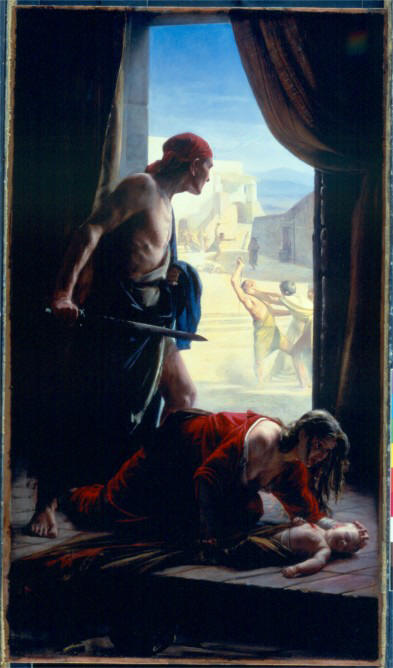
Sermon - Holy Innocents - Matthew 2:13-18
Matthew 2:13-18
Holy Innocents
December 28, 2008
“The Blood of Many – the Blood of One”
I hope you all had a merry Christmas filled with family gatherings, good food, peace and joy, and also meaningful time to ponder the mysteries of God's love in Jesus Christ, the true reason for the season.
Today's sermon, as well as hymns and prayers, are based on the Gospel reading for the day, from Matthew 2. For at least 1500 years the church has observed this strange day in our calendar, commemorating the slaughter of the “Holy Innocents”.
And with all of the “good vibrations” of the Christmas holiday, all the syrupy-sweet warm fuzzies our culture builds into the holiday, and especially here in the church where we celebrate our Savior's birth and focus on its actual meaning.... Still, it's kind of shocking, three days after Christmas, to be faced with such a gruesome story.
We know the background – the wise men from the East came looking for the one born to be king of the Jews. But the current, earthly king of the Jews, a wicked man named Herod, took exception. Through deceit he tried to trick the wise men into leading him to this potential rival. But God intervened, and saved the Christ-child. In Herod's anger and fear for his throne, he ordered that all the newborns of Bethlehem be killed – just to be safe and sure. And once again God intervened, telling Joseph to take Mary and the child to Egypt until Herod's death.
These first martyrs, these first to shed their blood for Christ, were children of the Old Testament covenant, and part of God's family by his grace. They were saved, even from death, by the blood of that other child – the one that escaped. But Jesus would not escape God's wrath. In the fullness of time, that Christ-child, as a grown man, would stand silently before another Herod. He would shed his holy precious blood in an innocent suffering and death to save those children of Bethlehem, and all of Rachel's and all of Adam's children.
In all the grief and mourning that must have followed such an unspeakable slaughter as the murder of those children, there was still hope, because of Christ.
Perhaps your Christmas wasn't all it was cracked up to be. For most people, it's hard to meet that ideal. If even the first Christmas was beset by trouble and sorrow at the death of these children at the order of a wicked man, what makes us think our Christmas will be immune from sorrow, or even death?
But as Christians we know that nothing, not even death, can separate us from God's love in Christ. And that love was made known on earth with a little child born in the midst of a cruel and wicked world. A little child, that gives us sinners hope.
I'd like to share with you an article by Donna Marmorstein of Aberdeen, South Dakota, called,
“Can Death Obliterate Christmas? Ask Herod”:
It's a long quotation but I think you'll find it applies well to our text today, and echoes the same sentiments I've mentioned. Marmorstein writes:
Early in December, when stars seem sharper and bluer than at other times, Christmas music seems to sharpen them even more. I unpack my age-old Christmas record collection. I’ll put on “Goodyear’s Great Songs of Christmas” with Mitch Miller and the Mormon Tabernacle Choir. I’ll brew some cinnamon tea, light a mulberry-scented candle and write Christmas cards. Usually, when stamps, return labels, address book and cards are arrayed before me, the carols swirl up together with the tea steam, and my toes turn warm. A deep, bone-radiating satisfaction takes over. Renewing contact with friends is one of the best parts of Christmas.
But this year something went wrong. It started when I tried to write a Christmas greeting to my aunt. How can you wish holiday cheer to someone who just lost a husband to cancer? Her chance of merriment at Christmas is about nil. My pen froze in midair as I tried to think of something to write. How jolly will her Christmas be, as she tries to mix celebration with grief? And his death will mar Christmases to come. My uncle’s voice, singing every morning as he shaved, now stilled. His jokes, smiles, and positive outlook--all gone.
And what do I write to warm the spirits of friends whose youngest child drowned in a lake this summer? Merry Christmas? Right. Every mall, every shop they enter where toys just right for a 6-year-old boy sit on display will become a torture chamber. No message I write can convey joy without pain. There’s no way around it.
My address book isn’t what it used to be either. Every page has abandoned addresses now. My grandpa, long gone. My grandma, who every Christmas cooked up fudge divinity and sugared walnuts, can’t receive my Christmas greetings now. My other grandma--whose flashbulb ALWAYS malfunctioned Christmas morning--is dead, too, and I would love to feel her knobby, blue-veined hand on mine once more, and watch her “fiddle with” her camera now. Her sister, wise, warmhearted Auntie Faye, died Christmas morning in her sleep at 97. Her address still echoes in my book.
All the expired addresses accumulate, and suddenly ripples spot my envelopes. The candle flickers out, the record player grinds to a halt. Stars blur and fall. The needles on the tree all turn brown and drop to the floor. Death creeps into my address book. It grips my pen and tries to overpower my Christmas. No carol seems able to withstand its ugly claw.
But then the turntable starts up again. The Coventry carol.. [is] ..the only carol I know that mentions Herod’s slaughter of the innocents to destroy the Christ child and, consequently, Christmas. Pain, grief and fear riddled the first Christmas. This problem goes back a long time.
Herod, however, did not have this day. Death does not have this day. In fact, the whole reason behind Christmas was to overthrow the power of death and sin and hell. So when death creeps up and grabs a loved one, Christmas kicks death in the teeth and says, “You can’t keep that one. That’s mine.”
Death, where is thy sting? Stuck somewhere under the mistletoe, I suspect. The needles fly back onto the tree and turn green. Falling stars rise and shine, resharpened. My cold tea steams up again. The candle relights. Appropriate, hopeful words spill from my pen onto cards. And Christmas, if not always merry, is always, always victorious.
And I would add, Jesus is always victorious, and in him we are always victorious. Even in the face of wicked men who seek to harm us. Victorious even over death. Even in the grave we Christians rest secure, for we know the one who has brought peace on Earth and God's good will toward man – Jesus Christ our Lord. In him we are Holy Innocents. Amen
Friday, December 26, 2008
Concordia Theology Videos
http://www.concordiatheology.org/ has some videos posted.... I can't link to them directly. But the second one (August 2008) is interesting. The panel includes Dr. Raabe, Dr. Hermann (a classmate of mine) and Dr. Diekelman (1st VP of synod). Dale Meyer, seminary president, moderates.
This roundtable discussion is on the restructuring proposal. I made some notes as I watched/listened.
Diekelman talks about how as a church body we are in decline, cites the numbers. Says the question the president asked is, "are we best structured to accomplish our mission?"
Meyer asks, "so are there any hard proposals yet?" Diekelman admits they are not final but this is a work in progress.
Raabe wonders if the word "synod" is helpful or not, with its many meanings.
Hermann, too, seems to emphasize that theology should inform our discussions of structure.
Diekelman: we're not changing the constitution or foundations (doctrine, etc), but how do we govern?
Hermann observes districts vary in size, staff, etc...
Raabe makes a good point, that the first quesiton is "what do you want the districts to do" then answer, "how big do you want them to be".
Hermann says how the Lord calls congregations to work together with each other.
Theology is a group process- being together helps us avoid falling for fads of false doctrine, and being lone rangers.
Raabe points to the question of national/local duplication.
Hermann says part of the conversation at the convocation that wasn't in the written report is how local congregations identify with synod, and that maybe that identification would be better with the district than the (national) synod.
Diekelman asks people what they know about the current structure, and observes, "some" don't know. He says as we talk about this, we will re-discover our identity, and then the structure will fall into place.
Diekelman goes on about adult baptisms/confirmations, people who didn't grow up in the LCMS. They won't be familiar with the structure??
Some of the other proposals are discussed. Interesting - the difference between congregations and pastors as "members" but not individual congregational members. The talk is to change it, so that everyone who belongs to one of our congregations will be a "member of synod". Hmm...
Meyer recites the history of the LCMS dealing with "clergy dominance" by maintaining a strict balance of clergy/lay representation.
Raabe supports proposal that doctrinal statements require 2/3 vote. This illustrates consensus.
I'd also like to see it clarified exactly which resolutions are doctrinal, which are binding, and in what way.
Hermann observes "don't just use theology as a boundary or hedge, but allow theology to fashion and form the structure". Pair up strong with weak churches, rather than isolate smaller churches. Honor the weaker. Nicely said.
Raabe: accountability starts on the local level, pastor accountable to other local pastors.
Hermann: Danger of making decisions only on fiscal reasons, but also on theology.
This, to me, is a VERY key point.
Rabbe: We are good at addition, we need to learn subtraction (of the many rules in the bylaws). I agree. Let's streamline.
Hermann: We need to be transparent about which things are matters of money, accountability or doctrine. Why are we doing what we are doing, in each case.
Meyer gets on his soapbox about "relevant" again. I heard him say some things about this at a recent pastors conference which concerned me a little, but that's another story....
Plug for the September symposium, Concorida Journal, etc.... I'm tuning out now.
This roundtable discussion is on the restructuring proposal. I made some notes as I watched/listened.
Diekelman talks about how as a church body we are in decline, cites the numbers. Says the question the president asked is, "are we best structured to accomplish our mission?"
Meyer asks, "so are there any hard proposals yet?" Diekelman admits they are not final but this is a work in progress.
Raabe wonders if the word "synod" is helpful or not, with its many meanings.
Hermann, too, seems to emphasize that theology should inform our discussions of structure.
Diekelman: we're not changing the constitution or foundations (doctrine, etc), but how do we govern?
Hermann observes districts vary in size, staff, etc...
Raabe makes a good point, that the first quesiton is "what do you want the districts to do" then answer, "how big do you want them to be".
Hermann says how the Lord calls congregations to work together with each other.
Theology is a group process- being together helps us avoid falling for fads of false doctrine, and being lone rangers.
Raabe points to the question of national/local duplication.
Hermann says part of the conversation at the convocation that wasn't in the written report is how local congregations identify with synod, and that maybe that identification would be better with the district than the (national) synod.
Diekelman asks people what they know about the current structure, and observes, "some" don't know. He says as we talk about this, we will re-discover our identity, and then the structure will fall into place.
Diekelman goes on about adult baptisms/confirmations, people who didn't grow up in the LCMS. They won't be familiar with the structure??
Some of the other proposals are discussed. Interesting - the difference between congregations and pastors as "members" but not individual congregational members. The talk is to change it, so that everyone who belongs to one of our congregations will be a "member of synod". Hmm...
Meyer recites the history of the LCMS dealing with "clergy dominance" by maintaining a strict balance of clergy/lay representation.
Raabe supports proposal that doctrinal statements require 2/3 vote. This illustrates consensus.
I'd also like to see it clarified exactly which resolutions are doctrinal, which are binding, and in what way.
Hermann observes "don't just use theology as a boundary or hedge, but allow theology to fashion and form the structure". Pair up strong with weak churches, rather than isolate smaller churches. Honor the weaker. Nicely said.
Raabe: accountability starts on the local level, pastor accountable to other local pastors.
Hermann: Danger of making decisions only on fiscal reasons, but also on theology.
This, to me, is a VERY key point.
Rabbe: We are good at addition, we need to learn subtraction (of the many rules in the bylaws). I agree. Let's streamline.
Hermann: We need to be transparent about which things are matters of money, accountability or doctrine. Why are we doing what we are doing, in each case.
Meyer gets on his soapbox about "relevant" again. I heard him say some things about this at a recent pastors conference which concerned me a little, but that's another story....
Plug for the September symposium, Concorida Journal, etc.... I'm tuning out now.
Wednesday, December 24, 2008
Sermon - Christmas Eve - Luke 2:1-20

Luke 2:1-20
Christmas Eve
December 24, 2008
“The Usual and the Unusual Christmas”
A decree went out from Caeser. It was a real time in history. Quirinius was governor of Syria. Nazareth. Galilee. Bethlehem. Real places. Real people facing real problems – travel, taxes, a difficult pregnancy, finding a place to stay.
Joseph dutifully obeyed the authorities. He did what Caesar said. He had no choice. But because he was a righteous man he had given Mary the benefit of the doubt when he had the choice. He would have divorced her quietly. But a higher authority prevailed, and once again, Joseph obeyed. He did his part.
Mary was betrothed and with child. Not quite married, but more than just engaged – still it wasn't normal for her to be great with child and going on a journey. But she too was an obedient to her authorities and to her Lord. She did what she what was expected of her.
What a strange mix of the usual and the unusual this Christmas story is. Everyday people and places and events – with that twinge of something special. A hint of greater things to come.
It's God's way. He uses the ordinary to do the extraordinary. Bread and Wine become the body and blood of Christ – the very medicine of immortality. Simple water becomes a flood of righteousness, washing away every spot and stain of sin. Imperfect pastors (is there any other kind?) speak words that unlock the very gates of heaven, “I forgive you in the stead and by the command of Christ”. The simple doing the extraordinary. The everyday touching the eternal.
And so it continues with the birth of a child. Not an unusual event. Children are born all the time. He was swaddled up lovingly, and carefully laid in a makeshift crib. In our great fortune, we're used to hospitals and sterile precautions. No such measures for most children who have been born, especially back then and over there. Still, Mary and Joseph did what they could to care for this little one, this special infant boy.
And as usual as he was, he was certainly unique. As everyman and everyday – like us in every way, yet this one was different. Without sin. Perfect and holy. In a regular infant we can see shades of the innocence that predates sins, but that's really just in comparison to ourselves. In this extraordinary infant, we see the very image of God – the living word of creation made flesh. The eternal Son of the Father humbled, made low, for us. Always, for us.
What a blessed union of the everyday and the once and for all. A paradox of cosmic proportions – God and man joined in this one person. Unfathomable power and authority placed in the care of these two humble travelers of little means. Indescribable glory and majesty shrouded in the swaddling clothes of a newborn. God's plan for eternal salvation hidden in the peace and calm of a dark night in a small town, long ago.
Yes, the usual meets the unusual, and this is God's way. The baby would grow and learn, as humans usually do. We suppose he learned his father's trade, and did his work, as one would expect. He took care of his widowed mother, as a son did in those days. He observed the religious traditions and practices of a pious Jew, with little hint of being anything more than a carpenter from Galilee. But he was more.
When the time came, things got unusual. He went to be baptized. The heavens opened, and God declared, “This is my Son”. He did battle with the devil – as we all do – but he won, as we cannot and do not. He began doing miracles – highly unusual! He preached a message unlike any other – his words had authority. Perhaps he was the Messiah? But he didn't meet the usual expectations. Instead of triumphant glory, he sought humble service. Riding a donkey instead of a war-horse. Being baptized instead of baptizing. Instead of being served, washing the feet of his own followers.
No, this was not the usual itinerant preacher, the everyday wanna-be messiah that had come and gone so many times before. This is not just another religious leader with yet more rules and regulations for us to follow, laying out yet another path for us to work our way up heaven's ladder. His was a kingdom of grace. And his kingdom would be no regular religion just like any other. It was not of this world.
This Messiah was one who came to die. If we look into the manger and gush over the image of a sweet and pure child, but see no cross, we miss the whole point. If we forget that this precious child came to shed his precious blood for sin, they why are we celebrating him anyway? For this is the perfect and spotless lamb of God, appointed for sacrifice, to take away the sins of the world. This doesn't happen every day. But it did happen on Good Friday. The Christ laid in the manger is the same Christ nailed to the cross. The Christ wrapped in swaddling clothes is the same Christ wrapped in grave linens. The one whose birth was peaceful and humble and ordinary was destined for a death that was violent and humiliating, and.... ordinary. Romans crucified people all the time. Such a death was part of life for ancient Jews.
But then the usual gave way to the unusual once again, and Christ conquered death. And this is his greatest miracle. This is what no one expected, even though he said so.
On this Christmas Eve, we do all the usual things, read the usual readings, sing all the usual hymns, light the candles, like we always do. We'll go home to our regular places at the regular times, and do our holiday traditions in the usual way, with the usual foods, and the usual folks. But through it all, and behind it all, and in it all is our God – present and working his extraordinary salvation. There is nothing common about his grace in Jesus Christ.
May your everyday Christmas be filled with those unique blessings brought by the lamb of God, the babe of Bethlehem, true God, true man, the firstborn of the dead, Jesus Christ. For God so loved the world that he sent us his Son, and believing in him we will not perish, but have eternal life. Amen.
Monday, December 22, 2008
Sermon - Advent 4 - Luke 1:26-38

Luke 1:26-38
Advent 4
December 21, 2008
“Mary's Impossible Faith”
We've had a very busy Advent season. We've heard from John the Baptist. We've remembered the Shepherds and Angels. We've covered all the usual prophecies and themes, we're almost ready for Christmas. But there's another Advent personality we haven't yet considered – Mary. Our lectionary puts her before us today. We read our Gospel text from Luke 1, an event called the “Annunciation”, in which the angel Gabriel tells Mary she will bear the Christ-child.
Let's consider today the words of the angel, the reaction of Mary, and what it all means for Advent, Christmas, and faith. We'll see Mary's faith, and in it, we will see our faith – faith in Mary's Savior and ours – Jesus Christ. We'll see how in Jesus, God accomplishes the impossible, and gives us every reason to respond like Mary, “Let it be to me as you have said”.
No we don't venerate the Virgin Mary like our Roman Catholic friends. Scripture gives us no indication that she was any more or less a saint or sinner than you and I are. She needed a savior like all of us. She is righteous only by grace through faith, like you and I are. Nor is she some sort of extra go-between mediating God's blessings to us. There is one mediator between God and man, the man Jesus Christ.
Still, Mary serves, like all the saints, as an example of faith. Through her life, God brought many blessings to all people. Her role as mother of the Lord Jesus is certainly special, and we honor Mary's memory if only for that. But there is more. Mary, especially in this text, is a shining example of faith in God's word of promise – even over against what seemed impossible.
Contrast Mary with Zechariah. Just a few verses before our reading, Zechariah lost his speech as punishment for his lack of faith, when the same angel told him he would become a parent. But he and his wife were old, and she was barren, and he doubted God's ability to do what he said. Zechariah, a priest, served God daily but didn't trust him when given this extraordinary opportunity.
Mary, for her part, made Zecharaiah look bad. She was not a religious professional, but a young woman- probably about 13 – but she believed the promise the moment it was spoken. She wasn't troubled that an angel appeared, but she was greatly troubled at his greeting. That greeting was, "Greetings, O favored one, the Lord is with you!" Why is this greeting more troubling than the appearance of an angel? Perhaps because Mary knew she didn't deserve God's favor, that she was no one special, and for God to be with her of all people.... well, why her after all?
Why any of us? For in Christ we are all highly favored by God. In Christ, the Lord is with us. One of Jesus' names, “Emmanuel” means just that. God with us.
Mary didn't even seem that bothered that she would bear the Messiah, or that this child would do great things and reign on David's throne. Her only question was how it would happen, not whether it could. Mary believed God when many would have said, “impossible”.
Isn't it interesting that Mary doesn't seem to blink that an angel would appear to her? If Gabriel showed up on your doorstep, I think you might be a little shocked. It might be hard to hear anything he said, much less believe it. But Mary listened to the word of God – and paid attention. She believed it, and wanted to know more. How will this be?
Some questions are sinful questions, and some are the questions of faith. Zechariah's question when he heard the news of his son was one of doubt. “How can I be sure, since my wife and I are old?”. Mary's question, “How can this be, since I am a virgin?” may sound the same, but it was a question of faith. Questions of doubt challenge God, and assume he can't do what he says. Sinful questions which assume we know better than him. But the questions of faith, like Mary's, yearn to simply hear more and learn more and grow in the word of God we receive. And the angel gives Mary her answer.
The answer was sufficient. The power of the Most High would overshadow her, and by his Spirit, she would be with child. With God, all things are possible. “I am the Lord's servant” she replied, “Let it be to me as you have said”. That's Mary's response of faith. That's her saying, “Amen”.
“Let it be to me as you have said” is the response of any faithful Christian to God's word of grace. Your sins are forgiven, “Let it be to me as you have said”. This is Christ's body and blood given for you, “Let it be to me as you have said”. I baptize you in the name of the Father, Son and Holy Spirit, “Let it be to me as you have said”. In Christ, you are highly favored, and God is with you. Let it be to me as you have said.
All along, this was God's plan. Did you notice the connection to our Old Testament reading from Second Samuel? There God promises David to build him a house. In fact, he promises him an offspring who would build the House of God into an eternal dwelling. To Mary, the angel promises her Son will rule on the throne of his father David. Jesus is that davidic king who rules eternally. He builds the house of God, the church, and the gates of hell will not even prevail against it, against us.
This impossible-sounding plan had been coming for some time. When a virgin from Nazareth responded in faith, the plan moved forward. When you respond to the Gospel in faith, it moves further forward. And impossible as it seems, God's word continues to bear fruit, and build his church, living stone by living stone, to stand the test of eternity.
Of all the miracles God did, is there anything more impossible than the virgin birth? You could make a case for the parting of the red sea, or the feeding of the 5000, or any of the great and mighty wonders. But perhaps the most impossible thing is accomplishing our salvation through his Son. Through a baby who was born, a man who suffered and died, and who rose from the dead, just as he said.
With God all things are possible.... according to his plan and promise. With God, all things are possible... for our salvation. With God, all things are possible by his grace, through faith in Christ. Therefore, let it be to all of us as he has said. And may we celebrate the birth of our Savior with joy.
Wednesday, December 17, 2008
Another Battle in the Culture Wars
So our City Council in Racine just approved a LGBT Community Center. You can read the story at the local paper's website here: http://www.journaltimes.com/articles/2008/12/17/local_news/doc49488be844b85734395983.txt
Rather than comment and get lost in the string of sniping back and forth that follows the article, I'll share some thoughts here -
I'm glad there was no taxpayer money used to fund this. I think there is an important difference between allowing something and, through use of state or local public funds, actually promoting it. This is what true tolerance is about - allowing something you disagree with.
Still, if I were a local Councilman, I would have voted against it. If you truly believe that an activity is immoral, then wouldn't you oppose it? For instance, if someone wanted to open a community center that helped people learn how to - oh - cheat on their wives. I would oppose that.
I'm sure there are "haters" on both sides of this issue. But I wish that level-headed people who disagree could talk about it without the emotions flying.
Just because I believe something is wrong to do doesn't mean I hate everyone who does it. I know some very nice people who do some things I don't agree with - even some of my closest friends and family. But they know where I stand, and they also know I don't hate them for it.
In fact, everyone I know does a lot of wrong - we call it sin. Nobody is perfect. We all need Christ's forgiveness. But as a Christian and as a pastor, I am especially concerned when sin is normalized, accepted, and even lauded.
Rather than comment and get lost in the string of sniping back and forth that follows the article, I'll share some thoughts here -
I'm glad there was no taxpayer money used to fund this. I think there is an important difference between allowing something and, through use of state or local public funds, actually promoting it. This is what true tolerance is about - allowing something you disagree with.
Still, if I were a local Councilman, I would have voted against it. If you truly believe that an activity is immoral, then wouldn't you oppose it? For instance, if someone wanted to open a community center that helped people learn how to - oh - cheat on their wives. I would oppose that.
I'm sure there are "haters" on both sides of this issue. But I wish that level-headed people who disagree could talk about it without the emotions flying.
Just because I believe something is wrong to do doesn't mean I hate everyone who does it. I know some very nice people who do some things I don't agree with - even some of my closest friends and family. But they know where I stand, and they also know I don't hate them for it.
In fact, everyone I know does a lot of wrong - we call it sin. Nobody is perfect. We all need Christ's forgiveness. But as a Christian and as a pastor, I am especially concerned when sin is normalized, accepted, and even lauded.
Sunday, December 14, 2008
Sermon - Advent 3

John 1:6-8,19-28
Advent 3
December 14, 2008
“Pointing to Christ”
We all know it's not polite to point at people. Pointing means you're talking about them, and usually not to say something nice. So momma always said, “don't point”.
But every Advent, we have a visit from John the Baptist, whose primary role was as a pointer. He pointed, of course, to Jesus. He talked about, preached about, and prepared the way for Jesus. Even his baptism of repentance for the forgiveness of sins found its fullness in Jesus Christ.
Now John was a popular guy. The gospels tell us “all of Judea” went down to be baptized by him, and while that's certainly a figure of speech, some estimate as many as 250,000 responded to John's preaching. The Jewish leaders were threatened enough to send delegations to John, “who is this guy?” And Jesus himself heaped praise on John. “Among those born of women none is greater than John” You'd think it would all go to John's head.
But he was a humble man. His dress was simple – rough skins, not fine robes. His diet was meager – insects and wild honey, scavenged from his home in the wilderness. His life was a living sermon of sorts.
But more than that, John knew his place. Great as he was, he was still unworthy. He was a sinner. His job was to point to someone greater, more powerful. “After me comes one more powerful than I, the thong of whose sandal I am not worthy to stoop down and untie” John preaches about someone else, talks about someone else, John points, not to himself, but to Jesus. And today in our text, he still points us to Jesus.
John didn't want to be a distraction. He very well could have been. The devil always wants us to take our eye off the ball, or rather, off our savior. And our sinful nature becomes a willing accomplice. That's why we see Christian holidays secularized. It's why we see Christian preachers turn into self-help gurus. It's why we see Christian people more worried about what they can do for God than what God has done for them in Christ. Anything to distract us from the one who sacrifices himself for our us, Jesus Christ.
John says, “Behold, the Lamb of God who takes away the sins of the world”. Look! There's the one you should be looking to, not me! He's the one you should pay attention to. He is the lamb of God, the sacrifice for sin – for all sins – the sins of the world. He will lay down his life to save yours. Oh yes, I baptize, but my baptism is based on him, and derives from him. My preaching is to prepare HIS way. I need to be baptized by him, I'm not even worthy to undo his sandals.
So what about you, fellow Christians? Are you distracted, or are you beholding the lamb of God? Are you tempted to look somewhere else? What's got your attention? Is it your work? Is it your lack of work? Is it your responsibilities at home? Is it a family situation or a health problem? Are you caught up in the day-to-day so much that the Ancient of days is missing from the picture?
Or are you so content with yourself that you don't see the need for the lamb of God? Are your sins not such a big deal? To that, John would preach, “repent!”. For if you don't see your sins, you'll see no need for them to be taken away.
We are so often the ones to bemoan people who take the “Christ” out of Christmas, but in reality we do the same. We take the Christ out of everything, when we live like he doesn't exist, when we make other gods to follow and trust in them. We even foul up the celebration of his birth with our own forms of pollution – bringing our own sinful issues to bear, focusing on our selves and our wants and needs and priorities and NOT on our neighbors and certainly NOT on Jesus Christ.
Hebrews 12 tells us to, “fix our eyes on Jesus”, and that's good advice. That's faith language. In other words, trust in Jesus. Believe in him. Not just in general, but in specific. Trust in his suffering and death on the cross for your sins. Trust in his promises made to you in your baptism, and in his forgiveness offered to you at his table. Believe that he has done ALL the work of your salvation, and that it is finished, as he said. Don't fix your eyes on your own good works and your own victorious life and your own prideful purposes, but instead, fix your eyes on Jesus, who will bring his good work in you to completion.
Jesus was never distracted in his work for you. He kept the goal always before him. He had to be in his father's house. He was baptized to fulfill all righteousness. He was not derailed by the temptations of the evil one. He was not deterred by faithless men who refused to receive him. He set his face like flint toward Jerusalem. He submitted to arrest, injustice, mockery, torture, and execution. Not my will, but yours, O father. He would not be distracted.
But we are not Jesus. We need the reminders. We need to be pointed to him again and again. Even John became doubtful, when he was arrested, he sent his disciples to ask if Jesus really was the one. And Jesus said,
"Go and tell John what you hear and see: the blind receive their sight and the lame walk, lepers are cleansed and the deaf hear, and the dead are raised up, and the poor have good news preached to them.
Open your eyes, and open your ears. What do you see? Jesus acting like the Messiah – because he is the Messiah. Jesus doing the miracles that are his calling card, but more importantly preaching the good news that is his purpose.
If even John the Baptist needed reminding, if even the pointer needed to be pointed again to Jesus, then so do we. Behold, look, see – the Lamb of God, Jesus Christ, who takes away the sin of the world – your sin and mine. Focus on Jesus, your savior, and not on yourself or your sins. Fix your eyes on him, trust and believe in him, and live. That's how to keep the Christ in Christmas, and in every day – by faith.
In Jesus Name, Amen.
Advent 3
December 14, 2008
“Pointing to Christ”
We all know it's not polite to point at people. Pointing means you're talking about them, and usually not to say something nice. So momma always said, “don't point”.
But every Advent, we have a visit from John the Baptist, whose primary role was as a pointer. He pointed, of course, to Jesus. He talked about, preached about, and prepared the way for Jesus. Even his baptism of repentance for the forgiveness of sins found its fullness in Jesus Christ.
Now John was a popular guy. The gospels tell us “all of Judea” went down to be baptized by him, and while that's certainly a figure of speech, some estimate as many as 250,000 responded to John's preaching. The Jewish leaders were threatened enough to send delegations to John, “who is this guy?” And Jesus himself heaped praise on John. “Among those born of women none is greater than John” You'd think it would all go to John's head.
But he was a humble man. His dress was simple – rough skins, not fine robes. His diet was meager – insects and wild honey, scavenged from his home in the wilderness. His life was a living sermon of sorts.
But more than that, John knew his place. Great as he was, he was still unworthy. He was a sinner. His job was to point to someone greater, more powerful. “After me comes one more powerful than I, the thong of whose sandal I am not worthy to stoop down and untie” John preaches about someone else, talks about someone else, John points, not to himself, but to Jesus. And today in our text, he still points us to Jesus.
John didn't want to be a distraction. He very well could have been. The devil always wants us to take our eye off the ball, or rather, off our savior. And our sinful nature becomes a willing accomplice. That's why we see Christian holidays secularized. It's why we see Christian preachers turn into self-help gurus. It's why we see Christian people more worried about what they can do for God than what God has done for them in Christ. Anything to distract us from the one who sacrifices himself for our us, Jesus Christ.
John says, “Behold, the Lamb of God who takes away the sins of the world”. Look! There's the one you should be looking to, not me! He's the one you should pay attention to. He is the lamb of God, the sacrifice for sin – for all sins – the sins of the world. He will lay down his life to save yours. Oh yes, I baptize, but my baptism is based on him, and derives from him. My preaching is to prepare HIS way. I need to be baptized by him, I'm not even worthy to undo his sandals.
So what about you, fellow Christians? Are you distracted, or are you beholding the lamb of God? Are you tempted to look somewhere else? What's got your attention? Is it your work? Is it your lack of work? Is it your responsibilities at home? Is it a family situation or a health problem? Are you caught up in the day-to-day so much that the Ancient of days is missing from the picture?
Or are you so content with yourself that you don't see the need for the lamb of God? Are your sins not such a big deal? To that, John would preach, “repent!”. For if you don't see your sins, you'll see no need for them to be taken away.
We are so often the ones to bemoan people who take the “Christ” out of Christmas, but in reality we do the same. We take the Christ out of everything, when we live like he doesn't exist, when we make other gods to follow and trust in them. We even foul up the celebration of his birth with our own forms of pollution – bringing our own sinful issues to bear, focusing on our selves and our wants and needs and priorities and NOT on our neighbors and certainly NOT on Jesus Christ.
Hebrews 12 tells us to, “fix our eyes on Jesus”, and that's good advice. That's faith language. In other words, trust in Jesus. Believe in him. Not just in general, but in specific. Trust in his suffering and death on the cross for your sins. Trust in his promises made to you in your baptism, and in his forgiveness offered to you at his table. Believe that he has done ALL the work of your salvation, and that it is finished, as he said. Don't fix your eyes on your own good works and your own victorious life and your own prideful purposes, but instead, fix your eyes on Jesus, who will bring his good work in you to completion.
Jesus was never distracted in his work for you. He kept the goal always before him. He had to be in his father's house. He was baptized to fulfill all righteousness. He was not derailed by the temptations of the evil one. He was not deterred by faithless men who refused to receive him. He set his face like flint toward Jerusalem. He submitted to arrest, injustice, mockery, torture, and execution. Not my will, but yours, O father. He would not be distracted.
But we are not Jesus. We need the reminders. We need to be pointed to him again and again. Even John became doubtful, when he was arrested, he sent his disciples to ask if Jesus really was the one. And Jesus said,
"Go and tell John what you hear and see: the blind receive their sight and the lame walk, lepers are cleansed and the deaf hear, and the dead are raised up, and the poor have good news preached to them.
Open your eyes, and open your ears. What do you see? Jesus acting like the Messiah – because he is the Messiah. Jesus doing the miracles that are his calling card, but more importantly preaching the good news that is his purpose.
If even John the Baptist needed reminding, if even the pointer needed to be pointed again to Jesus, then so do we. Behold, look, see – the Lamb of God, Jesus Christ, who takes away the sin of the world – your sin and mine. Focus on Jesus, your savior, and not on yourself or your sins. Fix your eyes on him, trust and believe in him, and live. That's how to keep the Christ in Christmas, and in every day – by faith.
In Jesus Name, Amen.
Sunday, December 07, 2008
Sermon - Advent 2 - 2 Peter 3:8-14

2 Peter 3:8-14
Advent 2
December 7, 2008
“Patience”
There are lots of ways to sin, and many forms sin can take. In this season of preparation for Christmas, perhaps some of those sins take a more prominent place. At this very busy time of year, we can easily become distracted, caught up in all there is to do. Perhaps we grow jaded over time, despondent, and even depressed. Some are just downright crabby. The “Bah Hum” bug bites more than a few of us. What is meant to be a season of joy and peace and hope and love can be, for many, a time of stress and sorrow and conflict and consternation.
Some can't wait for Christmas to come, and some can't wait for it to be over. Which brings us to another common species of holiday sin – impatience. How often anticipation goes sour, and our looking forward expectantly becomes looking forward cynically, perhaps too eagerly, as in, “let's get this over with already”.
Come to think of it, it's not just at Christmas that we are sinfully impatient. Everyday life brings lots of patience-testing. From the car to the grocery store, to the kitchen table, to the cubicle to the classroom to even the church pew – we are impatient at all times and in all places. After all, what is impatience but a form of selfishness. We want whatever we want, and we want it on our time, as in, right now! After all, my time is more valuable than yours, my priorities are more pressing, and my schedule is more important, even if it's only in my head.
And if love is "patient and kind" our impatience and unkindness is unloving, and breaks the command of Jesus.
And so also, our impatience leads us to other sins, and we are short with people – we speak hurtfully. We misplace our efforts and short-change our neighbor in order to get where we're going. We even sin in our thoughts against that person who takes too much of our time.
But it's not just our neighbor on the receiving end of our impatience. We can be, and often are, impatient with God himself. St. Peter says,
But do not overlook this one fact, beloved, that with the Lord one day is as a thousand years, and a thousand years as one day. The Lord is not slow to fulfill his promise vas some count slowness, but is patient toward you, not wishing that any should perish, but that all should reach repentance.
Just as we sin against our neighbor, so do we sin against God. Just as we are impatient with that person, so are we impatient with our Heavenly Father.
When God does not act on our time table, as is so often the case, we grow impatient. When our prayers seem to fall on deaf ears, when our waiting for an answer becomes unbearable. When God's promises seem so far off and hard to believe...
Peter reminds us who sets the schedule. God is not slow, he is patient. Perfectly patient. Sinlessly patient.
Now, some might end this discussion right there – we are impatient, God is patient, so go and be more like God, Amen. But it's not that simple. For our sins of impatience need to be dealt with. We don't get off the hook so easily. A day of judgment is coming, and the very creation will melt before God's holiness, and all the works of sin will be exposed, so Peter also says.
God wants us to repent, and he wants us to be forgiven. Bring your impatience, with all your other sins, to the cross of Jesus Christ. And wait for God's forgiveness – you won't have to wait long! While God is slow to anger, he abounds in mercy. He is patient with sinners like us, who need his constant grace and mercy. He takes the long-term perspective, and he can wait forever.
But he won't. And this too is good news for us who believe. Over the millenia, God's people have prayed the simple prayer, “come quickly, Lord Jesus” echoing some of the last words of revelation. We long for the day of his return in glory, the defeat of all our foes, and the restoration of all things. And yet, he hasn't come yet. 2000 years and counting – must God have forgotten? Perhaps he is just really slow? No, he is patient. We wants all men to be saved. But his patience has an end. The day of Christ's return is appointed, and it will happen.
Just as God remembered his promise to Adam and Eve, and thousands of years later brought forth the offspring of the woman who would finally defeat the serpent. Just as God remembered all his promises to Abraham, Issac and Jacob, to Moses, to David, Solomon and the prophets. Patiently, patiently, promising. And finally delivering. The baby was born. He grew up, and preached, and suffered and died, and rose and ascended, and sits – patiently waiting to fulfill the final part of the plan.
And since he's told us the plan, we see things differently. Since we know all this is temporary, that all our stuff and all our things, and even our earthly life is temporary. Even the sun and moon have an expiration date.... Since all of it will come to an end – that changes our perspective. It focuses us on things above, our hearts and minds are set on Christ. And his Spirit guides us with an eternal perspective. We live “lives of holiness and godliness” not out of fear, but in faith – with an eye of that day, and in grateful response to his merciful patience with us through Christ.
As we wait for Christmas, let us not grow impatient with each other. As we wait for the Lord's mercy, let us not lose faith in his promises. As we repent of our impatience, let our sorrow give way to joy and peace as we cling to his forgiveness in Christ. And as we wait for the day of his salvation – in patience and peace, but also with eagerness, we pray with all the waiting church, “come quickly, Lord Jesus” Amen.
Monday, December 01, 2008
Rev. Torkelson on Restructuring
Dear Blog Readers,
I received the following letter from our South Wisconsin District's delegate to the recent convocation on synodical restructuring. Having heard Rev. Torkelson address this issue in person, and also having grave reservations about the proposals myself, I submit this letter for the benefit of our district and others.
Thanks for your thoughts, Rev. Torkelson!
-Rev. Tom Chryst
___
Dear Brothers in the South Wisconsin District,
As many of you know, a proposal to restructure the LC-MS is rapidly approaching. As the clergy delegate from the South Wisconsin District to the so-called “theological conference” in August, I became convinced, for a number of reasons, that the proposals being set forth for Synodical restructuring were not in the best interest of the Synod’s pastors and congregations.
Among these reasons, I include the following:
1.The theological and Gospel foundations of our current structure were completely ignored in the Conference itself.
2.The proposals, as a whole, point to a greater centralization of Synod and not necessarily a greater sense of our congregational identity.
3.The proposals address the wrong problem—the main problem facing the Synod being disunity and uneven confession of our theology. This hampers missions considerably. A confessional church body will, by its very nature, be a missional church body. (Witness the ecumenical movement as a negative example of this truth).
4.The impetus for restructuring does not emanate from the congregations, but from the Synod’s leaders’ wrong perceptions of the problem in our Synod.
I have been travelling the District, as has President Wille, to measure attitudes toward this process. The response, at this point in time, has been singularly negative, crossing political/theological lines, as well as small/large congregational lines. Suffice it to say, the prospect of restructuring is not a popular one on the grass roots level. Many see this as a power play. Too many times now I have heard pastors tell me that the solution is simple. We simply need to return to the Lord our God through His Word. Unity will come when the pastors and congregations are freed from the constrictions of the national church body to be the mouthhouses of the Lord. Hearing God’s Word rightly, we can do no other than to boldly proclaim Christ’s love in word and deed in our villages, towns, cities, and regions.
To that end, if the LCMS is going to be delivered from such an unwise direction, the Synod’s congregations are going to need to demonstrate to the national church body that any call for restructuring of the Synod must needs come from them (the congregations) and should aim to confess the Gospel as well as our current structure does.
In other words, the congregations need to speak now or forever hold their peace. I am lovingly asking you to consider taking the following steps toward assisting your congregations in avoiding what could be a mistake of absolutely stunning proportions on the part of the national church body.
1.Please go over the proposals with your church councils, elders, and be ready to summarize the problems with your congregations as a whole, utilizing newsletters, bulletins, whatever communication options you have, in order to catechize the laity on the problem.
2.Select a lay delegate to the 2009 District Convention who is concerned not to allow this to continue and be willing to put forth delegates to the 2010 National Convention who feel the same way.
3.Overtures, overtures, overtures. The SWD is one district which is providing a special floor committee dedicated to the topic of Synodical Structure And Governance at its next District Convention in June of 2009. I invite you to “weigh in” in the form of overtures to the District Convention. The more, the better. We cannot receive too many.
With regard to overtures, I ask you to consider the reasons I listed above, as well as your own concerns, in writing your overtures. Please remember that a good overture is short and to the point. What the President of Synod needs to see is a large number of such overtures. Please ask your congregations to consider the overall benefit of weighing in with an overture, as well as your circuits.
Above all, I ask that you pray for our Synod. The proposals on the table will change the Synod at its most fundamental level. This is not merely a “rearranging of the deck chairs” but a centralization of authority which will likely breed further distrust and sap the dynamics that come from a vigorous confession of the Gospel in our congregations and localities. Please pray that the Synod not make such an unwise move as to restructure along the lines it is proposing and that she put the Lord of the Church first in her confession and in her mission.
The Lord bless you all richly this Advent season as you prepare for Christ’s Second Coming and the celebration of His first.
Sincerely in Christ,
Rev. Daniel T. Torkelson, Pastor
Zion Ev. Lutheran Church, Clyman, WI
SWD Clergy Delegate to the 2008 Theological Conference On Synodical Structure And Governance
I received the following letter from our South Wisconsin District's delegate to the recent convocation on synodical restructuring. Having heard Rev. Torkelson address this issue in person, and also having grave reservations about the proposals myself, I submit this letter for the benefit of our district and others.
Thanks for your thoughts, Rev. Torkelson!
-Rev. Tom Chryst
___
Dear Brothers in the South Wisconsin District,
As many of you know, a proposal to restructure the LC-MS is rapidly approaching. As the clergy delegate from the South Wisconsin District to the so-called “theological conference” in August, I became convinced, for a number of reasons, that the proposals being set forth for Synodical restructuring were not in the best interest of the Synod’s pastors and congregations.
Among these reasons, I include the following:
1.The theological and Gospel foundations of our current structure were completely ignored in the Conference itself.
2.The proposals, as a whole, point to a greater centralization of Synod and not necessarily a greater sense of our congregational identity.
3.The proposals address the wrong problem—the main problem facing the Synod being disunity and uneven confession of our theology. This hampers missions considerably. A confessional church body will, by its very nature, be a missional church body. (Witness the ecumenical movement as a negative example of this truth).
4.The impetus for restructuring does not emanate from the congregations, but from the Synod’s leaders’ wrong perceptions of the problem in our Synod.
I have been travelling the District, as has President Wille, to measure attitudes toward this process. The response, at this point in time, has been singularly negative, crossing political/theological lines, as well as small/large congregational lines. Suffice it to say, the prospect of restructuring is not a popular one on the grass roots level. Many see this as a power play. Too many times now I have heard pastors tell me that the solution is simple. We simply need to return to the Lord our God through His Word. Unity will come when the pastors and congregations are freed from the constrictions of the national church body to be the mouthhouses of the Lord. Hearing God’s Word rightly, we can do no other than to boldly proclaim Christ’s love in word and deed in our villages, towns, cities, and regions.
To that end, if the LCMS is going to be delivered from such an unwise direction, the Synod’s congregations are going to need to demonstrate to the national church body that any call for restructuring of the Synod must needs come from them (the congregations) and should aim to confess the Gospel as well as our current structure does.
In other words, the congregations need to speak now or forever hold their peace. I am lovingly asking you to consider taking the following steps toward assisting your congregations in avoiding what could be a mistake of absolutely stunning proportions on the part of the national church body.
1.Please go over the proposals with your church councils, elders, and be ready to summarize the problems with your congregations as a whole, utilizing newsletters, bulletins, whatever communication options you have, in order to catechize the laity on the problem.
2.Select a lay delegate to the 2009 District Convention who is concerned not to allow this to continue and be willing to put forth delegates to the 2010 National Convention who feel the same way.
3.Overtures, overtures, overtures. The SWD is one district which is providing a special floor committee dedicated to the topic of Synodical Structure And Governance at its next District Convention in June of 2009. I invite you to “weigh in” in the form of overtures to the District Convention. The more, the better. We cannot receive too many.
With regard to overtures, I ask you to consider the reasons I listed above, as well as your own concerns, in writing your overtures. Please remember that a good overture is short and to the point. What the President of Synod needs to see is a large number of such overtures. Please ask your congregations to consider the overall benefit of weighing in with an overture, as well as your circuits.
Above all, I ask that you pray for our Synod. The proposals on the table will change the Synod at its most fundamental level. This is not merely a “rearranging of the deck chairs” but a centralization of authority which will likely breed further distrust and sap the dynamics that come from a vigorous confession of the Gospel in our congregations and localities. Please pray that the Synod not make such an unwise move as to restructure along the lines it is proposing and that she put the Lord of the Church first in her confession and in her mission.
The Lord bless you all richly this Advent season as you prepare for Christ’s Second Coming and the celebration of His first.
Sincerely in Christ,
Rev. Daniel T. Torkelson, Pastor
Zion Ev. Lutheran Church, Clyman, WI
SWD Clergy Delegate to the 2008 Theological Conference On Synodical Structure And Governance

Subscribe to:
Posts (Atom)
