Thursday, February 15, 2024

Sermon - Ash Wednesday - John 18:1-11


A blessed Ash Wednesday to you, dear Christians.


We begin the season of repentance known as Lent.  The ashes on our foreheads a stark reminder of the wages of sin – death – that has marked itself on every cell of our body, indeed, our very soul.  But even as ashes was away easily with water, so our baptism has removed the soil and stain of sin from us, and thus also its consequences.  The flesh will die, but we who are in Christ will live, and one day see a resurrection.  The ashes form the sign of a cross, as a reminder that the death that counts is Jesus’ death, and that in that death we have victory over the grave.  So our repentance is not despair.  It’s not just sorrow and contrition for sin, it’s also marked by hope – the only hope the world has ever had – the sure and certain hope that is found in Christ crucified for sinners.  Therefore let us journey to the cross together in repentance and faith, in sorrow for sin, but in joy that springs from sins forgiven. 


Every year our midweek series affords us an opportunity to tread off the beaten path somewhat.  We have considered the 6 chief parts of the small catechism, the 7 churches of Revelation, the animals of the Passion, and many other series.  This year, I’d like to examine some of the minor characters of the Passion account.  You might call them the “supporting cast” if this were a movie.  Through them, each midweek we will delve a little deeper and peel back a few more layers of this rich and captivating story of our Lord’s passion.


And so we start, tonight, in the Garden of Gethsemane, at the arrest of Jesus, with a man named Malchus.


18 When Jesus had spoken these words, nhe went out with his disciples across othe brook Kidron, where there was a garden, which he and his disciples entered. Now Judas, who betrayed him, also knew pthe place, for qJesus often met there with his disciples. rSo Judas, having procured a band of soldiers and some officers from the chief priests and the Pharisees, went there with lanterns and torches and weapons. Then Jesus, sknowing all that would happen to him, came forward and said to them, t“Whom do you seek?” They answered him, “Jesus of Nazareth.” Jesus said to them, “I am he.”1 Judas, who betrayed him, was standing with them. uWhen Jesus2 said to them, “I am he,” they drew back and fell to the ground. So he asked them again, t“Whom do you seek?” And they said, “Jesus of Nazareth.” Jesus answered, “I told you that I am he. So, if you seek me, let these men go.” vThis was to fulfill the word that he had spoken: “Of those whom you gave me I have lost not one.” 10 Then Simon Peter, whaving a sword, drew it and struck the high priest’s servant3 and cut off his right ear. (The servant’s name was Malchus.) 11 So Jesus said to Peter, “Put your sword into its sheath; xshall I not drink the cup that the Father has given me?” ( John 18:1-11)


We know little of Malchus, but surprisingly he is mentioned in all four Gospel accounts.  His claim to fame is that his ear was cut off by Peter in the scuffle that ensued at Jesus’ arrest. Of course, only John’s Gospel tells us that Malchus was his name, or that Peter was the disciple who wielded the sword.  And only Luke’s Gospel tells us that Jesus immediately healed Malchus – perhaps not surprising since Luke himself was a physician.  This was Jesus’ last miracle that he performed before his resurrection!


Who was this Malchus?  And why does John mention his name?  What does the incident teach us about the Kingdom of God and of the Passion of our Lord?  Let’s consider these questions a little further.


Like many of the minor characters throughout the Gospels, Malchus is mentioned by name, as we said, though only by John.  This could be for various reasons.  One is simply, that was his name, and the Gospels don’t shy away from telling us the details of things that actually happened.  These are not fictions or myths, but Jesus was really arrested in a garden that had a name, by men that had names, and there are people who knew them all.  These little details add to the narrative those bits of realism that draw us into the story, but it is a true story, and the names and times and places we are told matter because they are true. 


And since only John’s Gospel tells us Malchus’ name, it could also be that John knew Malchus personally, as it is also indicated that John had some personal connection to the high priest – a connection that got him inside during the trial of Jesus.  Maybe Malchus was that connection.  We also know that the second servant girl who questioned Peter there was a relative of Malchus.


It’s also a tiny detail, but notice John mentions it was Malchus’ right ear that was cut off.  Again, the details like this indicate a true eye-witness account.  And if his ear was cut off, was he perhaps not wearing a helmet, and perhaps, then, not a soldier?  And is Peter, perhaps, just swinging his sword at just the nearest available enemy?


There is also some speculation that perhaps Malchus was known to the early church, to whom St. John was writing, possibly even because he became a Christian.  With the healing of his ear, it’s not a stretch to imagine the incident had a profound effect on Malchus.  But it is just that, speculation and imagination.  We simply don’t know.


We never want to push the narrative of Scripture past what it tells us, and forget the distinction between revelation and speculation.  Even the ancient traditions of the church surrounding these events can lead us astray if not taken with a grain of salt.

What is clear is that Jesus rebukes Peter’s violence.  He doesn’t condone it in general, and certainly not in this case.  This is not how his kingdom comes. 


If it was, Jesus could have called 12 legions of angels – that’s 72,000 or so, to his own personal protection.  One angel could have easily done the job against this bunch.  But Jesus has a cup to drink.  He has a cross to face.  He has a death to die for Peter, and Malchus, and you and me.


Peter’s a slow learner, as are we all.  Jesus already rebuked him, “get behind me Satan!” when he tried to talk Jesus out of going to the cross.  But Peter is still looking for victory and glory and triumph, not suffering and shame and cross.  We, too, often look for another way – our own way – though it may not be violence, it’s always some exertion of our own will, our own plan, our own efforts to make things right – when only Christ can. 


Peter is not the first, or the last person to try and take things into his own hands when it comes to Jesus.  Or to come to Jesus’ rescue, as if he needs Peter’s sword.  But Jesus doesn’t need Peter’s help, or ours.  Jesus is the Savior here.  We do well to remember that.


Another key takeaway here is this: Jesus didn’t have to heal Malchus, but he did.  Even in the midst of his own troubles, in the act of being arrested, Jesus acts in compassion.  While most of us would be distracted by the events at hand, too sidetracked to help poor Malchus, Jesus is not.  Though Jesus faced far worse than losing an ear, still he takes a moment to help this man who surely meant Jesus no good.


The preacher is practicing what he preaches when he says “love your enemies”.  And Jesus doesn’t have to save you, but he does.  In our sins we are, in fact, enemies of God.  Rebellious and impudent.  We are no better than Malchus, or the Jews, or the Romans, or the bloodthirsty crowds crying for his crucifixion. 


But Jesus prays for our forgiveness.  He bleeds for our redemption.  He dies for our healing.  He loves his enemies, loves us to death, to bring us life, and make us his friends.

Now what about that ear?  Why the ear?  Just as it would be wrong of us to drift into speculation and go beyond what Scripture says, nor should we draw any allegorical or symbolic meaning here as some have done:  that Malchus’ ear represents some symbolic refusal to hear and now, after Jesus, we can listen to God’s word anew.  Or that Malchus stands for all the unbelievers who are hurt by the violence of believers.  These aren’t symbolic events.  They really happened.


But they may serve to remind us of such truths.  Jesus is very concerned about who has ears to hear his message.  Paul tells us faith comes by hearing, and hearing by the word of God.  We are, in our sins, spiritually deaf until the Spirit comes and opens our ears to the Gospel.  All of that is true. 


David wrote “create in me a new heart, oh, God….” And we might well pray, “create for me, new ears, oh, God…”  Ears to hear the word with clarity, ears to hear it in all of its truth and purity.  Ears not stopped by pride or distracted by the noise of this world.  Ears that hear clearly the condemning law and the forgiving gospel. 


This Lenten season, let us tune those ears especially to his passion, his suffering, his cross borne for us.  For Jesus drinks the cup the Father has given, for Malchus, for Peter, for you.  Thanks be to God. 
 

Monday, February 12, 2024

Sermon - Transfiguration - Mark 9:2-9


What a strange event was the Transfiguration of our Lord!  Sticking out like, well, a mountaintop, in the midst of the Gospels.  Most of the miracles Jesus does directly benefit someone who is suffering or in need.  But this one is different.  This is a teaching moment.  This is a revelation.

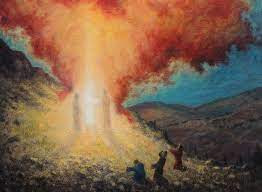
Peter, James and John have front row seats to a spectacular event – Jesus is transfigured before them.  And through their witness, we can peek on in to see it too.  His appearance, his figure, changes.  No longer appearing as your average, every-day, humble Jewish man of the first century.  Now Jesus gets all bright and shiny and glorious.  Even his clothes change, and are elevated to a brightness that is beyond anything of this earth. Normally, just looking at Jesus, you wouldn’t see anything particularly special about him.  But now, here, it’s unmistakable.  The picture speaks loud and clear.

But, look!  It’s not just Jesus!  There’s two other men, too.  Moses and Elijah!  Two of the greatest figures of the Old Testament!  (And as a sidenote – how did the disciples KNOW it was Moses and Elijah?  Perhaps something in the conversation clued them in.  Or perhaps, this is an indication that in glory, we will all be known to one another?)  But in any case it’s clear that Moses and Elijah they were.  And it’s hard to overstate what this would have meant to the disciples.

Moses – the great deliverer of the people of Israel!  The one to whom God appeared at the burning bush and revealed his personal name – Yahweh!  Moses!  The one through whom God rescued them out of bondage in Egypt.  Moses!  Who parted the Red Sea, and led the people through on dry ground.  Moses!  Who met with God on Mt. Sinai, face to face, and experienced such glory that his own face once glowed with borrowed light, and had to be veiled before the people.  Moses received the 10 commandments.  Moses received the instructions for the Tabernacle and the whole sacrificial system.  Moses who died at 120 years of age with eye undimmed and vigor unabated.  Moses who also promised a “prophet like me” would be raised up from among the people.

And then there’s Elijah!  Most famous of the prophets.  Elijah who had the guts to speak against wicked king Ahab and queen Jezebel.  Elijah!  Who bravely stood against the 400 prophets of Baal and mocked them when their false god didn’t answer their prayers, but who prayed simply for Yaheweh to hear and saw fire from heaven consume his sacrifice, his altar, and all the water he had dumped on and around it.  Elijah!  Who heard the voice of God not in the storm or earthquake, but in the whisper of the wind.  Elijah!  Who performed so many miracles, and even a resurrection, maybe the greatest of all the prophets.  And then it was Elijah, with a spectacle of his own, who was taken to heaven on the fiery chariot, as his protégé Elisha looked on. 

For Peter, James, and John, they must have been star-struck.  This would be like meeting two of your idols, two of the founding fathers, like if they had to make a wish to have coffee with any 2 historical figures, they might have chosen Moses and Elijah!  Starstruck, we might say, but Mark tells us they were terrified.

Peter didn’t know what to say, but that didn’t stop him from saying something.  “Lord, it’s good to be here!  Let me put up three tents – one for you, one for Moses, one for Elijah” 

Perhaps he had in mind that the three disciples would just sleep out on the ground.  We can stay and visit for a few days.  Maybe 40 days, Moses likes that number.  I can send John back down to get some refreshments.  Whaddaya say, Jesus? 

But, of course, Peter misses the point.  Jesus was not there to point them to Moses and Elijah.  Moses and Elijah were there to testify to Jesus. The cloud overshadowed them, and the voice boomed from the cloud.  The voice of the Father. And if Moses and Elijah being there was good, now it’s great.

“This is my beloved Son.  Listen to him.” And when the cloud was gone they saw Jesus only.

Listen to Jesus.  See Jesus only.  The message is clear.

The Transfiguration of our Lord Jesus Christ is a feast for the eyes and ears.  We see Jesus a little bit less veiled, a little peek at his true glory, just a tiny glimpse of the divine nature that he’s had hidden all along.  Moses and Elijah appear, to testify by their presence that this Jesus is the one they had been waiting for.  It was toward his coming that they had worked and preached and served.  Everything they did, and even now their appearance on the mount, is a testimony to Christ.

And oh, what the disciples heard!  The conversation with Jesus about his Exodus, his own going- out.  Moses had an exodus, he had THE exodus.  He wrote the book.  Elijah had a pretty fancy exodus of his own.  But the exodus of Jesus was to run through the cross and grave, and then an exodus from death and a glorious ascension to heaven.

Like the disciples, we are easily distracted.  Even with Jesus shining as bright as the sun before them, they are confused and terrified.  As great as Moses and Elijah were, this was all about Jesus.  As great as reveling and basking in the glory of the mountaintop experience might be, Jesus has work to do, down there.  

Jesus had told the disciples already about his upcoming death and resurrection.  He would repeat it several times, ever more plainly as it approached.  The voice of the Father reminds them, and us, “Listen to him.”

Listen to Jesus when he tells you about his mission.  Listen to Jesus when he points you to his cross.  Listen to Jesus when he prays, “Father forgive them” and declares, “it is finished”.  Peter, listen to Jesus when he forgives your denial and charges you to forgive sins on earth that they be forgiven in heaven. And Christians, listen to Jesus when he speaks through your pastor declaring to you your sins are forgiven. 

Listen to Jesus, and see Jesus only.  Moses and Elijah had their place, but only Jesus is our savior.  Only Jesus can save from sin and death and hell by his blood.  Moses and Elijah can’t.  You certainly can’t do it yourself, either.  But Jesus can, and Jesus did.  Listen to him.

The Transfiguration, it is said, was a sign to help prepare the disciples for what was about to happen.  When the come down from the mountain, you might say, it’s all downhill from there.  Jesus sets his sights on Jerusalem, and on his cross.

Lent is upon us, and so we do the same.  We set our sights on the cross – Good Friday, and also the resurrection to follow.

About a year after posting the 95 Theses, Martin Luther took part in a debate called the “Heidelberg Disputation”.  It was there that he began to articulate his famous distinction between the “Theology of the Cross” and the “Theology of Glory”.  And while there’s much more we could say about this contrast, we can see it clearly on display in the Transfiguration. 

Peter is interested in the glory.  Visiting with the great men of old!  Basking in the glory of the mountaintop!  It’s good to be here!  Peter is a theologian of glory – much like we all are at times.

But Jesus is a theologian of the cross.  He knows his true mission, his true work, his true glory – is in bloody sweat and agony on a cross. 

The Transfiguration is not the thing, it’s merely a step on the way to the cross.  The bright shining glory, the majesty and awe – none of it are the thing.  It you listen to Jesus, you’ll know it’s all about the cross.  If you see Jesus only, there you will see your salvation.


Monday, February 05, 2024

Sermon - Epiphany 5 - Mark 1:29-39


The Epiphany season is winding down, as next Sunday is Transfiguration and then we’re right on to Lent.  Throughout these Sundays after the Christmas season, we are presented with a number of different ways in which Christ manifests himself to us.  Different ways he shows himself – different aspects of his identity and mission.  He’s the king of the Jews worshipped by the wise men.  He’s the Son of the Father, recognized at his baptism.  He’s the Holy One of Israel, confessed even by the unclean spirit that he cast out. And he is the one who preaches with authority, to the amazement of the people.  

Today, we might say, in our reading from Mark, we see Jesus especially as a healer.

The Great Physician of Body and Soul, our Lord Jesus Christ is the ultimate healer.  The New Testament records around 42 different instances of Jesus performing a healing miracle, and in some cases as we see at the end of today’s reading, he “healed many”.  He healed leprosy and dropsy, the lame, the blind, the deaf and mute.  The woman with the flow of blood.  “All manner of diseases” Mark says.  And here, also, Peter’s mother-in-law, suffering from a fever.

That Jesus is a healer shouldn’t surprise us.  Of course our Lord, perfect in every way, has compassion on all those who suffer.  He sees people hurting and his heart goes out to them.  And as the almighty creator, he certainly has the power to cure any kind of sickness or disease.  If he can call forth light from darkness, and by a word bring all things into being, he can certainly heal a fever, or whatever is ailing someone.

He does this not only out of compassion, however, but also as a sign of his identity.  For a little later, when John’s disciples come asking if he’s “really the Messiah, or should we look for another?”, Jesus points them to his works of healing as major evidence that he is indeed the fulfillment of their hopes:  “the blind receive their sight and the lame walk, lepers are cleansed and the deaf hear, and the dead are raised up, and the poor have good news preached to them.” (Matthew 11:5)

Jesus isn’t here bragging, but rather showing how his works testify and confirm his identity and his message.  

And yet, his tenderness and compassion are evident.  He goes to Peter’s house, kneels by the bedside of his mother-in-law, takes her by the hand, and gently lifts her to health again.  Without a word, he brings his healing to bear.  Just as he has deep compassion on so many others whom he heals.

It sounds beautiful, but it may raise a question for us.  Why doesn’t Jesus do that for me?

It is a sad fact of life in this fallen world that sickness, disease, injury and death happen to all of us.  Old age takes its toll with aches and pains and this problem and that issue.  Genetics sometimes bring us diseases that cannot be avoided.  The foods we eat and the lifestyles we lead can also contribute, to be sure.  But even the healthiest among us can’t avoid it forever – something eventually gets us.  Whether cancer or heart disease, an accident or just old age.  We are all, all of us, subject to sickness and death.  Sickness and brokenness are just the little preludes to death.  Death is where they all eventually lead.

And this doesn’t happen by accident, either.  Death and its precursors of sickness and suffering – they have a root and a cause.  They are the wages of sin.  The perversion of our physical bodies begins with corruption of the soul.  And while we’d love to blame Adam and Eve for all this, the truth is we are just as willfully sinful.  The apple doesn’t fall far from the tree.

And so while you may not have a certain disease because you committed a certain sin, you are a sinner living in and contributing to the cesspool of this world with all of its spiritual and physical uncleanness.  And the wages that your sin has earned are just as much yours as mine are mine.  None of us can claim we deserve better.

But back to the question I posed.  Why doesn’t Jesus heal us all, just like he did for Peter’s mother-in-law, and for the crowds of Capernaum, and all those other people with their various needs?  I pray earnestly.  I believe faithfully.  I confess my sins and receive his forgiveness regularly.  What gives?  Why must I suffer? 

Well, one answer is that, often, he does heal us.  He provides doctors and nurses and all manner of medical care, especially to us in this modern age.  He has created the human body, also, to heal itself.  And yes, sometimes, he does even heal us miraculously, with no explanation that can be given by science or human understanding.  It does happen, thanks be to God.

But sometimes, he does not.  He allows us to suffer the effects of a chronic or acute illness, and sometimes even unto death.  Sometimes even the young and vibrant among us succumb to an early demise, despite our fervent prayers, and against all our human sense of justice and fairness.

Why does God heal one and not another?  Here we can only say it is part of his hidden counsel, his un-revealed will.  We are not privy to his thoughts, which are higher than our thoughts.  But we dare not sit in judgment over him, or how or when or to whom he chooses to show the mercy of healing this side of heaven.  We pray, humbly, for the sick, “thy will be done”.  We pray for healing, always, according to God’s will.  If the sick are healed and live another day, thanks be to God!  If the sick are not healed, and God allows fallen nature to take its course, he is still the creator and we are still the creatures, thanks be to God.

But there is comfort beyond this.  Jesus is the Great Physician of body and soul.  And that has serious implications.  His power over the unclean spirits indicates that there’s more going on here than just the physical healing.  There’s a spiritual dimension.

Our Lord Jesus Christ has borne our griefs and carried our sorrows.  The iniquity of all was placed upon him.  And God’s will was done.  He faced the wrath of God for sin – and suffered bodily and spiritually, to save us both spiritually and bodily.  And when his work on the cross was complete, and his rest in the tomb was fulfilled, he brought life and immortality to light in his glorious resurrection.  He conquered death.  Let that sink in for a moment.

While it is a mystery why he allows sin and suffering and disease and death to flourish here, now, for a time.  A little while, really.  It is no mystery how the story ends.  For our destiny is foreseen in his own.  Our life is guaranteed by his.  Our eternity is sure and certain in his eternal and unassailable life.

My friends, our hope is really not for this life after all, but in the resurrection.  Our prayers for healing are all answered with a giant YES – in the resurrection.  Our aches and pains and bumps and bruises and suffering and sorrow are all on the clock.  Their time is running out.  Life is on the horizon.  Life that cannot be dampened or darkened by sin ever again.  Life that cannot be tainted by disease or disaster.  Life that is, like Christ’s life, incorruptible, unconquerable, unending and glorious.  He will never die again.  And we who are in him, who are baptized into his death and resurrection, will also win the victory over sin and death in him.

When Christ returns with all his angels, riding the clouds and accompanied by the trumpet call of God…. When this heaven and earth melt away and make way for the new… When Christ calls forth the faithful dead to rise and stand before him, and changes the faithful living in the twinkling of an eye, when all the promises of God and of Christ come true in a flash.  Then life will be ours in its fullness – never to be taken from us.  And our life will be in him, and with him, and what a life it will be.  No more hunger or thirst, no scorching heat, we will see him face to face, and God himself will wipe every tear from our eyes.

That’s the healing he brings.  That’s the healing we have as a sure and certain hope, in Jesus Christ, the light and life of men.  That’s the healing that the unbelieving world doesn’t know, and cannot understand.  But it is the healing that we will surely receive and that we now boldly confess.  Healing from Jesus Christ, healing for not just our sins, but for our sin-sick souls and bodies.

So come receive the medicine of immortality, the body and blood of Christ, a foretaste of the feast to come, and a glimpse of our hidden life with him.


Monday, January 29, 2024

Sermon - Epiphany 4 - 1 Corinthians 8:1


Knowledge puffs up, but love builds up.  (1 Cor. 8:1)

Our modern world is sometimes called the “Information Age”.  We have more knowledge at our fingertips than ever before, just say “Hey Siri” or “Ok Google”.  Our children can hardly imagine what it’s like to have to look something up in an encyclopedia, or stop and ask for directions, or just be content not knowing something that you can now so easily ask of the little device in your pocket.  But knowledge isn’t always what it’s cracked up to be.

Sometimes we talk about “information overload” and “cutting through the noise”.  Information may not be reliable – we have fact-checkers and fake news and your truth and my truth.  People say it’s one thing to have knowledge, it’s another thing to have wisdom.  And there’s some wisdom in that.

As Christians, let us ever turn to God’s Word for both knowledge and wisdom.  And let us keep each in its proper place, and for its proper purpose.  And let us consider, today, what God has made known to us in Christ, and be amazed at his teaching.

I think Messiah is one of the better-educated and, if you can say so, “smarter” congregations out there.  We have doctors and engineers, and all manner of professional people, business owners and the like.  We have, compared to many congregations, I believe, a solid theological foundation.  We love and appreciate our history and our doctrine as Lutherans.  We have a rigorous confirmation program and we run a classical school.  Knowing things is important to us.  Knowing the truth is highly valued here.  But do we have a weakness?

Paul says that knowledge “puffs up”.  In other words, we humans are often tempted to become prideful, in particular about our great trove of knowledge.  This can work a number of ways.

We can become a little too puffed up in our knowledge, thinking we know better than we actually do.  We can become stubborn and obstinate in a hardened position, which is not quite right.  And our so-called-knowledge can lead us to pridefully close our ears to godly correction.  I know better.  I don’t need to be taught.  This is a dangerous attitude.

Or, we can simply become prideful and puffed up in what we do know – even if we are right!  And look down on others, despising God’s children who don’t know as much as we do.  We can feel self-satisfied with our great knowing, as if it makes us better than others.  Another dangerous, sinful, attitude.

Everything we know is by God’s grace.  Everything we have been taught, that is true, is a gift from him. But whatever we know that is wrong, is confusion sown by our own flesh, the sinful world, or the devil and his minions.  There are so many ways to go wrong when it comes to “knowledge”.  For we sinners excel at going wrong.

In fact, knowledge itself was part of the first temptation to sin – that Adam and Eve would have the “knowledge” of good and evil.  Well, they did learn a bitter lesson by their rebellion, a sort of knowledge I suppose.  But it is a lesson we’d all prefer they never undertook to learn, a knowledge we’d all be better off if they had not known it.

And add to that, knowledge itself doesn’t save us.  “Even the demons believe and shudder”, that is, the demons have the facts.  The demon in our Gospel reading knew exactly who Jesus was, the Holy One of God.  But such knowledge did him no Good.  The devil knows God’s word, better than we humans, it is often said.  But he hates God nonetheless.

And there are many today, even fancy-pants scholars with alphabets after their names, that “know a lot” about Christianity, and the Bible, and perhaps even about Jesus – but their knowledge gets them nowhere, because they have no wisdom, no love, no faith.

Knowledge and reason can even become an impediment to faith if we make them the judge of God’s word.  If we say, “oh, that can’t be Christ’s body and blood in the sacrament, because it doesn’t make sense” or, “Baptism can’t wash away sins or really do anything for you, because you have to be able to understand!” 

But who can plumb the mysteries of the Lord’s Supper?  Who can understand it?  That this bread and wine are Christ’s body and blood?  We can only faithfully confess it to be what Jesus says it is.

Who can take Baptism apart and put it back together?  Rather, we spend a whole lifetime learning its benefits, daily renewed by repentance and faith.  These sacraments are not to be understood in the sense of knowledge, as if we are their masters.  They are to be known and confessed as the blessed gifts that they are. 

The fear of the Lord is the beginning of knowledge, Proverbs tells us, so let’s back up the truck and start there.

The first thing the Lord would have us know is our sin.  Luther rightly begins his small catechism with the 10 Commandments.  There we look and see a glaring mirror, showing us the many ways we fail to love God or our neighbor. 

But he does not leave us with that knowledge only.  He does not let us sit around in the sackcloth and ashes of repentance, the muck and mire of our own filth.  He pulls us up and out and gives us a firm place to stand.  He sends his Son, Jesus, to destroy the forces of evil, to teach us the Gospel of his kingdom, and to bestow on us the true knowledge and wisdom unto salvation.

Paul writes,

20 Where is the one who is wise? Where is the scribe? Where is the debater of this age? Has not God made foolish the wisdom of the world? 21 For since, in the wisdom of God, the world did not know God through wisdom, it pleased God through the folly of what we preach to save those who believe. 22 For Jews demand signs and Greeks seek wisdom, 23 but we preach Christ crucified, a stumbling block to Jews and folly to Gentiles, 24 but to those who are called, both Jews and Greeks, Christ the power of God and the wisdom of God. 25 For the foolishness of God is wiser than men, and the weakness of God is stronger than men. (1 Corinthians 1:20-25)

And a little later,

And I, when I came to you, brothers, did not come proclaiming to you the testimony of God with lofty speech or wisdom. 2 For I decided to know nothing among you except Jesus Christ and him crucified. (1 Corinthians 2:1-2)

For the Christian, the most important thing to know is Jesus Christ and him crucified.  And to know it, not as a fact or an intellectual exercise, but by faith.

Yes, we must know our sins, so that we know our need for Jesus.  Yes, we should learn everything that he has commanded us, and keep it, indeed the whole counsel of God.  Yes, we should always seek to learn more, know more, to grow in the knowledge of God just as young Jesus himself did.  

We are not anti-intellectual. But we must never consider our own knowledge something to boast about, or consider ourselves above teaching and reproof.  God’s word teaches humility, and that should include intellectual humility.

And so here it is, today.  Know this, dear Christian.  Though you sin daily and sin much, God loves you, and has sent his Son, Jesus, the Holy One of Israel.  We preach Christ crucified – for you.  He has come to destroy the powers of darkness.  He has come to bring God’s love to bear on you, that you might be saved, and therefore also love your neighbor.  He has not come to puff you up with knowledge, but to build you up with his love, for yourself, and for your brother.

Lord, let us consider what right knowledge we have as a gift from you, and use it only, ever in faith.  May we grow in the wisdom of your word, and not in the wisdom of this world.  Amaze us with the teaching of Christ crucified for sinners, and let us always abide in the knowledge of his salvation. 


Monday, January 22, 2024

Sermon - Epiphany 3 - Jonah 3:1-5, 10

 Epiphany 3 – January 21, 2024

National Lutheran Schools Sunday

Today we welcome the children and families of our school, MLCA as part of our annual “Lutheran Schools Week” observance.  Messiah operates one of about 2600 Lutheran schools – and our church body still has more parochial schools than anyone else except the Roman Catholic system.  And so we have our school children here today to assist us in worship with their voices, and we add to our prayers, especially today, thanksgiving to God for the blessing that MLCA is to our congregation.  We pray we are also a blessing to all whose lives are touched by our work together here.  Just as we talk about our church as a family, MLCA is also part of our extended family.  With great joy we get to know our school families and students and share the love of Christ even as we teach these young people history, grammar, and math.

Today we also continue our journey through the Epiphany season, and another Sunday which emphasizes God’s calling – both Jesus calling his disciples, and in the Old Testament, God calling the prophet Jonah.  Since the Jonah story is one loved especially by children, I thought we’d turn our attention there at this time.  But even us big kids can enjoy the Jonah narrative and see in it God’s call to repent and believe, and be saved – that same call that comes to us through God’s servants today – that call to repent and believe in Jesus Christ our Savior.

Someone asked me just the other day what my favorite passage of the Bible was, and I suppose that’s like asking me which is my favorite child or my favorite song.   But I have to admit the book of Jonah has always been near and dear to me.

Jonah is just such an unlikable personality.  Not only does he foolishly try to run away from God, taking a boat in the opposite direction of where God told him to go preach.  But he also repeatedly whined and cried when he didn’t get his way.  What a drama queen!  Woe is me!  You might as well kill me now!  

Today’s reading is just a few verses from the Book of Jonah, but the whole thing is only 4 chapters long.  I suggest you read it for yourselves! (homework, children!)

But as we read it we find out exactly why Jonah is such a reluctant prophet.  We are told exactly why he didn’t want to go preach to Nineveh.  The reason is this:  He didn’t want God to forgive them!

You see the people of Nineveh were particularly wicked.  This was the capitol of the Assyrian Empire, the one that would destroy the Northern Kingdom of Israel and at whose hand the 10 “lost tribes” really became lost to history.  The Assyrians were brutal conquerors, killing women and children as well as the men, and hauling off whole populations of captives to make them their slaves.  They were pagan people, unbelievers, people who didn’t know or believe in the true God, Yahweh.  And so, in Jonah’s mind, they didn’t deserve God’s grace and mercy.

Ah, but Jonah, that’s just the problem!  None of us do.  All of us are full of sin, and in our hearts no better than the worst of the Ninevites.  We may make a good appearance of it on the outside, but the sinful heart is just the same.  In fact, no one deserves God’s grace and mercy.  That’s the whole point of it being grace and mercy.  

And so finally, Jonah goes to the city of Nineveh and preaches as God commanded him.  He spent three days preaching this short sermon, “Yet forty days, and Nineveh will be destroyed”.  In the Hebrew it’s just four words.  

Now we all know about the miracle of the great fish or whale that swallowed Jonah when he was taking a boat in the other direction.  And then after 3 days the fish spit him up on land, safe and sound, though probably a little smelly.  A great wonder and sign from God, and we’ll talk about that a little more in a minute.  But that’s not the most amazing miracle of the Jonah story.  The most amazing part is what we read today.  That after Jonah’s short sermon, the people of Nineveh listened!  They repented!  They turned from their evil ways and begged for God’s forgiveness!

My friends, it is a difficult thing to tell someone they are wrong.  It is hard to show people these days, perhaps especially, that they are sinners.  But God’s word endures forever.  And the same message of law and condemnation that Jonah preached to the Ninevites, is preached by faithful pastors today.  If you do not repent, you too will perish!  If you do not turn from your wicked ways, God will bring his punishment to bear on you – maybe not in 40 days.  But sooner or later.  The soul that sins shall perish.

And we need to hear this hard word of God.  This is why we teach our children the 10 commandments.  So they not only know what God expects, but so that they can see their sin, and their need for a Savior.  If you never know you’re a sinner, what do you need a savior for?  If no one ever told you the bad news, the good news wouldn’t make sense.  

Part of the great miracle here is that the Ninevites heard the call to repentance, and they repented!  From the king on down, even the animals were dressed in sackcloth.  They mourned their sins.  They begged for God’s mercy.  And much to Jonah’s displeasure, God showed them mercy.  Only God can turn hearts like this.  Only his word has the power.

Well, maybe the even greater miracle is this, and it’s so understated in the reading, “and God relented”.  God did not give them what the deserved.  He changed his course.  He went back on his threat.  He had mercy.

Sometimes I will pose the question to people this way, “Will God ever go back on his word?”  And most Christians instinctively say, “NO!”  But here is an example of it.  Your knee jerk reaction is right, God will never go back on a promise.  He will never fail to follow through on a blessing.  But he will sometimes relent from a threat.  And it’s not because he isn’t just.  It’s just that his justice is done another way – the punishment is borne by another target.  Jesus Christ takes the punishment that Nineveh deserved, and that we deserve.  And so by grace, through faith, we receive the benefits.  By the power of God’s Spirit working in his word, we are BOTH called to repentance, and receive mercy.  And this is the great miracle of Jonah’s story, and of ours.  Not being saved from the belly of a fish, or from drowning in the deep, but from sin and death and hell by the blood of Christ.

The last chapter of Jonah has him stomping outside of the city to sit and watch and wait, hoping God would destroy Nineveh maybe like he did Sodom and Gomorrah.  Send down some fire and brimstone on the bad guys, God!  Give them a good what-for.  Destroy them like their sins deserve!  But Jonah was disappointed that God showed them mercy.

Jonah was a preacher of God’s word quite in spite of himself.  He didn’t want to warn the Ninevites of their coming destruction.  He didn’t want them to turn from their sins and live.  And he certainly didn’t want them to hear the good news of God’s grace and mercy.  But Jonah also preached in spite of himself in another way.

Jesus once referred to the Jonah story.  When his enemies were looking for a sign, Jesus said, “You will receive no sign from me but the sign of Jonah.  For as Jonah was in the belly of the fish for three days, so the Son of Man will be three days and nights in the heart of the earth.”  Jesus saw Jonah’s fish miracle as pointing to his own resurrection.  And we better listen to Jesus when he interprets the scriptures.

Jonah was a terrible person, and not a very good preacher.  He hated his hearers.  He preached as short a sermon as possible, grudgingly.  He whined and complained the whole while.  And yet God used him to save many people.  He used Jonah to call many people to repentance, and even to point people to Jesus, even thousands of years later.

Our God continues to call preachers and pastors and all manner of people to speak his word to us.  This is a big part of what we do at MLCA, and it’s absolutely central to what Messiah Lutheran Church is about.  And it is through that message that God works, in spite of imperfect messengers.  It is through both the call to repentance and the promise of mercy in Christ, that God saves people even today.  Even wicked, terrible sinners like the Ninevites of old.  Even poor miserable sinners like you and me.  

He calls people who think they’re in pretty good shape, spiritually, showing them a shocking diagnosis of terminal sin.  He calls people who know the weight of sinful baggage, and may think its too much for even God to forgive.  He calls us to turn from our sins, and to turn to Christ in faith and live.  And he shows us mercy. In Jesus Christ, our Lord.  Amen.


Tuesday, January 16, 2024

Sermon - Epiphany 2 - John 1:43-51

One of the themes set forth in today’s readings is the importance of “vocation” or “calling”.  God calls people.  He calls us, first of all, to faith. He also calls us to various offices or roles.  

Samuel was called by God as the last of the judges, even when he was just a boy.  Nathanael is called to follow Jesus as a disciple, and later one of the 12 apostles.  And we have so many other examples in Scripture – Jeremiah, Isaiah, Ezekiel, David, Abraham, of course the 12 apostles, even St. Paul – are all called by God to serve in various ways.  Today we will focus especially on Nathaniel as an entrée to this idea of vocation.

Then there also is the Epiphany emphasis, the unfolding of Christ's identity – as the one who calls, the one who knows all, the one about whom the prophets wrote, the man from Nazareth, the Son of God, the King of Israel, and the ladder to heaven. That's a lot to cover, so let's get started.

When Jesus calls us to faith, much like when he calls the disciples, he also calls us to service. The call is “follow me”. First, this invites a trust in him as one worthy of following. But more than physically following him, they would follow him by faith. They would become Christians. And because of that, they would follow him, even to death.

We, too, have been called to faith. We confess as much in the Small Catechism, concerning the Holy Spirit – who has called me by the gospel. I can't believe in Christ of my own reason or strength. I can't decide for myself to follow him, as my will is bound in sin. The Old Adam in us is at war with God and in rebellion against him. There's no reason to think we'd follow him, believe in him, or trust him. We might well use Nathanael’s question, “Can anything good come from… me?”  And of course, that answer is, “no!”

But God breaks into that with his calling – the Spirit calls us to faith, just as Jesus called those disciples to follow. And by this Gospel call, grace is extended to us, each of us, and we are saved.

The call to faith is never alone, just as faith is never without works that follow, so the call to faith is always coupled with a call to serve. In the case of the apostles, Christ called them to serve in a very particular way – first as disciples and witnesses, learning and observing everything for 3 years - then as preachers and even fathers of the church, through whom he would build and establish his body on earth.

But the call to you and me also comes with work to do. For all Christians are servants, first of God, but also of one another. All of us have a place in the body, a calling to fulfill, a role to play. These vocations – husbands and wives, parents and children, teachers and students, preachers and hearers... all Christian vocations are callings from God to be done in faith and for the benefit of our neighbor. Faith doesn't sit in the vacuum. Faith is active and living. It seeks to fulfill its calling.

Sometimes God calls individuals personally, immediately, like he did for Samuel.  But that’s rather rare.  Notice how, even when Jesus calls Nathanael, he uses a go-between. Phillip, who himself had just been called to follow, now calls yet another. So also, we are called by the Spirit through the agency of another Christian. Perhaps it was your parents who taught you the faith. Maybe a pastor or teacher. Maybe a faithful friend or neighbor. Or perhaps a whole congregation.  Sometimes we are the Phillip. Sometimes we are the Nathanael. Sometimes we are the one who invites others to hear and follow Christ – to come and see. Sometimes we are the ones being called.

The calling of Nathanael also teaches us that Christ's call to faith is by grace. What was Nathanael doing when Jesus called him? Sitting around, under a tree. What qualifications or bragging rights did he have? What mighty works or holy credentials? Nothing we are told. Although, Jesus did pay him a high compliment – he called him a true Israelite in whom there is no deceit. High praise compared to the many in Israel who were full of deceit.

When it comes to deceit, self-deception is among the worst of it. If we say we have no sin, we deceive ourselves, and the truth is not in us. But here was Nathanael, who appeared to be a true believer – waiting, like all true believers of old, for God's promise of the Messiah to be fulfilled. A true Israelite would have humbly acknowledged his sin, and sought the mercy of God for his salvation. And this true Israelite would find it in the one who now called him.

That calling also leads to confession. At first, Nathanael was skeptical. What good can come from Nazareth? Perhaps he knew that the Messiah was to be born in Bethlehem. What good can come from the son of a carpenter? But little did he know, this was truly the Son of God. Until he did. When Jesus demonstrates his divine knowledge to Nathanael, the new disciple confesses just that – that this Rabbi is the Son of God!

Notice all the titles Jesus receives in this brief reading: Messiah. Rabbi. Son of God. Son of Man. It's the Epiphany season, after all, so why not mention some of the many aspects of who Jesus is?

He's the Rabbi, the great teacher. He has something to teach us – namely, the Word of God. He knows it like no one else does. He fulfills it like no one else can. Indeed, these scriptures are they that testify to him. He would spend years teaching these hard headed disciples he had just called, and only after his resurrection, by the power of the Spirit, would they come to understand so much of what he had been teaching them.

He's “him of whom Moses in the Law and also the prophets wrote”, that is to say, the Messiah. He is the one, the anointed one, set aside to save his people Israel. He's the one and only savior, who does what no one else can do. And he was appointed to this from the very foundation of the world. He's the fulfillment of their hopes and expectations. He's the one the prophets saw from afar, now arrived, in the flesh. Jesus himself would teach us of the scriptures, “these are they that testify to me”.

He's the Son of Man. He is a true man, like us in every way yet without sin. He is the one man, in whom all men are represented. He is the one man, to become the scapegoat for all men's sin. The one man to bear the iniquity of us all. That as in Adam all men fell into sin, now in the one man, the Son of Man, Jesus, all men would be saved.

He's the Son of God. Not just a favorite or high ranking son. The only Son of the Father. Not a created offspring but the eternally begotten Son.

And it is important that the Messiah be both Son of Man and Son of God. Man, to live and die for us. God, to conquer death for us and have it count for all of us.

But there's one more moniker or description of Jesus in this reading – and it is from Jesus himself. He identifies himself as the ladder or stairway to heaven.

Remember Jacob's dream as he left the promised land to flee from his angry brother Esau and to find his wife and fortune in the land of Padan-Aram, in the house of his uncle Laban. On his way, he stopped to sleep and with his head on a rock – had a dream of a stairway to heaven, angels ascending and descending on it. God reiterated to Jacob his promises to Abraham, and that this land would be his and his offspring's. Though Jacob was about to go away for some time, God would be with him always.

Jesus uses this story, of which a true Israelite like Nathanael would have been very familiar, and he applies it to himself. He says, “Hey Nathanael. You think it's so great that I showed you a little divine knowledge. You'll see greater things that that. You'll eventually come to see that I, the one standing before you, that I am the very stairway to heaven. That it is through me and only through me is heaven is opened to sinners.”

Heaven is opened at Jesus' Baptism and Transfiguration, as the voice of the Father confirms his Son. Heaven is opened to receive Christ's Spirit, when he commits it to the Father in death. Heaven is opened to receive the resurrected and glorified Christ, as he ascends there to regain his rightful place. And in Christ, heaven is opened to us his people, for he has promised to prepare us a place and to come to bring us there.

And so, we are called to faith, called to service, and finally called to heaven – all through Jesus Christ – who we, like Nathanael, confess as Rabbi, Messiah, and Lord. He is the one worthy of following, both in this life and even unto death, and through the grave to a resurrection and eternity with the Father. Be faithful to your calling, Christians, for he is always faithful to you.


Monday, January 08, 2024

Sermon - Epiphany (Observed) - Matthew 2:1-12


Today we observe Epiphany, the Christmas of the Gentiles, as it is sometimes called.  An “epiphany” is a manifestation or appearance.  It’s something that shows up abruptly.  Like a sudden realization, “oh, he’s had an epiphany!” or a light switched on in a dark room.  The “Epiphany of our Lord” is the day in which the world comes to recognize that the Christ has appeared on the scene.  And these wise men from another country stand as apt representatives of the gentiles – the nations – in coming to worship the king of kings. 

And as St. Matthew tells the story, the other prominent character is King Herod, who ruled Jerusalem at the time. 


 “Herod the Great” he was called.  A king who ruled the Jews on behalf of the Romans.  He built great monuments and cities and fortresses.  Most famously, he did a major renovation of the temple.  He came to power because his father was chummy with Julius Caesar, and he had already ruled Israel on behalf of the Romans for some 30 years when the wise men showed up.   


But Herod was also a bad dude.  A tyrant.  A scoundrel. He ruthlessly stamped out any possible threats to his throne, including executing family members on several occasions.  So when these strangers from the East come to town asking “where’s the new king?”, you can see why Luke’s comment here is understated:  “Herod was disturbed, and all Jerusalem with him”.  If Herod is disturbed, everyone is disturbed.  If Herod has it in him to execute even his own wife, then no one is safe from his paranoid wrath.   


But he was a schemer, too.  Wise and slick, not one to just smash indiscriminately.  So he had a plan.  He would turn these wise men into his fools, make them unknowing spies to do his bidding.  “Go find the child, and then tell me so I can worship him, too”.  But crusty old Herod had no intention to worship.  He just wanted rivals and threats out of the way.  We know it, because once the wise men gave him the slip, he ordered the slaughter of all the boys of Bethlehem in order to rule out any possible challenger to his power.  Better safe than sorry, he must have thought. And the children paid the price for his cruel pragmatism.  What a dark chapter in the Christmas story.

And perhaps no one represents the darkness of this world more than Herod.  Concerned with himself only, his power, his position and status.  Willing to sacrifice anyone and anything to get and keep what he wants.  Ready to lie and cheat and steal and scheme.  And no friend to God, or to Jesus.  Herod is the Old Adam on steroids, or perhaps just unleashed with the perfect opportunities. 


When reading a story, including a Bible story, it’s natural to “read yourself in.” To identify, perhaps even subconsciously, with a character or characters in the story.  We can often relate to the disciples, who didn’t quite understand what Jesus was about.  Or one of the people that came to Jesus with a need or a request, like we so often do. 


Here, in the Epiphany account, we might think of how the wise men felt, or sympathize with their eagerness or joy.  We might think of the gifts we would bring the baby Jesus.  But how often do we see ourselves as the villain?  Can we identify with Herod?  Let’s try those shoes on for a change. 


We may not murder others to serve our own purposes, but the thoughts of our heart are just as dark.  We may not scheme and schmooze quite like wiley old Herod, but we do our best to get our own way.  We may not have a kingdom or a throne, but each of us wants to be in charge, call the shots, set the agenda.  We set aside the law of God and get to writing our own rules, that we can surely live by.  We want to be king.  We want to be, dare we admit, even, we want to be our own god.   


But the light shines in the darkness. The Christ, the king, is born.


The birth of Jesus threatens everything that Herod is, but not in the way Herod thinks.  Jesus didn’t appear to bring a tyrant off the throne, or to establish a kingdom of his own (at least not a kingdom of this world).  He didn’t have to take on human flesh to do so – as the Lord raises and humbles human rulers in due course throughout history.   

But Jesus did come to destroy sin and the power of death.  He did come to free people from its bondage and tyranny.  He came to bring light in the darkness of a world full of Herods and to every sinner who is a little Herod-at-heart.  He comes to de-throne your old Adam and take your heart as his own. He comes to be your good king.


Christ’s kingship is quite different from Herod’s.  Herod built, or renovated the temple over many years.  Jesus said, “destroy this temple and I will build it in three days”.  Herod was made king of the Jews by the Romans.  The Roman governor wrote the sign for Jesus’ cross, “This is the King of the Jews”.  Herod surely wore the fine garments of those who live in kings’ palaces.  Jesus was stripped of his garments, and they were divided among the soldiers.  And surely Herod’s crown looked nothing like the twisted thorns with which they crowned our Lord.   


Jesus didn’t destroy us when we were his enemies as wicked Herod killed the babes of Bethlehem, or even his own wife.  Rather, he dies for his enemies, forgives us, redeems us by his blood, and makes us children of God!  No, his kingdom is not of this world, but what a kingdom he is!  See how he shepherds Israel!  By laying down his life for the sheep!  And he extends this kingdom not by the sword, but by the word – the gospel – turning hearts and shining the light of Christ. 


And Epiphany reminds us it’s not just the Jews that receive this king.  Sure the angels told the humble Shepherds where to find the infant Jesus.  But the wise men are brought by a mysterious star. 


Men of some wealth, perhaps even kings in their own right, come to humbly worship the one born king of the Jews.  They had the means to make the journey.  They had the resources to bring him precious gifts:  gold, frankincense, myrrh.   


But more than that they had the wisdom to know that this child, this king, is someone special.  Someone to be worshipped. 


Matthew doesn’t tell us much more about them, but that they were “from the East”.  Perhaps they came from the same country, perhaps they represent different areas.  Perhaps they were Persian, or Babylonian, or from some other long-forgotten tribe or nationality. 

But their uncertain origin is actually perfect, because it doesn’t matter.  The nations, all the nations, will come to worship this king.   

And so therefore also us.  We come from near and far, from the East and the north and south and west.  We would be wise – unto salvation, and so we come to worship this king.   


And what is the worship, the true worship of this king?  It is faith in his word, trust in his promise, it is, strangely, simply receiving his gifts.  It is hearing his word and confessing sins which he forgives.  It is taking and eating and drinking of the meal he provides, and believing it does what he promises. 


Yes, we bring our own treasures, humble as they may be.  But these are a response to his precious gifts.  For all the gold or frankincense or myrrh, or even all the dollars in the world, can never compare to the blood of Christ, the forgiveness of sins, and the eternal life that he brings. 


Wicked king Herod can’t hold a candle to our dear King Jesus, the light shining through the darkness of this world.  Even the people that walked in darkness have seen his great light.  The glory of Israel, the light to the nations, Jesus Christ our king, or shepherd, our Lord.  Lord grant us the wisdom to worship him, and lead us always to where he is, that we might share in exceedingly great joy. 

Tuesday, January 02, 2024

Sermon - Christmas 1 - Luke 2:22-40


The Presentation of our Lord and the Purification of Mary

Today, we have the epilogue of Luke’s nativity account,  with the story of Joseph and Mary bringing the infant Jesus to the temple just 40 days after his birth.  Bethlehem isn’t far from Jerusalem, and so they made the short journey to the temple and did all that we prescribed for them to do as good observant Jews.  We’ll look at that a little bit first.  And then the Holy Family meets Simeon and Anna, two elderly saints who sing and tell of their joy at seeing the infant Messiah.  We echo their song and their words today.  2 Ceremonies, and 2 witnesses, all of it pointing us to Christ, our newborn king.

We really have 2 ceremonies that were done together here.  The one is the purification of Mary after giving birth to a son.  Like all Jewish women, the process of childbirth made one ceremonially unclean.  And so, at a certain time after the birth, she had to come and make a sacrifice at the temple, and be restored to being clean.  We can read about this in Leviticus 12.

Even in the midst of new life’s arrival, there is the reminder of sin and death.  Not just the pain in childbirth that God increased due to the sin of Eve, but also the blood that was lost in the process – another sign of the corruption of sin in our world.  Even one of the most joyful and beautiful events in life is tainted by pain and sorrow, and reminders of death.  We can all relate to that.

Some radical feminist has probably written how misogynist these Jewish ceremonial laws were, but missing the point by a mile – that it all is a stark reminder of sin, and our need – all of us - for purification and restoration.  Our gracious God provides just that – and ultimately in Christ.  And so Mary is purified.  Faithful Mary and Joseph receive the gifts God prescribes for them in the way he prescribes them.

The other important ceremony is the redemption of the firstborn.  This we read about in Exodus 13:  The Lord said to Moses,  “Consecrate to me all the firstborn. Whatever is the first to open the womb among the people of Israel, both of man and of beast, is mine.”

This, of course, is also not a pointless exercise in religious piety.  God used this ceremony to remind the people of each generation how he acted to free them from slavery in Egypt.  When the final plague came, and the firstborn of all Egypt were destroyed, God saved the firstborn of Israel by the Passover.  Again, he made provision for his people through the shedding of blood.  And now, he declared, all the firstborn of Israel going forward would belong to him.  They must be bought back from death, with a sacrifice of a lamb. 

So in this way God had the people look back, but also foreshadowed his redemption by the Lamb of God who is sacrificed to redeem the whole world.  Blood is shed so that blood is not shed.  Life is given so that the debt for sparing life is paid.  And he who, as an infant, is redeemed by the sacrifice of animals today, tomorrow sacrifices himself for the sins of the world.

Mary is purified, and the infant redeemer is redeemed.  Two ceremonies which teach us, remind us, and orient us to the purification and redemption that come only through Mary’s son, Jesus, the Christ.  O Lord, purify and redeem us by your Christ, through the means you have provided!

And then we meet Simeon.  Simeon who we are told is, “righteous and devout, waiting for the Consolation of Israel”.  Simeon is a believer, and a faithful one at that.  Like Mary, he’s not sinless, but he trusts the Lord and practices his faith devoutly.  He’s there in the temple, after all.  He was probably there a lot. 

And like all righteous and devout believers at that time, he was waiting for the Messiah.  He’s kind of the whole Old Testament people of Israel summed up in one.  And look what Luke says about this one for whom they wait:  he’s the “consolation of Israel”.  Like a child that needs to be consoled, Israel is weeping and wailing in their sins.  But the Messiah comes to bring consolation, that is, peace and calm, making everything right.

Simeon, though had something special.  A revelation from the Holy Spirit.  We’re not told much else, but that he had received this message:  “Simeon, you will not see death until you see the Lord’s Christ”  Before you die, you get to see the Savior!

My friends, we are all Simeons, aren’t we?  Waiting to be dismissed, waiting to depart in peace.  And how can we depart in peace from this world until and unless we have seen the Lord’s Christ?  How can we not depart in peace if we have received him?

Simeon’s song, the Nunc Dimmittis, still sounds out today.  When we have received the Lord’s Supper and are getting ready to finish the divine service, we join our voices to Simeon’s.  “Oh Lord now let your servant depart in heavenly peace, for I have seen the glory of your redeeming grace”.  We are ready to depart, yes, even to die, because we have seen the Lord’s Christ.  Better yet, we have received him, his body and blood, for the forgiveness of our sins.  We depart in peace knowing God is at peace with us, and doesn’t hold our sins against us. We depart in peace knowing that Christ has redeemed us, purified us, shed his blood for us!  Our eyes have seen his salvation!

Simeon sang about seeing the light to the nations and the glory of Israel.  Yes, that’s true, those are both names for the Christ:  The light to the nations – he brings light, the shining light of God’s grace to all the people who sat in the darkness of sin and unbelief.  But he is also the glory of Israel.  The glory had departed the temple back in the days of Ezekiel.  God’s mystical presence in the cloud which filled the holy of holies.  But now, the glory of God made flesh has become a baby, a child, an Israelite.  Simeon had seen the glory of God, the glory of Israel, return to the temple once more! 

But the same happens every time the Christ brings his presence to us in the means of grace.  The glory of God and the light to the nations shine forth in the word proclaimed, in sins forgiven, in baptismal water and sacramental meal. 

Simeon also points us toward the cross, and the sword that will pierce Mary’s heart.  This Jesus, this little baby Jesus, will also bring a sword, and division – for the rising and fall of many in Israel.  To those that receive him, like Simeon, he raises us to righteousness and life!  To those that oppose him, they can only fall.  And in the final judgment, all hearts are revealed as either righteous in Christ, or corrupt and wicked and condemned.  O Lord, let us ever receive Christ joyfully like Simeon, and depart in peace according to your word.

And then we see dear Anna, the prophetess.  At 84, she was old, especially for her day.  Or look puts it more kindly, “advanced in years”.  She had a hard life, most of it lived as a widow after her husband died young.  But she knew where to find consolation, and spent her days in the temple, fasting and praying, day and night.  Like Simeon, righteous and devout.  Like Simeon, approaching nearer to death every day.  Like us, too, really, each of us moves closer to death each day.  Each of us has sorrows and troubles in life.  Each of us can fast and pray and worship as we prepare for that day when we depart in peace.

And look at what else Anna did – she spoke.  She told all who would listen about the Redemption of Jerusalem.  She told them about Jesus.  She probably witnessed the whole thing with Simeon.  They probably talked about what it all meant, this special child that God brought to them, to the temple, to this world. The light to the nations, the glory of Israel, the rise and fall of many, the Redemption of Jerusalem. O Lord, may we also be so free to speak of our redemption in Christ!

As we move away from Christmas and toward Epiphany yet again, we consider the end of Luke’s nativity account.  The Purification of Mary, which points us to Christ, who purifies us.  The Redemption of the Firstborn, and the Firstborn redeemer who saves us.  Simeon, who waited for the consolation of Israel, and who was consoled in Christ and could depart in peace.  And faithful Anna, who added her voice of thanks and praise and told anyone and everyone about the infant Jesus, the Redemption of Israel.

What a way to close out the Christmas season, with two ceremonies, and two witnesses – all pointing us to the one newborn Christ, the redeemer, the light to the nations, the glory of Israel, the consolation of all who trust in him.

In Jesus’ Name.  Amen.