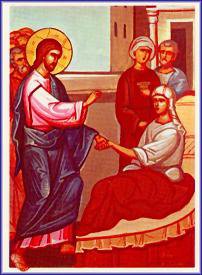
Sunday, March 26, 2006

Sermon - Numbers 21:4-9 - Lent 4


Lent 4 – March 26, 2006
Numbers 21:4-9
“Snakes!”


I. Introduction –
Snakes. Creepy, crawly, slithery, snakes. I don’t know about fear, but it seems safe to say most people don’t like snakes. Perhaps it’s the look of them. Perhaps it’s a cultural thing. Or maybe it’s something more than that.

Snakes should remind us of the Ancient Serpent, the tempter, who first led Adam & Eve into sin. The Devil. And maybe that’s why so many revile the snake, because of its associations with evil.

Today we read an account from Numbers 21, near the end of the 40 year wanderings of Israel. As the people are about to enter the promised land, they grow impatient, and begin complaining. In judgment, God sends venomous snakes into the camp. But then God also shows mercy. And we don’t have to look too hard to find Christ in the story either. Put aside your heebie jeebies this morning, and meditate with me on Numbers 21 and “Snakes!”

II. Venomous Complaints
The people of Israel had become venomous in their complaints against Moses, and against God.

Particularly Blasphemous is their ingratitude for the merciful gifts God has been giving them – freeing them from slavery, feeding them with heavenly bread for 40 years, protecting them from enemies, not to mention the blessings of the tabernacle and the sacrificial system.

Sinful man has a way of spitting his venom at God. And we are just the same. We despise the gifts God gives. We speak careless, thoughtless, hurtful words with forked tongues. We speak against the good, and praise the evil. We gossip. We slander. We lie. Sinful speech of all kinds which makes each of us as much a snake in the grass as all the other sinners. We confess, we have sinned in thought, deed, and word!

And so the punishment fit the crime. Sin always brings death, but here in Numbers the link is so directly seen. The venomous complainers are stricken by a just God with venomous snakes. And many die.

III. The Antidote
So often it takes a shake-up to bring people to their senses. Here the suffering prompts an attitude adjustment – we call it, “repentance”. The people turn from their sinful complaining, confess their sin, and ask for a reprieve from the snakes. And merciful God gives them that, and much more.

Many of you have seen the common symbols on medical building (actually taken from Greek mythology): a serpent on a pole, or two winged serpents on a pole. They are the signs of the modern practice of medicine. But the Israelites needed more than just some doctor’s anti-venom for their bites. The real problem was God’s wrath. The snakebites were only outward signs of the anger and judgment of God over sin. And this, no doctor can cure.

But merciful God provides the cure. The serpent on Moses’ staff is the only antidote for their suffering. Simply look on it, and live, God said. And they did.

Likewise, only God has the cure for the venom of sin pulsing through our veins. A venom which we ourselves have caused and deserved. That venom which paralyzes and destroys us cannot be removed – except by Jesus Christ. We have only to look to him, and live.

IV. Look…and Live

“Just as Moses lifted up the snake in the desert, so the Son of Man must be lifted up, that everyone who believes in him may have eternal life” So Jesus told Nicodemus during their evening chat. So Jesus interprets these Old Testament events for us in our Gospel reading for today. He says it’s really about him!

The Israelites were complaining about the mana God gave them to eat – bread from heaven. Jesus Christ is the bread from heaven that sustains us. He even gives his true body with the bread of the sacrament, But like the Israelites we often despise such heavenly bread – and the blessings it brings. Yet still God promises blessings.

Jesus is the intercessor between God and Man. Like Moses, who pleaded with God on behalf of the People, so Jesus takes our side, “Father forgive them” he prays.

And just as the serpent was lifted high on Moses’ staff to bring life to all who saw it, so Jesus is lifted high on the cross to bring eternal life to all who believe. Why a serpent? Because Jesus becomes the embodiment of all our sin. He becomes – sin – for us, and the object of all God’s wrath. He takes the fatal blow, he bears the venom, he faces the punishment for our sins.

And so the fulfillment of Genesis 3:15, that the seed of the woman, the one offspring that is, crushes the head of the serpent, though the serpent bites his heel. Jesus crushes the Devil at Calvary, and though fatally wounded himself – death has no power over Jesus. He rises victorious.

The people had prayed that God would take away the snakes. But notice, God didn’t actually take away the snakes, or their bites. Even after his forgiveness some people got bit. But the bites had no sting for those who turned in faith toward God’s promise of life.

Likewise, God does not make us sin-free in the way we might expect. He declares us free of sin. He forgives us. He doesn’t consider us sinful now that we are in Christ. But we are still bitten by sin and death. Even those belonging to Christ still face the grave. We still suffer by our sin and the sin of the world around us. Even the Serpent is allowed to assail us in this world. But there is something more going on .

Jesus said, “He who believes in me will live, even though he die, and he who lives and believes in me shall never die”.

Paul says that at the last day the “saying that is written will come true: ‘Where oh death is your victory? Where oh death is your sting? The sting of death sin and the power of sin is the law, but thanks be to God, who gives us the victory through our Lord Jesus Christ”.

That victory, that life – is the eternal, spiritual AND physical life that God promises to all believers in Jesus Christ. That we shall rise again, and in our flesh, see God. That life begins at the baptismal font – and it continues throughout our wanderings in this desert – and in finds fulfillment in the new heaven and earth which have been promised.

Jesus rose from the dead, and crushed the head of the serpent. We will rise from the dead, as sin and serpent have no power over us who trust in Christ. Snakes? Ha! Look to the cross, and don’t be afraid of snakes. For you will live, in Jesus Christ, our Lord. Amen.

V. Conclusion
The Bronze Snake of Moses points to Jesus who was “lifted up” for us. Though sinful venom would poison us, we have only to look to the Cross of Christ and live!

Friday, March 24, 2006

Political vs. Moral

A radio talk show host made this claim about his opponents today,

"They turn moral issues (like abortion) into political issues, and political issues (like immigration) into moral issues".

This struck me, because I try to limit my comments as a pastor to the realm of the moral and NOT the political. But what happens when these overlap, or the distinction is not as clear?

Take immigration, for example. Faithful Lutherans can certainly disagree about what should be done on this issue. But isn't there also a moral component to the problem to? (*that being, the violation of the 4th commandment and disrespect of governmental authority by illegal immigrants)

An Insult to Islam?

From Fox News:

"Rejecting Islam is insulting God. We will not allow God to be humiliated. This man must die," said cleric Abdul Raoulf, who is considered a moderate and was jailed three times for opposing the Taliban before the hardline regime was ousted in 2001.

Is conversion from Islam to Christianity an "insult to Islam" as Afghan clerics argue?

I say yes.

Any time you convert from one religion to another, you make the claim that your former religion is not true. Some of us call this a public "confession". Just as it would be insulting to God if a Christian falls from the faith, so it is insulting to Islam (and to the false god Allah) when someone leaves Islam behind.

Now, that doesn't mean we kill someone who insults our God or faith.

Wednesday, March 22, 2006

"Typey-ness" (Sermon Preview)


From Wikipedia:

Truthiness is the quality by which a person purports to know something emotionally or instinctively, without regard to evidence or to what the person might conclude from intellectual examination. Stephen Colbert popularized the word during the first episode (October 17, 2005) of his satirical television program The Colbert Report, as the subject of a segment called "The Wørd."

While ruminating and discussing this week's OT text, from Numbers 21, I was reminded of Colbert's recently coined word. Since Numbers 21 is so rich in typology, with many connections and foreshadowings of Christ, could we say it has high "Typey-ness"?

Sunday, March 19, 2006

Christian Convert To Be Executed?

Story from Foxnews:

Afghan Man Faces Death for Allegedly Converting to Christianity

Sunday , March 19, 2006

KABUL, Afghanistan — An Afghan man who allegedly converted from Islam to Christianity is being prosecuted in a Kabul court and could be sentenced to death, a judge said Sunday.

The defendant, Abdul Rahman, was arrested last month after his family went to the police and accused him of becoming a Christian, Judge Ansarullah Mawlavezada told the Associated Press in an interview. Such a conversion would violate the country's Islamic laws.

Rahman, who is believed to be 41, was charged with rejecting Islam when his trial started last week, the judge said.

During the hearing, the defendant allegedly confessed that he converted from Islam to Christianity 16 years ago when he was 25 and working as a medical aid worker for Afghan refugees in neighboring Pakistan, Mawlavezada said.

Afghanistan's constitution is based on Shariah law, which states that any Muslim who rejects their religion should be sentenced to death.

"We are not against any particular religion in the world. But in Afghanistan, this sort of thing is against the law," the judge said. "It is an attack on Islam. ... The prosecutor is asking for the death penalty."

The prosecutor, Abdul Wasi, said the case was the first of its kind in Afghanistan.

He said that he had offered to drop the charges if Rahman changed his religion back to Islam, but the defendant refused.

Mawlavezada said he would rule on the case within two months.

Afghanistan is a deeply conservative society and 99 percent of its 28 million people are Muslim. The rest are mainly Hindus.

Sermon - Lent 3 - John 2:13-22

March 19th, 2006
Lent 3
"Three Temples"
John 2:13-22


I. Introduction:
As the mood has shifted this Lenten season, and our tone gets more and more serious, we come to John’s account of Jesus clearing the temple. So many people today want a Jesus that is always happy, always loving, never judging – and certainly not angry. But here John shows us Jesus at his fiercest.

Not only does he get angry, but he even makes a whip to drive out the moneychangers and merchants. There is a bit of violence from our usually peaceful Jesus. But is this the “dark side of Jesus”? Was he just having a bad day, or was he out of control in some way? No. His action is highly symbolic, and loaded with meaning for you and me.

The Temple was God’s house. It was where God dwelled on Earth. God, who is everywhere in one sense, made his presence manifest at the temple in a special sense. It was there, in the temple, he made himself accessible to man in a specified way. Through the sacrifices and prayers offered there, God was worshipped, and more importantly, he showed his grace and mercy to sinners.

The Old Testament Temple, first built by Solomon, was destroyed by the Babylonians. When the exiles returned, they built a new temple. Later, King Herod the Great – builder that he was – did a major renovation project on that temple.

It was in this “third temple” where Jesus was presented as an infant, stayed behind as a 12 year old boy, and now caused a ruckus by overturning tables and scattering coins.

3 temples. But today we look at the temple in three different ways: The temple of the Jews, the True Temple, and the Temple Today. In each, we will see Christ – dealing with sin and corruption as only he can.

II. The Temple of the Jews

First, the Temple of the Jews.

Sin, corruption, perversion. Jesus sees it and gets angry. But what sin gets Jesus the most angry? Perhaps his rebuke of the hypocritical Pharisees – false teachers that they were. But just as fierce is Jesus’ reaction here to corruption in the place of public worship. It’s not the secret sins, or the personal sins that he reacts to like this. It’s the public corruption of God’s word and worship. This should be a stern warning, especially for Christian clergy.

And it wasn’t just that there were some shady deals going on here, though there probably were. The point was that honest or not, God’s house was not meant to be a marketplace. By turning a special, holy place into a secular swap-meet, the Jews had desecrated the house of God.

An affront to God’s house is an affront to God. And we are just as guilty. I’m not talking about having a bake-sale in the narthex. That’s harmless enough. But when we make God’s house, and our worship, into something other than God means it to be… the sin is just the same. And God’s wrath is rightly directed at such sin.

How do we desecrate God’s house?

  • By not worshipping regularly.
  • By worshipping regularly and making it a point of pride.
  • Or by acting like a Christian only at church on Sunday.
  • By getting distracted when we are here, so that it’s like we’re not really here.
  • By thinking God owes us something for our worship and praise.
  • By expecting other things from worship that God doesn’t promise- like entertainment, an emotional high, or the answer to all of life’s problems.

It may not be cattle and coins, but we clutter up God’s house with all sorts of filth – and the temple needs to be cleansed. We need to be cleansed.

And so the Jewish authorities, rather than deal with the corruption itself, change the subject. They ask, “By what authority do you do this? Show us a sign”. Jesus was stepping, stomping on THEIR toes – and they wanted answers. “Just who do you think you are!?”

And in giving answer, Jesus points to the coming reality that would cleanse all corruption once and for all. “Destroy this temple and I will raise it again in three days” “But the temple he had spoken of was his body”

III. The True Temple

You see, Jesus is the True Temple. The Old Testament temple – the building itself and all that went along with it – it all points forward to him – the true dwelling of God with man.

In the previous chapter, John 1, we read that “In the Beginning was the Word…. The Word was with God and the Word was God” and then, “The Word became flesh and made his dwelling among us” That is, he made a tabernacle, a tent, among us. The son of God took on the dwelling, the temple, of human flesh. Jesus is that temple.

The sign he offers the Jewish leaders, and us, is the sign of his authority over the temple building and really, over all things, is this: When his temple is destroyed, he rebuilds it in three days.

His temple, his body was destroyed, of course, at the cross. There, Jesus did what needed to be done to cleanse more than just the temple, but the world of all sin.

Though now the money changers saw their tables overturned, soon 30 silver coins would clink on the floor of the temple, the blood money paid for Christ’s betrayal. And rather than swinging a whip made of cords, Christ would submit to the flogging of the Roman soldiers. And at his death, the temple curtain will be torn from top to bottom – as this holy and ancient building becomes obsolete.

And then, on the third day, the Temple is rebuilt. In our modern day of pre-fab homes and ultra-fast construction, it would still be a miracle to see a magnificent temple rebuilt in just three days. But an even greater miracle is the one Christ delivered when he raised up the temple of his body from the depths of the very grave. Modern medicine can hold death at bay for only a time. But Jesus defeats, conquers, destroys death. His authority knows no bounds.

IV. The Temple Today

Finally, then, what of the temple today? Where is it? Well the Muslim shrine, the Dome of the Rock sits where the Jewish temple once was. For 2000 years no sacrifices, no priests, no temple worship have we seen. So it’s not there.

You might say that since the body of Christ is the temple, theChurch is the temple today. Christ dwells within us. The church, never free of corruption either, are we? As a whole and individually – much desecration takes place in the church. Sin is an ever-present interloper – and Jesus is always there to drive it out. Not with a whip and a shout – but with his word and sacraments.

Where is the temple, today, that is, God’s house? It is where he makes his presence known. Where Christians gather around His word and sacraments. So here – and every Christian place of worship becomes the temple of the Lord. We see that most clearly perhaps as Christ is truly present in a real presence – in, with, and under the bread and wine – that truly is his body and blood for the forgiveness of our sins.

And finally, if were to ask where the temple is today, you might point to yourself. For Paul teaches that our bodies are temples of the Holy Spirit. And that Christ lives in us, too. By our baptism, our originally sinful temples are cleansed in a washing of rebirth and renewal. Our temples are destroyed and rebuilt.

And we receive the promise of Christ – that though this temple one day be destroyed in death – that he will raise us up at the last day. When the first-born of the dead returns, then our resurrected, glorified bodies will live with him forever.

And when Revelation paints us a picture of the heavenly city – we see there is no temple there. “The Lord God Almighty and the Lamb are its temple”. For we will live with God forever.

“Zeal for your house will consume me” The disciples saw it, and we see it, in the Christ – who cleansed the temple, and cleanses the world by his blood shed at the cross. May that same zeal consume us, his little temples, as we gather here in his house – and wherever we go. For in the True Temple, we are clean! In Jesus Christ, Amen.

V. Conclusion

At Jesus’ first cleansing of the temple, he is already planning to die and rise again. May his death and resurrection also cleanse us from our sin.


Wednesday, March 15, 2006

Tuesday, March 14, 2006

Ford and Gays

Wow. My wife stumbled across this website: http://www.boycottford.com/

Apparently Ford is DEEPLY involved in promotion of the homosexual agenda.
Go to the website and check out some of the picutres of their ads (if you can stand it!).

Now, I don't typically go around endorsing boycotts. Faithful Christians could probably find fault with almost any well-known company. But really. Doesn't this seem a little over the top?

By the way, if you mispell the website, with only one "t" in "boycott", it takes you to a gay and lesbian marriage website. Great...

Ostapowich on Women

What is the scriptural (and therefore Lutheran) understanding of the role of women?

Perhaps one of the best explanations I have heard is from Ms. Sandra Ostapowich, who once aspired to be an ELCA pastor herself. Here is a paper she presented on the subject - well worth the read!

Sunday, March 12, 2006

Sermon - Lent 2 - Mark 8:31-38


Lent 2 – March 12th 2006
Mark 8:31-38
“The Things of God”

I. Introduction –
We all have our good days and bad days. Some days everything seems to go right, to fall into place. But some days, we are just not on top of our game. Those are the days you wish you had just stayed in bed. St. Peter too had his ups and downs too, it seems.

Here in Mark 8 Peter had just made his great confession that Jesus was “The Christ, the Son of the Living God”. And as Jesus commends him for his excellent answer, he also explains that this was revealed to him by God in heaven.

But Peter’s bright shining moment doesn’t last. For now when Jesus begins talking about suffering and dying, Peter rebukes him. But Jesus rebukes Peter harshly, “Get behind me Satan!”

What’s going on here? Why is Peter rebuked so harshly, and how can we avoid the same? What does Jesus mean when he speaks of the things of God and the things of men? And what does it all have to do with me? Let’s take a closer look this morning.

II. The Things of Men
What was Peter thinking? He was thinking the things of men.

On the table for discussion was Jesus’ plan for the future, which he now spoke about plainly. No parables or riddles here – “Hey guys, I am going to suffer and die and rise from the dead”. There it is. He lays it out.

But something about this rubbed them the wrong way. Peter, (Mr. initiative), takes it upon himself to talk some sense into Jesus. For surely, suffering and dying don’t make much sense. Let alone this rising from the dead business.

I wonder what he said. Maybe, “Jesus, look, you are scaring people with all this talk. You don’t have to die. We’ll just avoid the authorities. Maybe if you toned down some of the rhetoric a little. Look. You’re of more use to us alive than dead anyway. You have so much to teach us…” And I wonder how long it took for Jesus to turn his back on Peter and answer, “Get behind me Satan! You have in mind the things of men, not the things of God.”

Have you ever tried to talk some sense into God? Have you ever thought that your way was better than God’s? “Look here, Lord. You’re making this too hard on me. If you would just answer my prayer now, then I could trust you even more. Why do I have to suffer this way? Can’t you give me what I want? I don’t deserve this. Look at all that I’ve done for you. Isn’t there another way?”

But Jesus rightly says that such thoughts are of the devil. They are not of God. For Peter tempted Jesus with the same material the Devil used on Jesus in the wilderness. “Take the easy way out Jesus” “Don’t make it too hard on yourself”. “You don’t have to starve – just turn some stones to bread”. “You don’t have to die, just float down from the temple’s peak and they will all believe you.”

And when we have in mind the things of men, we too fall for the same temptation. Looking for, sometimes taking the easy way out. “I know God wants me to tell the truth, but a little lie here would be so expedient.” “Sure we’re supposed to give back from what we have been given – but the more I keep for myself the easier it is to pay the credit card bill.” So many ways to let my way, the easy way, win out over God’s way. Wide is the road that leads to destruction.

There’s a popular commercial on TV these days, which imagines what life would be like with an “Easy Button”. Just press it, and your problems are solved. It appeals to us, doesn’t it? The things of men. Always the easy solution to the problem.

It is this form of sin that Jesus so harshly rebukes. A subtle form, but no less satanic than any other sin. Anything that takes us and our minds from the things of God is of the devil. The temptation to turn to ourselves for answers, instead of looking to Christ. The things of men, instead of the things of God.

III. The Things of God
What then, are the things of God? They are what Jesus was just talking about – the suffering and dying and rising. All that he would endure and accomplish for us. In other words, the Gospel. Christ crucified for sinners. Jesus’ blood shed for you and me. These are the things of God – the things of Jesus. They are the main thing – the only thing.

The things of God, it seems, are always a surprise to us who think the things of men. His wisdom beyond our own. His plan so much better than ours.

The things of God are different than the things of men. For where man would take the easy way, Jesus took the hard way. He did not turn away from suffering, but endured it. He did not shun death, but submitted to it. Even while being crucified, his adversaries mocked him and tempted him to end his suffering, to come down from the cross. To “hit the easy button.” But Jesus does no such thing. Shame and pain, suffering and sorrow, nothing would keep him from accomplishing salvation for us.

This is the Gospel – that Jesus accomplished our salvation not in power, but in weakness. Not in apparent glory, but in shameful suffering. He endures the full measure of God’s wrath and finally, when “it is finished”, commits his spirit to the hands of the Father.

Not even death itself could deter him. For where man cannot save himself from death, Jesus Christ is Lord of life - and death has no power over him – and so he rises from the grave. Always connected to Good Friday is Easter Sunday – always after the suffering and death, there is life. Not only for Jesus, but for us too.

And the things of God – the cross and the empty tomb – are the only antidote to the things of man. For only Jesus – crucified and risen – provides forgiveness for our constant taking of the easy way. Only he frees us from the satanic thoughts and actions and words – and the devil’s claim on us. Jesus does for us what is so difficult- yes even impossible. But “with God, all things are possible”.

IV. The Meaning of Suffering
Whoever thought the Christian life was free of suffering, thought wrong.

Granted, suffering, for the Christian is NOT what saves us. Christ alone, by his suffering and death has done that already. His cross goes first, we take our crosses and follow. Yet a certain amount of suffering seems to come with the territory. That’s what these hard words of Jesus say.

What makes it even harder is that this is the same Jesus who also says, “Take my yoke upon you… for my yoke is easy and my burden is light”. So which is it? What does Jesus mean by all this?

In one sense, it is easy. There is no hard work needed on our part. Jesus has done all that. The burden of our sin he bore up the hill to Calvary. And there he made our yoke eternally “easy”.

And yet, the life of a disciple is not a “walk in the park”. It involves suffering. It means “taking up your own cross”. It means “losing your life”. It is not the easy way. But the promise of Jesus is that in him and his gospel, our lives are saved – despite the suffering.

Christ’s suffering saves us from eternal suffering, and gives meaning and purpose to our present sufferings. Paul says “rejoice in… sufferings, because we know that suffering produces perseverance; perseverance, character; and character, hope. And hope does not disappoint us.”

The cross, shameful suffering that it is, brings hope. It brings hope to all of us who suffer our own crosses. A sure and certain hope that no matter what are sufferings are now, they are temporary. God has better things planned for us, even if we don’t see them in this life.

Martin Luther once said it well…
If we consider the greatness and the glory of the life we shall have when we have risen from the dead, it would not be difficult at all for us to bear the concerns of this world. If I believe the Word, I shall on the Last Day, after the sentence has been pronounced, not only gladly have suffered ordinary temptations, insults, and imprisonment, but I shall also say: "O, that I did not throw myself under the feet of all the godless for the sake of the great glory which I now see revealed and which has come to me through the merit of Christ!
Christ doesn’t call us to follow the easy way, he calls us to follow him. And his way is a way of suffering. But it is the only way that leads to the glory of Easter, and life from the dead.

He doesn't promises easy. He does promise life. The things of God, in Jesus Christ our Lord. Amen.

V. Conclusion Christ speaks plainly about his cross and resurrection, but Peter couldn’t swallow it. May we set our minds on the things of God, and persevere in suffering for the sake of Christ. Amen.

Monday, March 06, 2006

Sermon - Lent 1 - Genesis 22:1-18


Lent 1 – March 5th, 2006
Genesis 22:1-18
“Where is the Lamb?”

I. Introduction –


And so we embark on the ancient church season of Lent. As Christ was in the wilderness for 40 days, struggling with the temptations of the Evil One, we mark our 40 day journey to the cross, and wrestle with our own sinfulness. But even in this meditative, reflective time, we do not forget that Christ has vanquished both the Devil and our sin, and by his perfect life and death made atonement for us. Though we put away our Alleluias for a time, we know they will return with the bright glory of Easter. Though we grow sober, we know joy is just around the corner. And so Lent doesn’t essentially change what we are about as God’s redeemed people. It’s just a different way of looking at things.

Last year on the first Sunday of Lent, I shared some thoughts on the Temptation of Christ from Matthew’s Gospel. This year, we read the shorter account of the same from Mark. But we also have this magnificent story of Old Testament faith from Genesis. It’s here we will focus this morning, and as Issac asks the pivotal question, we will wrestle with the same, “Where is the Lamb?”

II. Sin – Death - Blood

There are some things in life we don’t want to think about. Some things that are hard realities. Things that don’t make us feel good. One of these is sin. The idea that there is something very wrong with us. That we have offended God. That we, by our actions, are guilty and deserve punishment.

We don’t like to think about death- which always comes along with Sin, so God has declared, “The soul that sins shall die”. We whisper about death in hushed tones, we find less offensive euphemisms like “passing away” or “leaving people behind”. But the hard reality is still there. Sin means death. And not just you die and that’s it. There is the living death of the sinful life without God. Then there is the eternal death of an eternity without God. Death is never a pretty picture. But it’s always what we deserve.

Sin and death also mean the spilling of blood. Most of us don’t think much about blood. Some can’t even stand the sight of it. It’s gross. But more than that, it means someone has been harmed. Someone is suffering. Violence has occurred. Death is in the air. Bloodshed is a stark reminder of the reality of sin – of our sin – and its consequences. And we may not like the sight of that. But God draws our attention to it. Here in our reading from Genesis, blood will be shed. Abraham’s knife will find its mark. This is serious business.

I’m sure that Abraham didn’t want to think about what God had commanded him. We who have children can relate. For we know few stronger impulses than to protect our own children from harm. Imagine if God asked you to sacrifice your own child, with your own two hands. It’s the unthinkable. Yet Abraham knew that sin is serious business, and that it brings a heavy price.

Perhaps it was this very sentiment that the prophet Micah was aiming for when he wrote:

With what shall I come before the LORD
and bow down before the exalted God?
Shall I come before him with burnt offerings,
with calves a year old?
Will the LORD be pleased with thousands of rams,
with ten thousand rivers of oil?
Shall I offer my firstborn for my transgression,
the fruit of my body for the sin of my soul? (Micah 6:6-7)


We find ourselves in a similar predicament. We, like Abraham, are sinners. We, too, owe God more than we could hope to pay. Our sins are grievous, inescapable, and our powers to please God leave us no hope. And the reality that we may wish to avoid is that sin means death and blood. A sacrifice is in order. If only we had one that sufficed. We don’t. But God does…

III. Where is the Lamb?

I love the honesty of the question Issac asks. “Where is the lamb?”
And we can identify with Issac’s apparent anxiety. For the dagger of God’s judgment and wrath would hang over us all the same. We too stand at the point of the blade, which would rightly cut us down in punishment. There is blood on our hands from sin – and a price must be paid in blood. “Where is the lamb?” or must I die for my sins?

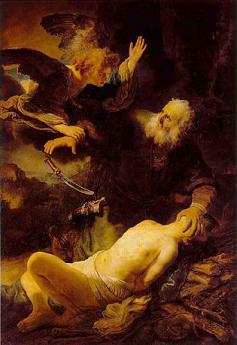
But there is good news: Abraham answers his son, “God himself will provide the lamb…” And surely, God does. Just as Abraham is about to deliver the lethal blow – a voice calls out to stop him. This was only a test, you see.
And wonder of wonders, the story doesn’t stop with the angelic cancellation. No, sin is still there. A sacrifice must still be made. But “God will provide the lamb”. And God does… A ram caught in a thicket becomes the substitute for Issac. Sin still means death and blood, but not HIS death and blood. And what a mystery that what God demands, he also provides. Well and good for Abraham and Issac, but how does this help us?

Jesus said,
“You diligently study the Scriptures because you think that by them you possess eternal life. These are the Scriptures that testify about me” (John 5:39)

And so it’s not by sacrificing a ram like Abraham that we attain eternal life. Nor is it by appreciating or emulating the story. It is by finding in them the testimony of Christ – who IS the Lamb that God provides – and having the faith of Abraham – that in Christ, “the Lord will provide”. You see…

Issac was the only son of Abraham, but Jesus Christ is the only Son of God.

Issac was the heir to the Messianic promise. Christ is the fulfillment of that hope.

Issac bore his own sins and deserved, like all of us, to die. Christ bore no sin of his own, but bore all the sins of the world.

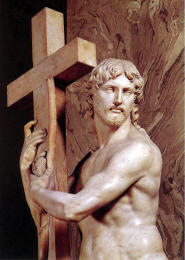
Issac carried the wood for his own near-sacrifice. Christ carried the beam of his cross and was not so spared.

Christ takes our place. Not on the altar of Mt. Moriah, but on the cross of Mt. Calvary. He sheds his blood for us.

Not the ram caught in a thicket, but the Savior crowned with thorns. A once and for all sacrifice for us and our children for thousands of generations. His blood, his death pays the price, and takes our sin away.

“Where is the lamb for the sacrifice?” Good question, Issac. “God will provide” and God did. Where is the lamb for our sacrifice? We have only to look to the cross, and see the Lamb of God who takes away the sin of the world – including ours.

IV. Where am I?

So where does that leave us? Like Abraham and Issac, we walk away. But we can’t forget what happened on the mountain of sacrifice.

When I hear of something happening to someone else’s children – abuse or harm of any kind, I often just want to go hug my kids. I wonder if Abraham didn’t feel the same when this was all over. Appreciating what God had done for him, Mt. Moriah gave Abraham a deeper understanding of God’s love in Christ. A God who loved so much that “he spared not his own son , but gave him up for us all”.

I suppose the events of Mt. Moriah had an effect on young Issac, too. I suspect he remembered that day quite well for the rest of his life. He probably told his children and children’s children, of the sacrifice the Lord provided. Maybe he appreciated his own life a little more after almost losing it there.

Was it a life changing experience for Abraham and Issac? Did each become a different person? Who knows? What does seem clear is that God had brought them both to faith before Moriah, and kept them in that same faith to the end. For Abraham to take the sacrifice as far as he did – what greater example of faith is there? And for young Issac, who obediently submitted to his Father’s will, he too showed a striking depth of faith.

And so Abraham and Issac went, in faith, to Moriah to worship, and returned strengthened in their faith. So too with our worship. God brings us, by his Spirit, to gather in his house. God confirms on our weekly “trip to the mountain”, that HE ALONE deals with sin. HE ALONE provides for his people. HE ALONE makes the sacrifice. We receive the blessings in his word spoken, and his sacrament received.

Some Christians seem, even today, tend to think they can please God with their own sacrifice. By living a holy life, by a long list of good works, by enthusiastic worship - by sacrificing something – something important - to the Lord. But these are all the wrong sacrifice – they are not what God truly wants of us.

And they may look at us who believe so strongly in God’s grace in Christ, and say, “Look, they aren’t sacrificing enough”. But the truth is, we sacrifice nothing. We earn nothing. We bring nothing. We have nothing. Nothing but the lamb that God provides. We have Christ alone. And that is more than enough.

So where does that leave us? It leaves us with Christ. Like Issac, we are not under the knife of judgment. Like Abraham, we don’t have to pay a price for our sins. We know that Christ has done it at the cross. And we go forth from the mountain in peace. For the Lord has provided, and always will. In the name of Christ, Amen.

V. Conclusion
As Lent begins, the mood changes. We ponder the seriousness of our sin. With Issac, we ask, “Where is the Lamb?” And then we see Christ, the “Lamb of God who takes away the sins of the world”.

Saturday, March 04, 2006

Lutheran Town?

Pastor Alms, at Incarnatus Est, asks this question in light of the recent story about the founder of Domino's Pizza who is trying to establish a Roman Catholic town.

What Would a Lutheran Town Look Like?

Thursday, March 02, 2006

John the Baptist Missed the Memo:

I just received this bit of religo-spam at our church email account:

March 2 2006 Ms. Lee Jai Cook, Roaring Springs, TEXAS USA. [1.806.348.7315]

Arrival of the Prophet Elijah

Christians expect the arrival of Jesus in the not too distant future in fulfillment of his promise to come again.
However, the prophecy in the Bible at Malachi 4:5,6 seems to state that God will send Elijah to earth before Jesus returns:
Behold, I will send you Elijah the prophet before the coming of the great and dreadful day of the Lord: And he shall turn the heart of the fathers to the children and the heart of the children to their fathers . . .

Just where Elijah's arrival might fit into the Events of the End Times I don't know. However, it appears certain that we can expect the arrival of Elijah in the near future.

http://freeurantia.org/LeeJaiCook.htm


Anyone else get this too?

LCMS Astronaut


Interesting story from the online "Reporter" here....

LCMS astronaut plans to worship from space

By Paula Schlueter Ross

His Christian faith is important to astronaut Jeff Williams, who wouldn't dream of leaving home -- or earth, for that matter -- without it.

Williams, a member of Gloria Dei Lutheran Church, Houston, says he plans to stay in touch with his congregatioastronaut/Williamsn even though he'll be off the planet -- orbiting 250 miles above the earth during a six-month stint aboard the International Space Station.

In fact, if Williams has his way -- and NASA technicians can make it happen -- the Gloria Dei lay minister will "join" fellow congregation members in a July 2 worship service. Williams, still aboard the space station, will receive only audio from the service, but if all goes well the congregation will be able to see and hear Williams via a live video feed from space.

Read more...

Tuesday, February 28, 2006

Hymn - "O Father, Where's the Lamb?"


“O Father, Where’s the Lamb?”
Based on Genesis 22:1-18
Tune: Was frag' ich nach der Welt
(LW #418
What Is the World to Me )

“O Father, Where’s the Lamb?”
The wood and fire are yonder,
A sacrifice at hand,
young Issac, left to ponder.
And so said Abraham,
Who on the Lord relied,
In answer to his Son,
“The Lamb, God will provide.”

Upon the altar then,
The son his father tying,
In faith, perhaps with tears,
The boy would soon be dying.
But then there came a voice,
While raising high the knife,
“O Abraham be still,
And do not take his life!”

How great a mystery,
We see on mount Moriah,
Foreshadowing much more,
Foretelling our Messiah,
The one who takes our place,
Upon the wretched cross,
Who suffers all God’s wrath;
Our gain is through his loss.

Yes, Christ, the Lamb of God,
The One the Lord provided,
Has by his blood atoned,
For sin that had divided,
Us from our Father-God.
His suff'ring calmed the strife.
His death destroys our death.
His life delivers life!

© Thomas E. Chryst, 2006

Friday, February 24, 2006

"Taking Up" for Lent

The following is my "pastor's page" from the March 2006 church newsletter. (Note also the new "PreachrPoll" in the left sidebar which goes along with this article).

______________________________________________________

Lent begins this year on March 1st, Ash Wednesday. As you read this month’s newsletter, it’s probably already begun. But I have some questions…

What is Lent? Where did it come from? What does it mean? Why do we do it?

I found the following short essay helpful in briefly answering some of these questions. It’s from the website of DOC pastor Kenneth W. Collins (www.KenCollins.com):

Lent is a season of soul-searching and repentance. It is a season for reflection and taking stock. Lent originated in the very earliest days of the Church as a preparatory time for Easter, when the faithful rededicated themselves and when converts were instructed in the faith and prepared for baptism. By observing the forty days of Lent, the individual Christian imitates Jesus’ withdrawal into the wilderness for forty days.

All churches that have a continuous history extending before AD 1500 observe Lent. The ancient church that wrote, collected, canonized, and propagated the New Testament also observed Lent, believing it to be a commandment from the apostles…

Because Sunday is the day of the Resurrection, we skip over Sundays when we alculate the length of Lent. Therefore, in the Western Church, Lent always begins on Ash Wednesday, the seventh Wednesday before Easter. In many countries, the last day before Lent (called Mardi Gras, Shrove Tuesday, Carnival, or Fasching) has become a last fling before the solemnity of Lent. For centuries, it was customary to fast by abstaining from meat during Lent, which is why some people call the festival carnival, which is Latin for farewell to meat.

Copyright ©1995-2006 by
the Rev. Kenneth W. Collins and his licensors. Used by permission.

And on “Giving Something Up for Lent”. A question I often hear this time of year. Do we Lutherans do it? The answer is: “If you want to”. It is a purely voluntary practice which depends on one’s own personal piety. But if you choose to do it, think about this:

Unlike some Christians, Lutherans expect to earn no merit from God in return for our Lenten sacrifice. Christ has already given us the fullness of God’s grace. Instead, what would we gain from giving something up? Perhaps a reminder of Christ’s sacrifice for us. If you find foregoing a favorite food or activity you like helps you remember and give thanks for Christ’s sacrifice, then that’s great!

Some probably also “give things up” because they know it’s a bad habit in the first place. Quitting smoking, giving up sweets, fast food, etc… all are modern favorites to “give up” for Lent. If Lent is the excuse you need to break a bad habit, I won’t criticize you too harshly. But think about this. Lent might also be a good time to “take something up” instead. Form a good habit that you’ve been meaning to do. (Sort of a second chance at a New Year’s resolution).

But since Lent is a season of the Church, especially think about a spiritual habit. Perhaps read your Bible once a day during Lent. Pray for a few minutes at lunchtime. Come to church on Wednesdays for our midweek Lenten series. “Take something up” for Lent that is God-pleasing and will be a blessing to you.

For Christ took up the cross. He bore our sins, and gave his life as our ransom. May your Lent be a time of solemn pondering and meditative reflection on the great love of our Suffering Servant, Jesus Christ our Lord.

Thursday, February 23, 2006

WordCloud


Neat little blog-thing: a graphic representation of common words used on your blog.

You can do your own here, you can even order a T-shirt from them!

HT to WICatholic

Tuesday, February 21, 2006

Banner Brouhaha


One of the LCMS signers of the "Clergy Letter Project" has come to my attention again.

Rev. Robert L. Barker appeared in my sitemeter listing of search terms. Upon a little digging, I came across this publication of a pro-homosexual group. Read the story, then take a close look at the picture on banner on the right of the story (and the caption). Note who took it, who submitted it, and who is responsible for the banner.

I hope this means that Rev. Barker is no longer serving a congregation.


UPDATE:

According to President Hoesman of the Michigan District, Rev. Barker is on Emeritus status and no longer serving a congregation. Also, Rev. Hoesman assures me both these matters are being addressed. I am quite satisfied with this response.

Excuses for Sleeping in Church

Thanks to fellow Lutheran Blogger, David Yow, for the following humor:

-----------------------------------------------------------------

Good Excuses for Sleeping in Church (depending on the church)
The folks at Wittenburg Door have been keeping track:

  • Good thing I'm a contemplative!
  • Whoa! The Third Heaven is so cool. There's—whoops, sorry. They told me not to tell.
  • Isn't this the healing service for narcolepsy?
  • I was testing to see if my new Bible cover is, uh, waterproof.
  • The church espresso machine is on the blink.
  • I wasn't really asleep—just blinded by the pastor's forehead.
  • I was entering into the Sabbath Rest.
  • Well, excuse me for staying up all night Saturday in prayer.
  • I was getting in touch with my inner Bible study.
  • I always snore when I'm slain in the Spirit.

Monday, February 20, 2006

Sermon - Mark 2:1-12 - Epiphany 7


Epiphany 7 – February 19th, 2006
Mark 2:1-12
“Paralyzed. Forgiven!”


I. Introduction –
As this Epiphany season has unfolded, we have been reading through the action-packed first chapter of Mark. There we have seen a growing expression of just who Jesus is – with an emphasis on his authority. He has authority in his teaching. He has authority over evil spirits. He has authority to heal many diseases. Today we seen an even greater aspect of Jesus’ authority – and that is to forgive sins. (Next week will see Jesus fully revealed as the glorious Son of God on the Mt. of Transfiguration).

But for today – the well known account of Jesus healing the paralytic. It’s one of those healing stories that sticks in our memory, perhaps. Jesus’ reputation as a healer has grown, so that now he is surrounded by great crowds. So great a crowd that is was standing-room-only on that day when the paralytic was brought in hopes of healing. But his determined friends would not be pushed out by the crowd. They dug a hole in the roof layers of dirt and straw – and in dramatic fashion lowered their crippled friend right down to Jesus.

You can understand their determination. It’s not like this man had a hangnail or a stubbed toe. His paralysis made him completely dependent on the kindness of others. With no modern American social welfare system available to him, his survival from day to day would have been at the mercy of others. He couldn’t work to support a family (if he even had one). He couldn’t even take care of himself. He was so helpless he had to be carried around on a mat – presumably from place to place to beg for his living.

So here comes this man with great expectations of healing. He had heard about Jesus’ earlier visit to Capernaum. How he healed many that Saturday evening. He heard, perhaps, about the leper whom Jesus had cleansed – we read about that last week – the man who was told to keep it secret but couldn’t keep from blabbing. And perhaps as a last resort, the paralyzed man calls in a favor and has his friends go the extra mile so that maybe, JUST MAYBE this “Jesus of Nazareth” would work a miracle.

As he is lowered in to the house where Jesus is, Jesus takes notice. He comes over to the mat, and speaks to the man. Perhaps the whole crowd waited with hushed anticipation of the miracle that Jesus would do. How he would command the paralysis to be gone, or declare that the man should rise and walk. But he doesn’t do that. At least not right away. Perhaps to the surprise of many, Jesus says something else, “Son, your sins are forgiven”.

II. What Do You Need?
What do you need from Jesus? It’s a question worth asking. None of us here today are completely paralyzed. But we do come today dragging a mat full of hurts and problems.

Sometimes we differentiate between these “felt needs” and our true need. The felt needs are the needs we feel – the tangible things going haywire in our lives – relationships gone awry, health problems galore, struggles at work with co-workers and bosses, conflict at home and in the family, and of course there never seems to be enough money. When we come to this house of God each week we drag a mat weighed down with all sorts of worldly troubles and cares. These things have a way of paralyzing us, at least spiritually. What do you need from Jesus today? What’s paralyzing you?

Whatever it is, you can probably identify with the paralyzed man – who had some expectations, some hopes at least, of finding help. And the surprising answer that Jesus gave him is the same answer he gives us - “Son, (daughter), your sins are forgiven”. And maybe that’s not exactly what we wanted to hear.

Maybe we wanted Jesus to make the cancer go away. Maybe we wanted him to make our kids behave like they should. Maybe we were hoping Jesus would somehow make my spouse see the light and start treating me right. Maybe we were just hoping for a little less stress in our lives. Some minor (or major) miracle so that we can get up get on with our life. But Jesus says, “Your sins are forgiven”.

He says it through the absolution of sins, when the pastor stands in his stead and by his commands. “I forgive you your sins” is one of the first things God says to us as we gather. And there’s a reason for that. First things first.
It’s because Jesus knows what we really need. He knows our need better than we do. Jesus knows that the first, the most important, the number one priority for us all – whether we know it or not – is to have our sins forgiven.

It may surprise us, but it shouldn’t. For all our other problems derive from sin. Whether our sin, or the sin of the world we live in. All our other problems are consequences of, mere symptoms of sin. Like the paralyzed man, our real problem, our only real problem, is sin. And Jesus is the one who can and does solve it. He is the One who forgives.

III. The One Who Forgives
In fact, compared to sin, all these other problems are child’s play. For the teachers of the law were right to ask, “who can forgive sins but God alone?” Rabbis can teach, and doctors can sometimes heal. But only God can forgive sins. What a bold statement Jesus makes here, not only forgiving someone’s sin, but also in effect declaring himself to be God! For anyone else to do this would have been blasphemy. But not for Jesus, who is God. He has the rightful authority to forgive sins. And not just because he is God.

The forgiveness that Jesus offers is a forgiveness based on the cross. All the sacrifices for sin in the Old Testament led up to, pointed to, and found power in this once-and-for-all sacrifice of Christ on the cross. All the times Jesus forgave sins, all the authority he gave to his disciples to do the same – it all goes back to the cross. And every time a Christian pastor announces the absolution, or performs a baptism, or administers the Sacrament of the Altar – it all goes back to the cross.

For there we see the One who forgives sins doing the dirty work of forgiveness. There he procures it, so that we can receive it – again and again. There at the cross Jesus takes care of our greatest need – he appeases God’s wrath, he pays the price, he takes our place, he wins forgiveness. So that God, when he forgives our sins doesn’t do so just because he’s God and just because he’s nice. He does so for the sake of Jesus Christ and his death on the cross. “Father Forgive them” cries the condemned Christ, and the Father forgives.

IV. Paralyzed No More
And Jesus does heal the paralytic. He does it to prove to the detractors – and to us – that he has the authority to forgive sins. No, Jesus doesn’t heal us just because we ask every time and at the drop of a hat. No, he doesn’t offer pat answers and easy solutions to all the problems of life. Sometimes a healing or solution is given. And for those times, thanks be to God! Other times, He doesn’t address the needs we feel… at least not right away. But he always forgives. He is “faithful and just”, and promises to “forgive our sins, and cleanse us from all unrighteousness”.

And the forgiveness he brings has a ripple effect. As forgiven children of God, we live life by His Spirit. We have the comfort of knowing we belong to God. Even when the problems and sins of life try to paralyze us, we have a peace that passes understanding. Even when times are tough and the mat we drag around seems so heavy, we have the riches of his grace.

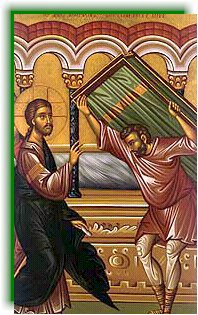
And we have a future promised to us. We have the hope of heaven. And not just being with the Lord when we die, but also the promised resurrection to life eternal. What that means is this. That someday, all our ills of the body will be healed. That someday, all our troubles and problems will be a long-distant memory (as Isaiah says today, “forget the former things”). When that day comes, the Resurrected One will raise us also to life. The same Christ who has by his word forgiven our sins, will also command our bodies to rise, and finally “get up, and come home”, to live with him forever. And God himself will wipe every tear from our eyes.

Whatever needs you are dragging on your mat, if you’ve come to Jesus, you’ve come to the right place. But remember our greatest need is to be forgiven of our sins. And know that forgiveness which comes only through Jesus Christ and his cross. And see that effects that forgiveness brings, and in Christ, be paralyzed no more. For in him, “your sins are forgiven”. Go in peace. In Jesus Name, Amen.

V. Conclusion
Like the paralytic, we too are afflicted with sin and its consequences. But we too receive what we need the most- forgiveness of our sins – from the only One who can give it: Jesus Christ our Lord. Amen.

Saturday, February 18, 2006

Millenials and Worship

Nice article further building the case that a vibrant, traditional form of worship is appealing to young people nowadays.

HT to Kelly Klages

Faith: New Generation Is Looking Back

by Uwe Siemon-Netto

WASHINGTON, April 18 (UPI) -- A new generation of worshipers is confounding pastors and church musicians alike.

No sooner had they got used to sometimes nerve-wrecking new forms of worship smacking of trivial entertainment, than a youthful thirst for tradition seems to be the liturgical aroma of the day.

Meet the Millennials who are succeeding the Baby Boomers and the GenExers. The Millennials are young people born between 1981 and 2000.

"They are called that way because they will presumably live most of their lives in the new millennium," explained Robert Olsavicky, an organist and graduate student at Duquesne University in Pittsburgh. Olsavicky has become a specialist of the roller-coaster changes in worship preferences, changes that parallel developments in society at large. According to Olsavicky, today's young Christians often desire the exact opposite of what the Rev. Rick Warren, a Californian church growth promoter, preaches. Warren shouts at fellow pastors, "Why are you still using that pipe organ people hate?"

"What is happening in the religion of teenagers is nothing short of astounding," wrote Robert Webber in the current issue of Reformed Worship, a theological journal. "They want to return to a more stable time, a period of tradition. Not the tradition of the fifties, but of a much earlier time, the tradition of the old, very old times." Webber is director of the Institute of Worship Studies at Northern Baptist Seminary in Lombard, Ill. He sees in the "tradition emerging among the Millennials, Generation X and some Boomers a tradition of classical Christianity filtered through the grid of postmodern, post-Christian, neo-pagan society."

Olsavicky, who is also the musical director of First United Methodist Church in Butler, Pa., concurred: "They are looking back to the Reformation era."

Article Continues Here...

Friday, February 17, 2006

Agape Press on Homosexuality and Alcoholism

'Ex-Gay' Ministry Leader Finds ECUSA Bishop's Alcohol Problem Unsurprising

An interesting article about Stephen Bennet, an "ex-gay" ministry advocate.

Here's an excerpt:
Through his advocacy, the SBM founder and spokesman tries to communicate both to homosexuals and to the general public that no one is born homosexual and that, through the power of Christ, freedom from that lifestyle is attainable. Having left that lifestyle himself 12 years ago, he attests that he is "completely free of homosexual thoughts, actions and desires and completely happy" as the heterosexual man God created him to be.

Interesting how the power of Christ is not about forgiveness, but freedom from the lifestyle (and happiness, of course).

Wednesday, February 15, 2006

The "Fours" Tag

Tim the Enchanter has tagged me. Things have been pretty serious around this blog lately, so maybe it's time for a little fun. Thanks, Tim!

Four Jobs I've Had:

  1. Shrimp-peeler at "Deli-Dimensions"
  2. Popcorn-butter jerk at a movie theater
  3. Office Temp
  4. Pastor (my favorite so far)
Four Movies I Watch Over and Over Again:
(I don't really do this. I watch them once, usually. If I see a movie a second time it's a big deal. Here are just some favorites)
  1. Star Wars
  2. The Matrix
  3. The Usual Suspects
  4. The Shawshank Redemption
Four TV Shows I Watch:
  1. Anything on the History Channel
  2. NFL Football
  3. PGA Golf
  4. The Tonight Show (Leno)
Four Places I've Lived:
  1. Baltimore, MD
  2. Bronxville, NY
  3. Warren, MI
  4. St. Louis, MO

Four Places I've Vacationed:
  1. Ocean City, MD
  2. Orlando, FL
  3. St. Louis, MO
  4. Wisconsin Dells, WI
Four Websites I visit daily:
  1. Foxnews
  2. Google
  3. Newsgator
  4. KFUO
Four of My Favorite Foods:
  1. Egg Foo Yung
  2. Steak
  3. Lobster
  4. Anything else cooked by my lovely wife
Four Places I'd like to be right now:
(Don't know about the "right now" part, but four places I would like to go someday...)

  1. Malta
  2. Israel
  3. Greece
  4. The Grand Canyon
Four Bloggers I'm Tagging:
(Since most of the blogs I read have already done this, I'll just let it die here.)

Monday, February 13, 2006

LCMS Evolution Supporters


The Lutheran Church-Missouri Synod (LCMS) teaches unabashedly and overwhelmingly the Doctrine of Creation. See here, and here. That's good, cause so does the Bible.

Yesterday, hundreds of churches celebrated a sort of “Evolution Sunday”. Noted Australian Creationist (and a Lutheran too, I think) wrote this piece about it.

Here is the related "Clergy Letter Project" letter itself (signed by over 10,000 clergy of various denominations):

Within the community of Christian believers there are areas of dispute and disagreement, including the proper way to interpret Holy Scripture. While virtually all Christians take the Bible seriously and hold it to be authoritative in matters of faith and practice, the overwhelming majority do not read the Bible literally, as they would a science textbook. Many of the beloved stories found in the Bible – the Creation, Adam and Eve, Noah and the ark – convey timeless truths about God, human beings, and the proper relationship between Creator and creation expressed in the only form capable of transmitting these truths from generation to generation. Religious truth is of a different order from scientific truth. Its purpose is not to convey scientific information but to transform hearts.

We the undersigned, Christian clergy from many different traditions, believe that the timeless truths of the Bible and the discoveries of modern science may comfortably coexist. We believe that the theory of evolution is a foundational scientific truth, one that has stood up to rigorous scrutiny and upon which much of human knowledge and achievement rests. To reject this truth or to treat it as “one theory among others” is to deliberately embrace scientific ignorance and transmit such ignorance to our children. We believe that among God’s good gifts are human minds capable of critical thought and that the failure to fully employ this gift is a rejection of the will of our Creator. To argue that God’s loving plan of salvation for humanity precludes the full employment of the God-given faculty of reason is to attempt to limit God, an act of hubris. We urge school board members to preserve the integrity of the science curriculum by affirming the teaching of the theory of evolution as a core component of human knowledge. We ask that science remain science and that religion remain religion, two very different, but complementary, forms of truth.

All this made me wonder, “Do you think any LCMS pastors signed this document?”

Here's what I found. The following LCMS signatories of the “Clergy Letter Project”:

The Rev. Robert L. Barker
Lutheran Church - Missouri Synod
Clare, MI

The Rev. Eugene V. Brueggemann, Retired
Lutheran Church--Missouri Synod
St. John's Lutheran Church
Fort Collins, CO
(Also a Jesus First Supporter)


The Rev. Robert Stuenkel
Emeritus Lutheran Campus Pastor
University of Colorado at Boulder
Lutheran Church--Missouri Synod
Boulder, CO
(Son of former CUW president Walter Stuenkel)

Pastor Thomas G. Van der Bloemen, Retired
Redeemer Lutheran Church Missouri Synod
Fort Collins, CO
(Also a Jesus First Supporter)

The Rev. Karl H. Wyneken
, Retired
The Lutheran Church--Missouri Synod
Fresno, CA
(Also a Jesus First Supporter)

(Along with NUMEROUS ELCA pastors)

Friday, February 10, 2006

Mocking Mohammed, Mocking Christ?

An excellent blog post from Wretched of the Earth, quoting and commenting on yet another post. The topic:

Being mocked is Christ's work, not Muhammad's

Wednesday, February 08, 2006

The Sermon Outline


One of my weekly habits in preaching is to include in the bulletin a "Sermon Outline" for the congregation's use. I understand this is probably an innovation of American Evangelicalism, and an interloper in our confessional Lutheran tradition. I don't expect that most confessional minded pastors do this too. But hear me out...

For one, I do not use "fill-in-the-blanks" exercises. I find that a bit pedantic, personally. Nor are my outlines extensive, but they simply cover the (usually 3) major sections of my sermon. I also include a brief paragraph ("Conclusion") at the end, which summarizes the basic gist of the sermon. I usually throw in a graphic too.

I do this for several reasons, but primarily as a "listening aid". In our day people are less and less accustomed to listening to oral presentations of any length. Some people (not all, but some) find it helpful to have a bit of a "road-map" in front of them when listening. But too much information would lead to more of a reading than listening exercise, in my opinion, and so a good outline should draw you into the sermon not away from it.

Not everyone in our congregation uses these outlines, or even seems to notice they are there. I don't often mention it. But there are a few who have remarked how helpful they find this tool. One lady in particular, has shown me on several occasions, how she takes copious notes and "fills up" the outline during the sermon. While this isn't a Bible class or lecture, I have a hard time saying that for her this is a bad thing to do.

So what of it, gentle readers? Pastors and laity alike? Any comments on the practice of printed sermon outlines (mine or someone else's)?

Monday, February 06, 2006

LCMS Pastor Arrested Mid-Sermon!

Strange but true, according to the Chicago Tribune:

The Associated Press
Published February 6, 2006, 7:31 AM CST

Some members of a Lutheran parish on Chicago's far South Side said they are outraged police arrested Rev. Jimmy McCants in the middle of his sermon.McCants, 54, has been the focus of a dispute between rival factions at Zion Evangelical Lutheran Church.

The church's board of directors told police the board fired McCants on Christmas Eve, and a woman affiliated with the church signed a complaint against him for trespassing on church property, said Chicago Police spokeswoman Monique Bond.

But a Lutheran Church official said the board fired McCants without going through the proper steps to resolve disputes.

``They have removed a pastor inappropriately,'' said Rev. William H. Ameiss, president of the Northern Illinois District of the Lutheran Church Missouri Synod. ``The real tragedy is the ministry gets put on hold for a power struggle.''

McCants was not handcuffed when police led him out of the church Sunday. He was booked on a misdemeanor charge of criminal trespassing and released in lieu of $1,000 bond.

``My church is the house of the Lord, and I had not committed a criminal act,'' McCants said. ``We're going to see what the lawyers say. I intend to go back next Sunday.''

Sunday, February 05, 2006

Sermon - Epiphany 5 - Mark 1:29-39

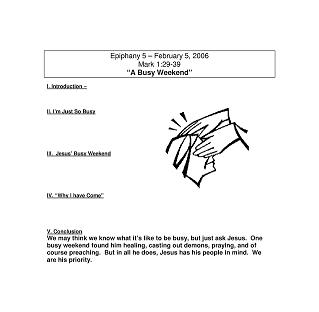
"A Busy Weekend"
Mark 1:29-39

I. Introduction –

Today’s Gospel reading from Mark picks up where we left off last week. Jesus had gone into the synagogue in Capernaum and served as guest preacher. He was confronted by a man with an evil spirit, which he promptly cast out of the man. And the people who heard and saw him were amazed by his power and authority.

It’s still the Epiphany season. Our readings are still shedding light on different facets of who Jesus is, and what he is about. Today, if there’s one word to describe the way Jesus is presented, it might be this: “busy”. Mark, of all the Gospel writers, whose favorite word seems to be “immediately”, presents Jesus as a man with lots to do, and little time to do it. He is busy.

We know about “busy”. But today as we read about Jesus’ busy weekend, we think again not only of how much he does, but how much he does for us! Our busy Savior.

II. I’m Just So Busy

If there’s one thing people are nowadays, it’s busy. Find me the person that has too much time and not enough to do – and I will give you a medal. We are busy. We have full calendars and full plates. We juggle the responsibilities of family, work, play – of chores and errands, of commitments and involvements. And then there’s church on Sunday morning, which for many is way down on the priority list. And even though we’re all here today – maybe our minds are already on to all the other busy things we need to do next – today, this week, etc.

There’s a sin aspect to our busy business. When we take on too much or don’t balance our responsibilities well. When we mis-prioritize our time. I am reminded a phrase I have heard used more frequently, “Me-Time”. And, while it’s not always a sin to take time for oneself (and some need to do more of it), many are too selfish with their time. We’re not Jesus – we won’t (we can’t) balance our busy lives perfectly. We get it wrong so often.

Yet into the mixed-up mess of our hectic schedules comes Jesus Christ. Today we see that he, too, is busy.

III. Jesus’ Busy Weekend

Jesus Saturday started off in the Synagogue (as I mentioned, we read about that last week). Next, he is off to Peter and Andrew’s home – and to the bedside of Peter’s mother-in-law. Jesus’ afternoon doesn’t give him much “me-time”, as he heals the woman and shares a meal with his newly called disciples.

After the sun sets (and the Sabbath is officially over), Jesus’ Saturday evening is not spent out on the town. Rather, the town comes to him. Mark says, “The whole town gathered at the door, and Jesus healed many who had various diseases. He also drove out many demons” So it was a busy time. It was perhaps a late night. But Jesus got no overtime.

The next morning, Sunday, Mark tells us Jesus is up and at-‘em quite early. But he’s not out playing golf or going to rummage sales. Jesus goes off by himself to pray. Finally some “me-time”, or is it? I suspect that even then, Jesus’ prayers were not for his own sake, but for the sake of the people. Even if he did pray for himself, it was surely that he might have strength to continue serving, ministering, and loving his people.

When the disciples finally roll out of bed, they get busy looking for Jesus. Finally they find him, and (no rest for the weary), the demands on Jesus continue. “Everyone is looking for you” they said. And what truth they had spoken.

Still, today, in a sense, everyone is busy looking for Jesus. They just don’t always know it. Sin’s reality makes us aware that something is wrong with us – something needs to be fixed. It may not be a disease or a demon-possession, but our problems are just as real.

Everyone is busy looking for Jesus – but not always to the right Jesus. A Jesus who only leads by example and asks “what would I do?” is a poor excuse for a Jesus. That’s a Jesus of the Law. Not a Jesus of the Gospel. Our Jesus doesn’t ask people to do anything but believe in him and what he does for us.

Everyone is looking for Jesus, but not always for the right reasons. Some, like the disciples, even do it on Sunday morning. Perhaps even in church. If you have come here today mainly to give something to God, or do something for God, or praise him or serve him – then you are busy with the wrong things. Our first concern must be to receive what he gives us, on his terms, by his grace. Our business is to receive, and only then to respond.

And so, wherever Jesus was – praying – the disciples found him. “Everyone is looking for you Jesus”. It’s actually a nice confession of our need for Jesus. We too look for him – and to him – as the source of our blessings. And he does not disappoint.

He doesn’t book a vacation to some far off land. Rather than take a holiday from all the stress – Jesus gets busy again. He says, “Let’s go somewhere else – to the nearby villages – so I can preach there also. That is why I have come”.

There are more people who need him. So Jesus goes.

IV. “Why I have Come”

Did you catch what he said, though? He didn’t say, “Let’s go so I can heal some more people,” or, “Let me go cast out some more demons”. Jesus is focused in his task – his purpose – and that is to preach. He comes with a message. All the signs and wonders point to the message, his preaching and teaching and proclaiming of the Kingdom of God.

It was a message of greater healing than all the disease-busting he did. It was a message of even more defeat for the forces of evil than a simple exorcism or two. Jesus came to bring ultimate healing to the suffering sinner, and ultimate victory over our spiritual enemies.

Why did Jesus come? Well it was to preach, but not only to preach. As the ultimate prophet he brought God’s word to the people – he was – is – the very word of God made flesh. But this prophet is also a priest. And priests make sacrifice. And Jesus does the same.

In another purpose statement, Jesus says, “I have come that they might have life, and have it abundantly”. Of course the great surprise is that he brings life to us by offering himself to die. His sacrifice at the cross – and his resurrection from the dead – are the heart and foundation of his message. They are what make the kingdom of God accessible to us poor sinners. This too is why he came.

For on another busy weekend, Jesus had lots more to do for his people. It started on a Thursday, when he established a Holy Supper for his people, washed his disciples’ feet in service, and prayed in the garden. He was arrested, and a long night and morning of trials led to a hill outside of Jersusalem where he was crucified. Dying mid-afternoon and buried before sunset, his body lay in the tomb until early Sunday morning, when divine power burst open that grave, and his cold clay took on breath and life again. Then too, his disciples went looking for him. Then too, they would find him – not dead, but alive! Appearing to the women that Easter morning, and to the 12 later in the day – Jesus’ OTHER busy weekend is the one to remember. That too is why he came. And in all his work – in his dying and rising – he does it for us his people.

And as we come this Sabbath day – this day of rest from our busy-ness, we too hear the message of Jesus and his cross. And by that message we are healed of our sinful disease. And we receive victory over our evil foes. We get just what we need from the only one who can give it. Forgiveness, life, salvation offered in words of absolution, in remembrance of our baptism, in bread and wine that truly are Christ’s body and blood. Here the busy-ness stops, and the business of forgiveness gets done. Here we find pardon for all the times we are too busy, not busy enough, or busy with the wrong things. Here Christ is busy still, forgiving and loving us, his people.


“This is why I have come” Jesus said. What a busy weekend.

In His Name, Amen.

V. Conclusion

We may think we know what it’s like to be busy, but just ask Jesus. One busy weekend found him healing, casting out demons, praying, and of course preaching. But in all he does, Jesus has his people in mind. We are his priority.

Friday, February 03, 2006

More on Local Shooting

This morning's paper carried a column, "Parson to Person", in which the ELCA Lutheran, Rev. Carol Baumgartner, wrote, "How can we cast out the spirit of violence?" Here is the link.

A few things strike me about Rev. Baumgartner's comments. As the title itself suggests, in her remarks the onus for change and the focus of actions is human beings, not Jesus himself. Therefore, even though she mentions Jesus (as a "risk taker" and "rule breaker"), she does not mention the most important thing Jesus does - namely dying for his people. Nor is there really any talk of the forgiveness of sins. There is slight mention of what God (in general) will do (if we "let him").

Now, you might argue that this wasn't a sermon, and so shouldn't be held to the same strict standards of Lutheran orthodoxy. You might say that it was a "pep-talk" to the community. But I believe that when a Lutheran speaks out to the community in such a visible way, he (or she) must hold the cross before their eyes.

Paul says, "I am not ashamed of the gospel, because it is the power of God for the salvation of everyone who believes" Romans 1:16

Her original question, "How can we cast out the spirit of violence?" can best be answered:

We can't. But Jesus Christ has - at the cross. And he continues to "create in me a clean heart and renew a right spirit within me" through the gifts of Word and Sacrament. There's no other way.

Thursday, February 02, 2006

How Sinful Are You?

Take the quiz here.

My results:

Your Deadly Sins
Sloth: 80%
Gluttony: 60%
Greed: 40%
Envy: 20%
Pride: 20%
Lust: 0%
Wrath: 0%
Chance You'll Go to Hell: 31%
You will die while sleeping - and no one will notice.

Wow. This test went easy on me. ;-)