Wednesday, May 29, 2024

Sermon - Holy Trinity Sunday - John 3:1-17


Holy Trinity Sunday

One of the nifty little neo-logisms we hear these days is “man-splaining”.  When someone, especially a man, explains something in a condescending way, especially to a woman.  A related term is “over-explaining”.  In our impatient world of fast-moving information, we don’t have time to sit through a long explanation of something we already know, so we skip to the end, or speed up the video, or ask for the “too long, didn’t read” version.

And while we probably all could be well-served by more patience, especially when it comes to the important teachings of the faith….  It is also true that Christian preachers may run into the danger of “over-explaining” certain doctrines, especially the one on center stage today – the doctrine of the Holy Trinity.

Through many years of experience and great controversies, the church has learned a hard lesson about the doctrine of the Trinity.  It is a truth of scripture to be confessed, but not over-explained. It is a teaching to be fully accepted, but never completely understood.  It is a blessing that God graciously reveals to us, not something that we, of ourselves, concluded or deciphered about him. 

And so a right approach to such a doctrine comports very well with the Gospel itself.  Just as we are saved by grace and not by works, so we receive God’s revelation of himself as three and one – by grace – it comes to us, it’s not something we, even the whole church has “worked out”.  It is, rather, a gift.

This is why tools like the Athanasian Creed are so valuable for the church.  It sets a safe framework in which we may rightly confess the doctrine of the Holy Trinity.  It guards us from going astray, and repeating the errors of the past, which the church has already resolved.  It keeps us from new and divergent and false teachings which always detract from the Gospel, tend toward works righteousness, and diminish the work of God in Christ for our salvation.

We sinners want to master the material, we want to claim expertise and knowledge.  We want to be, in a word, like God.  It was our first temptation.  But just as Adam and Eve would have done far better if they simply trusted God’s word, “in the day you eat of it you will die”.  So we also do better to simply trust what God says about himself in Holy Scripture, concerning the Holy Trinity.

Today we have three of the great passages on which the doctrine of the Trinity rests… Isaiah 6, John 3, and Acts 2.

In Isaiah’s vision, like much of the Old Testament, the three-ness and one-ness of God is not as clearly revealed as it is in the New Testament.  Nonetheless, there are shades of it.  The angels sing that God is, “Holy, Holy, Holy”.  In the Hebrew, a three-fold repetition indicates a superlative.  As if to say, holy, holier, holiest.  But therein is also a hint of the three persons of this Holy Trinity and Undivided Unity.  The early church fathers understood this to be such a reference to the Trinity.

In John 3, Jesus explains to Nicodemus the importance of Holy Baptism, that is, being born again.  Later Jesus would command his disciples to baptize in the name of the Father, Son and Holy Spirit.  But already with Nicodemus, Jesus is teaching that the Father so loved the world that he gave his only Son, that we may be born of water and the Spirit.

Holy Baptism is thus another doctrine that is intricately linked to the doctrine of the Trinity.  For we are baptized into that threefold name of the one true God.  His triune name is upon us.  We are people of the triune God.  Children of the Father, Saved by the Son, Sanctified by the Spirit.  And whenever we hear that triune Name we can remember our baptism and make the sign of the cross.  In a way, your baptism is where the rubber of the this doctrine hits the road of your life.  You are baptized into the name, the three-fold name of God.  Thus he shares his divine unity with you.

Lest anyone say that the Christian Church invented this teaching at some council hundreds of years later, we have also the testimony of St. Peter in his Pentecost Day sermon.  From Acts 2, today, we hear Peter preach: 

this Jesus, delivered up according to the definite plan and foreknowledge of God, you crucified and killed by the hands of lawless men.  God raised him up, loosing the pangs of death,

Peter unfolds the working of the Father and the Son: Jesus is crucified according to the Father’s plan, and the Father raises him from the dead, also according to plan.  Peter goes on:

Being therefore exalted at the right hand of God, and having received from the Father the promise of the Holy Spirit, he has poured out this that you yourselves are seeing and hearing.

The ascended and exalted Christ, at the right hand of God the Father, pours out his Holy Spirit.  Here we see the oneness of purpose, the united activity, the deep and mysterious way in which the Triune God accomplishes his purposes.

The Father sends the Son, to take on our flesh, to suffer, to die, to rise… to ascend and reign over all things.  The Son obeys the Father’s will, makes the Father known to his people, is obedient unto death, even death on a cross, and rises victorious, ascends in glory.  The Son then sends the Spirit, the Helper, the Comforter, to guide his people into all truth.  The Spirit, who testifies to Christ.  The Spirit, who calls, gathers, enlightens and sanctifies.  The Spirit who gives life, and that life is in Christ.

The Christian faith is no preschool lesson.  Yes, there are simple truths – God created you.  You are a sinner.  Jesus died for you.  We get to go to heaven.  But here there is not only spiritual milk, but meat. 

Here there are truths that exceed the greatest minds of the most learned scholars.  The deep and profound and sublime – the mysteries of the faith which are worthy of our attention, our study, and our pondering.  And the deeper we peer into these, like the doctrine of the Trinity, the more we are both humbled and amazed.  The more we see the riches of God’s grace.  The more we are comforted and encouraged.  The more we appreciate our salvation in Jesus Christ.

And then we come back to this, that we can ultimately not understand it, but only confess it.  That Jesus Christ is Lord, to the glory of God the Father, by the power of his Holy Spirit.  One God, Three Persons, a Holy Trinity and Undivided Unity – all for you, always.

In the Name of the Father, and of the Son, and of the Holy Spirit.  Amen.


Monday, May 20, 2024

Sermon - The Day of Pentecost - Ezekiel 37:1-14


Can these bones live?

What a question!  Surely not.

It would be different if whatever battle had happened here was just finished.  Then you could go through and look for survivors.  You’d maybe hear a faint groaning here or there, and be able to give someone aid, nurse them back to health.  Maybe find some wounded and help them get on their feet, and off to the hospital. Maybe it would be like that line from the Princess Bride, “He’s only mostly dead!”

But not here.  Not in this valley of dry bones.  It’s been a while.  The bodies have decayed.  There’s not even any flesh left, just dry, dry bones, bleached in the sun.  The life is long gone.  It’s more like the line from the Wizard of Oz, “Not only merely dead, but really, most sincerely dead.”

Can these bones live?  Surely not.

For one thing, they were dead.  And the thing about death is that it’s permanent.  Even a child knows that once a creature is dead, that is the end.  It’s what death is, what it means.  There’s no life and the life isn’t coming back.  That’s what death is, by definition.

And so death becomes the great cloud that covers all of us.  It’s the sword hanging over our heads.  It’s the constant threat to life that at any moment we could die, and then the story is done, that’s all she wrote.  Game over.

The world around us tries many things to manage death:  denial is a common strategy.  Shuffle death off to a hospital room and sanitize it.  Speak about death in words that take some of the edge away from it, “oh, she passed.  He’s with us no more.  Heaven just got another angel.” and so on. 

Darwin tried to give death credit for making life better – survival of the fittest. New Age gurus paint death as natural, part of the circle of life.  Pop culture doesn’t do much better when it makes death the center of so much entertainment. 

And secular philosophers have even tried their stab at it.  Take this increasingly common idea:  “Without death we cannot know how to truly live. Our mortality is what creates meaning in our lives.” Hmph.  Nice try.

But as Ezekiel waded through that valley with its piles of bones, I doubt he was thinking any of that.  The prophet knew what we Christians know, that death is the invader, the enemy, and it does not belong in this world.  But Adam’s sin opened the door to death, and it’s been an unwelcome squatter in our living room ever since.  So much death, because so much sin. 

This valley of bones wasn’t there to give life meaning, or show Ezekiel how to get the most out of life.  Standing knee deep in femurs and tibias and skulls, denial wasn’t really an option for him either.  No philosophy of man could re-cast the sad truth staring Ezekiel in the face.  Those bones told the story that couldn’t be sugar-coated.  The reality of death.

But the bones were not the whole story.  Yahweh was there, and so also the Spirit.  And the Lord was showing Ezekiel this vision to make and impress upon him a certain point.  Can these bones live?  Yes!  They can, and they will!

These bones are the house of Israel.  See, at the time of Ezekiel, the people of God were in a crisis.  They were in exile.  The Babylonians had destroyed Jerusalem, destroyed the temple, and destroyed all hope for them as a people.  They were as good as dead, as dead as a pile of dry bones.  If anyone looked on them and said, “can they live?”  The answer would surely be no.

But Yahweh had other plans.  He sent his prophets, and along with them his word.  And in his word, the working of his Spirit.

Just as the bones in Ezekiel’s vision came back to life at the preaching of the prophet – so does God revive and restore his people.  He did it then, and he does it still today.  By the Spirit, through the word.  The exile ended, the people returned, the temple was rebuilt, and God’s plan and purpose resumed, the promise of a Messiah soon fulfilled.  The bones of Israel would live again.

You and I are in a crisis.  Oh, we haven’t been conquered by an evil empire (at least not yet).  We haven’t died in battle.  We’re not pining away in exile.  But death still breathes down our neck.  We can’t escape it no matter how many doctors we visit, how many fruits and vegetables we eat, or how many steps we get on our fit-bit.  The wages of sin is death.  There’s no getting around it.  In the end, these sinful, unclean bones can’t live.

But for Christ.  Christ, who destroys death by his death.  Christ, who takes all sin upon himself.  Christ, who answers the question, “Can these bones live?” with his own glorious resurrection. 

The Spirit, the Holy Spirit, is the Spirit of Christ.  Jesus breathed his Spirit on his apostles on that first Easter Sunday evening.  Now, on Pentecost, he breathes the Spirit again upon his church.  The Spirit who gives life to dead bones does so for the sake of Christ, the life of all the living.  The Spirit who is sent by Christ accomplishes Christ’s purposes – bringing forgiveness, life and salvation to his people. 

The Spirit, who comes from the four winds, the four corners of the earth, is sent out to make disciples of all nations through the baptism of Christ and the teaching of Christ.  The Spirit, the Lord and Giver of Life, is sent by Christ, the Way, the Truth and the Life.  They are distinct, but united, one God, and with the Father, three persons.

On the last day, when Christ who has ascended in glory returns in the same glory, with angelic shout and trumpet call of God… then the Spirit will resurrect all who are in Christ to glorious bodies fit for eternal life.  And what a site that will be.  Not just a vision, like Ezekiel’s valley of dry bones, but a reality.  Not just an army – but all the dead in Christ will rise, for our Lord Jesus has gone before us and where he goes there we will follow.

On this day of Pentecost, we give thanks for the Holy Spirit, and for the life that he brings, the life that is in Christ.  Through the preaching of the Gospel, he restores us now, and by his mighty power will restore us fully on the last day – body and soul – to live forever.  The resurrection of the body, and the life everlasting.

Can these bones live?  In Christ, by his Spirit, yes!  They will!


Monday, May 13, 2024

Sermon - Easter 7 - John 17:12–19


John 17:12–19

“Sanctified in the Truth”

Today is a sort of an in-between Sunday as we finalize the Easter Season.  We have observed, this past Thursday, Christ’s Ascension, 40 days after Easter.  And next Sunday, Pentecost, will be 50 days from Easter.  So it’s a transitional time.  Christ has ascended, reigns as our heavenly king, and soon we will celebrate the outpouring of the Spirit on the church, and the spread of the Gospel from Jerusalem to the ends of the earth.

So what does the lectionary do with this sort of odd Sunday?  It focuses us on Christ’s great “High Priestly Prayer”.  Really all of John 17 records this prayer for us that Jesus would have prayed on Maundy Thursday.  It’s 26 verses in all, but today’s 8 verses are the heart of this prayer.

Now, of course, Jesus was genuinely praying to his Father with these words, but he was also praying them so the disciples, and now we, the church, could hear them and learn from them.  And so this prayer teaches us about Christ’s will and his work for us.  In a way, he answers his own prayer by his messianic activity.  And he also sets us an example of prayer, so that we too may come to the Father asking for the good gifts we need in Jesus’ name.

Now, what does Jesus ask for when he prays?

Well, he prays for his disciples – the 12 – and also after this, for all of us who would follow in the faith they would preach.  He prays that they would have joy, that they would be guarded from the evil one and the hateful world.  And then he prays that they would be “sanctified in the truth”.  He repeats that request, too, so it must be an important petition.  Let’s focus on it especially today:  What does it mean to be sanctified in the truth?

Sanctification is one of those theological terms that we don’t hear much outside of the walls of the church.  To sanctify means, simply, to “make holy”.  The Holy Spirit’s chief work is sanctification.  He makes us holy.  And so it makes sense to hear this prayer of Jesus the Sunday before we move on to remember his pouring out of the Spirit on Pentecost.

We also speak of sanctification in two senses.  In the wider sense, it means the Spirit’s work of calling people to faith in Jesus.  In other words, conversion.  We are all sanctified, that is, made holy, by the Spirit, in the water of Baptism, and by the faith that he creates in our hearts. 

The other, the narrower sense of sanctification, has to do with the Spirit’s ongoing work in the believer’s life.  As he continues to call us to repentance and faith, we are ever sanctified by God’s grace.  The Christian grows in love for God and his neighbor.  He grows ever more hateful of his own sin, and ever more thankful of God’s grace in Christ.  No, we never master sin, we will have the Old Adam clinging to us until death.  But we do, in a very weak sense, cooperate with the Spirit, to bring forth the good works that are the fruits of faith in our life. 

This week with our 7th and 8th grade MLCA students I watched a video of a famous TV preacher.  We’ve been looking at various Christian denominations and how they developed, and what they believe.  And I wanted them to see an example of this well-known celebrity pastor preaching to a stadium full of people – so that they can learn to critically evaluate good and bad preaching.

Well, this was some bad preaching.  I’m not really even sure I would call it Christian preaching, for Christ was missing and sin was not mentioned.  Instead, it amounted to a continual string of “do this, don’t do that.  Don’t be bitter, be happy.  Don’t give in to your flesh, but take control of your life…” And on and on he went.  As if we could sanctify ourselves, make ourselves holy all on our own by force of will.

The Lutheran knows better.  We confess in the meaning of the 3rd Article of the Creed:  “I believe that I cannot by my own reason or strength believe in Jesus Christ my Lord or come to him, but the Holy Spirit has called me by the Gospel, enlightened me with his gifts, sanctified and kept me in the truth faith.” 

Sanctification, in both the narrow and the wide sense, is the work of God the Holy Spirit, who brings us to faith in Christ, and keeps us in the true faith.  We are powerless apart from him and his work.  We are blind and dead in our sins.  We can’t sanctify ourselves.  We need our God, Father, Son and Spirit, to sanctify us.

So how does this happen?  Jesus says it simply.  “Sanctify them in the truth.”  And where do we find the truth, but his word?  “Your word is truth” he also prays. 

The Christian simply must hear and know and live and breathe the word of God.  Apart from Christ himself, who is the Living Word, the Word of God is our highest treasure, our great heritage.  It is the chief and only means by which we are and must be saved.  For even the sacraments themselves depend on the power of the word.  Baptism is not just water, but it is water combined with God’s word and promise.  The Lord’s Supper is not just bread and wine, but it is, by Christ’s command and at his word, also a gift of his precious body and blood.  Everything, for the Christian, depends on the word.

It is the word of truth that sanctifies us.  And not just any truth, but particularly the truth of the Gospel.  That Christ was crucified for sinners, of whom I am the foremost.  That he who believes and is baptized will be saved.  That all who believe in his name he gives the power to become the children of God.  That he is faithful and just, and will forgive our sins and cleanse us from all unrighteousness.

Of course, we also need the truth of the law, to show us our sins and need for our savior.  But the law only is only part of the story, it’s just half-the-truth.  The Gospel finishes out the plan of God for our salvation, our redemption, our sanctification.  We are made holy – not by keeping the law, because we can’t and we don’t.  We are made holy, only by the merits of Jesus Christ our Savior.  And the good news of this word is the way he delivers that sanctification to us, through the working of his Spirit.

What a treasure we have in God’s word!  We hear it read and preached here.  Our whole liturgy every Sunday is almost entirely the words of Scripture.  We sing back to God in songs and hymns and spiritual songs the truth of his word. And we, like Jesus, pray.  We pray in accord with his word, asking our dear Father as dear children, through the name of our brother, our savior, our Lord Jesus Christ.

Let the word of Christ dwell in you richly, dear Christian, that you may be continually sanctified in the truth, and that Jesus’ prayer may be answered.  Come to his house regularly.  Read and study his word as you have opportunity.  Teach your children and pray with them.  Live and breathe the word of God in all that you do.

You have been, and you are – sanctified in the truth – made holy, set apart as God’s people.  Different from the world.  Faithful.  Sins forgiven.  People with a future, guarded and kept by God for that day when he calls you home and your sanctification is complete, and Jesus’ prayer for you is finally and fully answered.  In his holy name, Amen.

Saturday, May 11, 2024

Sermon - Ascension Day - Luke 24:44-53


Luke 24:44-53

Up, Up, and Not Away

Today we observe the Ascension of Our Lord.  40 days after his resurrection, and after many appearances to his people, our Lord Jesus Christ ascends into heaven and claims his rightful throne on high.  Liturgically speaking, this day falls, of course, 40 days after Easter Sunday, always on a Thursday.

Even though we mention it every time we confess one of the Creeds, it seems the Ascension has been neglected or ignored by many churches these days.  Some observe it on the nearest Sunday, and others seem to ignore it entirely.  But here, tonight, let us consider the meaning and significance of Christ’s ascension.  For like everything that Jesus says and does, he ascends into heaven for you.

For starters, let us address the paradox of the Ascension.  Jesus disappears from the sight of his disciples, and with few exceptions, he will not be seen again until he comes again in glory.  And yet on the other hand, Jesus had recently promised his disciples, “lo, I am with you always, even to the end of the age.”

But before some snide critic cries, “Bible contradiction!” we are quick to note that Jesus has only removed his visible presence from us, while he remains with us in other ways according to his promise.  He is with us, by his Spirit, whenever two or three are gathered in his name.  He is with us, in his word, especially when it is preached to us – for he himself is the living word of God made flesh.  And perhaps most poignantly, he is with us in, with, and under the bread and wine of the Sacrament.  Gone, but not gone.  Ascended but still very much present in his church, among his people.  Up, up, and not away… but ever with us, according to his promise.

Nor should we imagine that Jesus is now confined to some penthouse in the clouds, as if the glorified Christ is bound by physical location.  He who created time and space, who holds the universe in the palm of his hand, is not subject to his creation but master of it.  God has placed all things under his feet. All authority in heaven and on earth is given to him.  And so for Jesus, heaven is not a place, a location, as if you could find it on a map or even in a certain direction.  Rather, it is a spiritual status of being over and above all things.  That he rose up into the clouds is really incidental to all of that.

Lutheran pastor Bo Giertz puts it this way:

“The scorner asks whether we really believe that God dwells above us.  That we do not believe.  We know that God dwells beyond both time and space.  Heaven and the heaven of heavens cannot contain him.  But God has given us the heavens as a symbol of his majesty and power.  He has taught us to lift up our eyes to the heavens in prayer.  Jesus himself speaks of our Father “who is in heaven” and notes that Pilate has his power “from above.”  Such figures of speech are necessary and just as valid as when we say that the sun “rises.”  Therefore, our Lord was lifted up in the presence of the disciples when he was taken from them and entered through the heavens which separate our world from God’s kingdom.

The Ascension is one of the great milestones in the history of the world.  Its meaning is first and foremost that Christ is raised above all and has received the name which is above every name, God’s own name:  Lord.  He has been “received into glory” and is “seated at the right hand of the Majesty on high.”  The time of his humiliation is now past.  He possesses once more all the glory and majesty of God.

And now he has begun his reign as king in the kingdom of grace.  God “exalted him at his right hand as Leader and Savior.”  Now “he must reign until he has put all his enemies under his feet.”  He who previously walked in our world like one of us and could speak only to a limited number of people at one time is now everywhere and works throughout the world.  He is the Lord of the church who has sent his Spirit and is with us always, even to the end of the world.

From "Preaching from the Whole Bible", Augsburg, 1967.  Thanks to Pastor Mark Taylor, Faith, Plano.

Pastor Giertz then rightly goes on to say how the next great milestone in the history of the world is the Second Coming of Christ.  We Christians, you see, measure time and history much more by the working of our Lord and God than of the rise and fall of governments and the wars of nations. 

And the truth is, Christ’s Ascension and his second coming are related.  The angels said as much, “This Jesus will return in the same way you have seen him go”  That is to say, visibly, coming in the clouds with angels attending, just as he ascended and was obscured by the clouds with angels attending.  And yet, it will be different, too.  For not only the small apostolic band will see him, but this time, all eyes will see him.

For the disciples, his Ascension was a cause for great joy.  Perhaps they couldn’t fully comprehend it or explain it yet (and really, still, who can?)  But that Jesus ascended caused them to rejoice, as it does for us.  When he returns in glory, there will also be great rejoicing for all who believe in him, and great weeping and sorrow for all who reject him.

But until that time – his Ascension still matters.  It still brings us blessing.  For Christ reigns.  And his exercise of all authority in heaven and on earth is, like everything Jesus does, for your good.

He reigns as the king, in this kingdom of grace called his church.  He guides and governs us by his holy law and blessed gospel.  He bestows the gifts of his Spirit, and consoles us with his means of grace, the Sacraments.  He intercedes for us with the Father, and prepares a place for us in the mansions of heaven.  He opens the seals of God’s plan of salvation for mankind, working through all things for the good of those who love him. 

Christ has ascended, bodily, into heaven. And this is good news for you, dear Christian.  By his death he has destroyed death.  By his rising again he has brought life and immortality to light. And by his Ascension he continues to receive and exercise his divine glory and power, for the good of his people the church.  And he will come again with glory to judge both the living and the dead.  And his kingdom will have no end.

Christ has not left you as orphans.  He is with you by his Spirit.  He is with you by his word.  He is with you in the midst of your gathering with other believers in his name, even if only 2 or 3.  And he is with you in the real presence of his body and blood in his supper.  Truly, he is with you always, even to the end of the age.

Monday, May 06, 2024

Sermon - Easter 6 - 1 John 5:1-8 (Youth Confirmation)


Water, Blood, Spirit

The Child of God, that is to say the Christian, must believe and confess that Jesus is the Christ.  The Child of God must also believe and confess that Jesus is the Son of God.  These two basic truths form a sort of backbone for our faith.

And yet, throughout history, and even today, there are those who have denied either or both of these truths.

Now, to say that Jesus is the Christ is actually saying quite a lot.  Implicit in this is the confession that we need a Christ, a Savior.  And implicit in that is the notion that we are, in fact, sinful, as the Bible teaches.  Those, especially today, who deny the Christ also tend to deny their own sin and need.  Oh sure, they’ll admit that no one is perfect.  Oh, sure, they’ll confess sin in a very harmless sort of way.  But they don’t stand before God and plead guilty of temporal and eternal punishment.  They don’t confess original sin, the entire corruption of our human nature.  Or maybe think they need only a little help from the Savior, a leg up, a sort of initial push before salvation becomes do-it-yourself, you finish the job.  But that’s not a Savior.  That’s not a Christ.  That’s not the one who lives and suffers and dies for you.

Confessing Jesus is the Christ means that he does it all, and he does it all for us who need it so badly.  Forgiveness, life and salvation come only through him, and are worked only by him.

But he’s also the Son of God.  This, too, needs some un-packing.  The Son of God implies God is not just Father or Son, and quick study of Scripture shows us also God the Spirit.  A triune deity with three persons and one united substance.  We will confess this in detail in a few weeks on Trinity Sunday with the Athanasian Creed.

But saying Jesus is the Son of God is more than just giving him divine credit.  It means he alone has access to the Father and can bring us to the Father, and make us God’s children.  He alone can lay down his life and take it up again, paving the way for our own resurrection from the dead on the last day.  He alone will come to judge the living and the dead.  And He, as the Son of God, lives and reigns to all eternity and gives us a share in that life, and that reign.

So, yes, John is right, in teaching us that every Child of God must confess Jesus as the Christ, and as the Son of God.  But these short statements are like the tip of an iceberg of meaning, with Jesus as the center and focal point of our faith.

You 5 Confirmands.  I want to speak to you about this, too.  In a few moments we will hear you speak your confirmation vows, and as Jesus says, confess him before men. You will confess that Jesus is the Christ, and also the Son of God.  You’ve learned, especially these last three years, but really your whole lives, what is behind these statements.  You’ve studied the commandments, which show us our sin and our need for a Christ.  You’ve studied the Apostles’ Creed, which teaches us how God, Father, Son and Holy Spirit, works for our Good.  We’ve looked at the Lord’s Prayer, which teaches us how to pray, and what to ask of our Father in the name of his Son.  And we’ve studied the Sacraments, which Jesus the Son of God establishes to bring his grace to his people.  Surely none of us has mastered all these things, and we continue to grow in knowledge and wisdom and the fear of the Lord until God finally calls us home.  We continue to be confirmed in this faith – even into our old age.

John goes on to tell us how we ought to know the testimony of Christ, and he says it in a rather strange way:  That the Water, the Blood, and the Spirit all testify and that these three agree.  What does he mean by all this?

Well as Lutherans when we hear “the water”, we think of Baptism.  And our baptism is a precious gift.  It’s a gift we confirm in these young people today.  A gift which is no mere symbol, but a true means of grace – a conduit for God’s love and forgiveness toward the individual sinner.  Baptism saves you.  But it also testifies.  It bears witness that you are a child of God.  It shows and indicates that the Old Adam in you is daily drowned by repentance and faith, and that a New Man arises.  It is by baptism, after all, that we are buried with Christ and raised with Christ.  And it is our baptism that seals us as God’s own child, we gladly say it, marked and redeemed by Jesus, the Christ, the Son of God.

Water… and also blood.  While we’re on this track, of course the blood reminds us of that other gift – the blessing of Christ’s body and blood, given and shed in the Lord’s Supper.  Here, again, is no mere symbol, but a true thing – Christ’s real presence – chock full of blessings.  Again, the chief blessing is the forgiveness of sins, but with it comes so much more – life, salvation, victory over sin, power to live as God’s child, and more.  It is by the testimony, and the testament of Christ in this meal, that we are strengthened in our faith.  And when we eat this bread and drink this cup we proclaim the Lord’s death until he comes again.  We confess, along with the blood and the body of Christ, all that Jesus the Christ and the Son of God has done for us.

And the third witness here that testifies to Christ is the Spirit.  The Holy Spirit always points us to Christ.  The Holy Spirit first led us to Christ, called us by the Gospel, and still enlightens us with his gifts.  The Spirit speaks to us – not in the fuzziness of our feelings, or a voice in our head, or the murky depths of our heart.  He testifies through God’s word, through Holy Scripture, and through the Gospel of Jesus Christ rightly preached and taught.  And the Spirit leads us to love God’s commands, and makes the to be not burdensome.

The Word of God and the Sacraments – Holy Baptism and Holy Communion.  These three testify, and agree, that Jesus is the Christ, the Son of God for you.  These three point you to Christ, deliver Christ’s riches to you, and shape you ever further in to a child of God by repentance and faith.

And as a child of God, you have this promise – back to the first paragraph where John says, “For everyone who has been born of God overcomes the world. And this is the victory that has overcome the world—our faith.”

You have overcome the world, because Christ has overcome the world.  And what he has, is yours.  You have overcome the world that wants nothing for you but death.  But Jesus defeated death, and gives you all his good things, and especially, life.

It’s true of all Christians, but especially this day we encourage you confirmands.  The world is against you.  The world, which is fallen and dying, does not want you to be saved, to be forgiven, and to have life in Christ’s name.  The world wants you to forget your Confirmation vows and the confession of your faith you make today.  The world despises the Word, disregard’s the Sacraments, and knows nothing of God’s grace in Christ.  But you do.  You have heard the good news, and you believe.  We rejoice with you today and always.  Especially as you join us at Christ’s table, and into ever deeper faith – for we have the victory in Jesus Christ, our Lord.  Amen.

Monday, April 22, 2024

Sermon - Easter 4 - John 10:11-18


I Am Jesus’ Little Lamb

Today is known as “Good Shepherd Sunday”.  As the 4th Sunday in the Easter Season, each year, our lectionary directs us to readings which draw us into one of the grand metaphors that run throughout Scripture – that Christ is our Shepherd, and we the people are his sheep, his flock. 

This is a picture that begins with the first shepherd, Abel.  It is seen in the lives of the patriarchs, Abraham, Isaac and Jacob.  God leads his people Israel, his flock, through the wilderness to the green pastures of the Promised Land.  The kings of Israel are called “shepherds”, though they were often wicked.  And of course, David, the most famous of these, was himself, literally, a shepherd from boyhood.  And of course David wrote our beloved Psalm 23, “The Lord Is My Shepherd”. 

Jesus, the Son of David, is the Good Shepherd who lays down his life for the sheep, but also takes that life up again in resurrection, also for the benefit of his sheep.  In John’s Gospel, especially, we see this picture of Jesus, the gate for the sheep, the good shepherd, the one who knows his sheep and the sheep know his voice.

Today, I’d like to preach less on any one particular passage, but on the whole of this biblical theology of sheep and shepherd – and to do it through the framework of one of our beloved hymns on the topic.

Our Lutheran Hymnody is rich and robust, and many of our hymns are as much a sermon in and of themselves.  They are time-tested and well-worn.  As old as some of them are, they have a timeless quality, and many of them are also accessible even to children. 

Today I want to look closer at the hymn, “I am Jesus’ Little Lamb” Written in the 1700s and appearing in most of the hymnals that you and I have known in our lifetimes, this is certainly a well-loved treatment of Jesus as our Good Shepherd.  Its simple words and melody also lend itself as a beloved hymn for children.

When I grew up at St. James Lutheran Church in Baltimore, our local tradition was to sing this hymn every time we had a baptism.  The children of the congregation were also invited forward for a close-up view of the baptism (usually of a baby, of course).  I’m sure it was a bit of a chaotic scene as skads of us kids crowded around the font, jockeying for a better view of the baby, and of this special thing called “baptism”.  Yet thinking back, what a wonderful way to teach little ones that Holy Baptism is precisely how God makes us one of his little lambs, and welcomes us into his loving arms.

The hymn begins, “I am Jesus’ little lamb.”  And therein is already a profound confession.  We are little.  We are helpless little lambs.  We aren’t Jesus’ fierce lions or mighty predators.  We are sheep, and baby sheep at that.  Defenseless, practically helpless, in need of protection and guidance.  That little phrase “Like a lamb led to the slaughter” reminds us how vulnerable lambs are, and of course, that ultimately refers to Jesus’ own sacrifice as the Lamb of God for the sins of the world.  We are little lambs, vulnerable to all the evil and sin of this miserable world – not the least of which comes from our own fallen nature.  With all these dangers around us, and even within us, yet we are still not without hope.  For I am Jesus’ little lamb.  I belong to him.  And that changes everything.

“Ever glad at heart I am – For my shepherd gently guides me, knows my need and well provides me”  Yes, Jesus, to whom I belong, is my shepherd.  And he is a gentle shepherd.  He doesn’t beat the sheep into submission with his rod or staff.  That would be the power of the law, which always accuses, and always kills.  No, he gently guides me with he loving voice of his gospel.  And the sheep know that voice.  It’s a voice of grace, mercy and peace.  It’s a voice that offers free forgiveness.  And it’s the only guidance that brings about any good from me – for the law can’t force good works but the gospel coaxes them out of us.  A joyful response to the grace of God in Christ.

He knows my need – my greatest need – for forgiveness.  And well does he provide it.  Not just by his once and for all death on the cross, but also repeatedly in the means of grace – through his word and in his sacraments he well provides me – forgiveness, life and salvation. 

Yes, he also gives even more – all the physical blessings of this life, and promises of future blessings in a life of the world to come.  “Well provides me” kind of understates the case, doesn’t it?

He “loves me every day the same”.  His love is not fickle or fleeting, but it is constant and sure.  His love doesn’t depend on me, or how naughty or nice I’ve been that day.  But each and every day his unchanging love for me in Christ is just as certain and unwavering.

He “even calls me by my name” – again, in holy baptism each of us is called by name and given God’s gift of forgiveness in such a particular way.  His love is for everyone.  But his love is also very much for you.

“Day by day, at home, away, Jesus is my staff and stay”  Our good shepherd watches over us wherever we go.  There is nowhere we can go that he can’t see us, or won’t watch over us.  Even when we think he’s forgotten us or it seems he’s abandoned us, he hasn’t.  He won’t.  He knows just what his sheep need.

“When I hunger, Jesus feeds me” Yes, daily bread, but also his body and blood in the sacrament.  Jesus feeds me, his little lamb, even in the presence of the enemies.  “into pleasant pastures leads me.  When I thirst he bids me go where the quiet waters flow.”  The pleasant pastures here in this life are where his sheep can find rest, sustenance and water to quench their thirst.  And that can only be the green pastures of his holy church, where our Good Shepherd distributes the goods to his sheep.  But we also have greener pastures ahead of us, in the resurrection of the dead and the life of the world to come.

“Who so happy as I am?  Even now the shepherd’s lamb” The Christian’s joy runs deeper than anything the world can offer.  For we belong to the good shepherd now, and forever.  “and when my short life is ended by his angel host attended, he shall fold me to his breast, there within his arms to rest”

It’s true.  Life is short.  What do we have, 80 years, 100 at the high end?  The older we get, shorter it seems.  And while this life is a great gift, it isn’t the best of it – we have something even greater waiting beyond.  So when God at last sends his holy angels to carry us to his side, when we are finally with Jesus in paradise, he welcomes us into his loving arms like a shepherd picking up a dear little lamb.  That’s the picture.  But it’s just an earthly picture.  The reality is so much greater, and indescribable, of the joy that we will have in that day, and even more, in the resurrection and life everlasting. 

So on this Good Shepherd Sunday, rejoice in Jesus Christ, you his little lambs.  Your shepherd loves you, cares for you, and will bring you home to himself at the last.  There within his arms to rest.

Monday, April 15, 2024

Sermon - Easter 3 - Luke 24:36-49


The Risen Christ’s Agenda

Christ is risen!  (He is risen indeed!  Alleluia!)

In this Easter season, we of course celebrate Christ’s victory over sin, devil and death.  That Jesus died and Jesus rose is of paramount importance for us, for our faith, and for our future.

But simply being alive isn’t all.  Our risen Lord has quite an agenda, and our reading from Luke’s Gospel today shows us a risen Christ who is still very busy doing things for his people, making promises and giving gifts.  Let’s take a closer look.

For starters, if today’s reading reminds you of last week’s Gospel reading from John 20, that’s because it seems to be telling us about the same event.  John, of course, emphasized certain aspects of Jesus’ appearance to the disciples on that Easter evening.  But here Luke shares other details.  Just prior, Luke tells the account of the 2 disciples who walked with Jesus on the road to Emmaus.  After he appeared to them in the breaking of the bread, they turned around and ran back to Jerusalem to report all this to the 12.  Now, Jesus appears to the whole lot of them, even though the doors are locked. 

Luke isn’t concerned with Thomas being absent.  He doesn’t mention the breathing on them or the charge to forgive sins.

But he does also mention Jesus showing them his hands and feet.  These wounds, these scars, they both prove he is the crucified one and testify to that most precious work he had just completed.  By his wounds, we are healed.

And Luke tells us that they are conflicted, confused and afraid.

They thought he was a ghost!  Their superstitions got the better of them with the risen Jesus himself standing before them.  But they couldn’t believe their eyes, and fell back on their homespun spiritual misconceptions.  And if he’s a ghost, maybe he’s an angry ghost, a vengeance spirit here to punish us for deserting him in his hour of need! 

But Jesus dispels their superstition and shows them what is real – and it’s him!  He is no ghost.  He’s a resurrected man, with very tangible hands and feet.  He even eats some fish in their presence to further prove it.  “See and touch!” he says.  And they do.

Superstition isn’t there only problem.  They find themselves in disbelief.  Thomas wasn’t the only doubter, it seems.  But Jesus chases away doubt by his peaceful presence, and his wonderful words.

Their emotions, too, got the better of them.  Fear and joy all mixed up and leading them in so many directions.  But Jesus’ calm presence cuts through it all.  He is there for them.  It’s all going to be ok.

Those dear disciples are just like us.  We, too, have spent our time with Jesus, learned from Jesus, trusted in Jesus.  And yet our fears and doubts can get the better of us, too.  Our emotions can lead us astray, our hearts chase after assurance in all the wrong places.  Sometimes, free and full forgiveness seems “too good to be true” and we doubt Jesus.  But he always sets us straight, too.

My friends, the risen Christ is here, for you, too.  Not visibly, but just as present.  Not to see and touch, but certainly to hear.  He comes to you today, not in vengeance but forgiveness.  He comes with peace.  And he shares a meal with you, too.  Giving you his own body and blood in the Sacrament.  Just another proof of his grace, a pledge of his sure and certain forgiveness for you.

But the risen Jesus still has more business with the disciples, and with us.  First he sets them straight about his resurrection, and proves he is alive.  Next he opens the disciples’ minds to understand the Scriptures.

They surely knew the Scriptures.  They probably knew them, in many ways, better than we do.  They would have sung the Psalms, and perhaps known those words as well as we know so many pop-song lyrics.  They would have known the stories and genealogies of the Old Testament, and likely so much of its prophecies.  They would have also known it in the Hebrew, which most of us have never learned. 

But Jesus must still open their closed minds to understand.  And here we are in the same boat.  Natural man, apart from Christ and his Spirit, cannot understand the Scriptures.  Our mind closed, and our heart darkened, sure we can read the words on the page.  Sure we can make sense of the vocabulary and grammar.  But we do not receive the Scriptures properly, understand them as they are meant to be, until our minds are opened.  Christ did it for the disciples directly, and he does it for us through his Spirit.

Apart from Christ, the Scriptures are a closed book of contradictions and moralisms and esoteric ancient history.  For most of the world, it remains this way.  But only in Christ can we see the Scriptures rightly, and that the Scriptures testify to him!  And in him is life!

From the beginning to the end, Jesus Christ is the heart of Holy Scripture.  First, the promise of his coming, then the unfolding of his birth, life, death and resurrection.  Then the promise of his return in glory and the life of his body, the church, until that day.  The Bible is all about Jesus Christ, Son of Man and Son of God, and all that he is and does for you!  Jesus himself says so, both here in Luke, and even more tersely in John 5:39  “You search the Scriptures because you think that in them you have eternal life; and it is they that bear witness about me”

His appearance proves he is alive.  Check.

He dispels their doubts and fears, confusion and superstition.  Check.

He opens their minds to understand the Scriptures.  Check.

And yet there remains some unfinished business on the risen Christ’s agenda.

He commissions his witnesses to go and proclaim this good news!

“…repentance for the forgiveness of sins should be proclaimed in his name to all nations, beginning from Jerusalem. You are witnesses of these things.”

Repentance and forgiveness of sins in the name of Jesus – that’s the message of the Christian faith, that’s the Gospel in the wide sense.  That’s the very thing that Peter preached in our reading from Acts, and that the disciples preached as they went forth into the world.  It’s the same message of law and gospel that sounds forth from faithful Christian pulpits around the world today.  Repent, sinner, turn away from your sins, and turn to Jesus Christ in faith for the forgiveness of your sins.  And just as surely as Christ has come, has died, has risen, and will come again, so also as surely are your sins forgiven in him and your life, even to eternity, is just as secure.

The disciples are witnesses of everything Christ had done.  And it was given, first, to them, to proclaim that witness.  But the witness carried on, as churches were founded all around the Roman empire, and then all around the world, and down through history’s twists and turns, and even up to this day, the witness of the disciples echoes on and on.  We have it written in Holy Scripture, the full testimony to Christ.  And we preach it and teach it faithfully, and take it to heart fervently.

This is the ongoing agenda of the risen Christ – that repentance and forgiveness continue to be proclaimed in his name.  Thanks be to God.

The risen Christ is a busy Christ.  He has much to say to his church, much to promise, and much to give.  He spoke to appeared to those disciples, set them straight, opened their minds, and gave them a mission. So also he shows us himself today, in the Scriptures and in the breaking of the bread.  He calls us to repent of our sins, and receive the forgiveness that he won by his death.  For Christ is risen, and still doing amazing, wonderful, blessed things for you.

Monday, April 08, 2024

Sermon - Easter 2 - John 20:19-31


The Spiritual, The Material, and Jesus

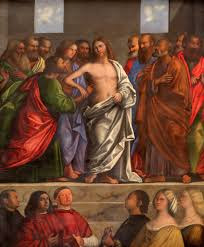
Every year, right after Easter, we have the reading that is often called, “Doubting Thomas”.  For whatever reason Thomas missed the first appearance of Jesus in the locked room, and only a week later did he get his wish – to see and touch Jesus and even put his hand’s in Jesus’ side where the spear had pierced him.  Thomas confesses his faith, “My Lord, and my God!” and Jesus commends him for seeing and believing, but even more those who do not see and yet believe.

You’ve maybe heard some treatment of this text which sort of downplays the importance of seeing – and suggests that all we need is the word!  And there’s some truth to that.  But a closer look at today’s reading shows that Jesus is concerned about both the seeing and the hearing, both the spirit and the material.  For he is the Savior of all people and the Savior of the whole person.

Bear with me today as I get a little bit more into the weeds of philosophy than we usually do.  We have two errors to avoid when it comes to the resurrection of Jesus:  materialism and spiritualism.  Both have a long pedigree and both lead us away from the fullness of Christ’s work for us.  What do I mean by these?

Well, Thomas, it seems, was somewhat of a materialist.  He disregarded the word of the disciples, and doubted the miracle of the resurrection.  All that mattered to him, at least, at first, was what he could see and touch.  The material world.  He needed concrete proof, firsthand experience, he needed something physical and real. 

We have a hymn, a more recently written hymn in our hymnal, that expresses this well: “These Things Did Thomas Count as Real”:

These things did Thomas count as real:  The warmth of blood, the chill of steel, the grain of wood, the heft of stone, the last frail twitch of flesh and bone.

The vision of his skeptic mind was keen enough to make him blind to any unexpected act too large for his small world of fact.

His reasoned certainties denied that one could live when one had ded, until his fingers read like braille the markings of the spear and nail.

May we, O God, by grace believe and thus the risen Christ receive, whose raw imprinted palms reached out and beckoned Thomas from his doubt.

This skeptical posture of Thomas is really quite similar to many today who doubt or disbelieve the resurrection.  Mainstream science has largely hitched its wagon to a materialistic worldview that also considers only what is physical, real, provable, and most importantly- doesn’t need God.    Science has to do with observation and evidence, hypothesis and theory, testing and proving.  The very word “science” comes from the word for “knowledge”, and the great temptation of the scientist is to overestimate his own knowledge, and the ability of humans to know and learn all things that can be known. 

And many Christians fall prey to this modern version of materialistic skepticism, at least in part.  Many, for example, deny the bible’s teaching of creation in favor of a Darwinistic evolution.  They simply can’t take God at his word that he created everything from nothing by his word.  It’s the same foolishness of Thomas that doubts the truth of God on any subject matter, which idolizes reason and senses over and against divine revelation.

Somewhat in reaction to materialism, we have, today, a growing movement of spiritualism.  Reaching all the way back to the philosopher Plato, this is an elevation of the spiritual over and over against the material world.  For Plato the idea of a thing is far better than any example of the thing itself.  For Plato, the body isn’t nearly so important as the spirit.  This leads to a denial of the physical blessings of God, the blessings of creation.

We see examples of this influence today in the New Age Movement, in all manner of people who declare themselves, “Spiritual but not religious”, and even in the Christian church where the spiritual aspect of life pushes out almost entirely the theology of the body.  But We confess a God who is the creator of heaven and earth, and that the stuff, the physical stuff of creation is good.  That the body that he has given me is just as much a part of who I am as the soul or spirit.  And Jesus died for the whole person and saves the whole person, not just the spirit.

We see this neo-platonic influence, sadly, in many Christian funeral services, when the preacher may wax eloquently about the promise that our loved ones are with the Lord, that they rest in peace, and that their spirit is in heaven with Jesus.  But they neglect to preach the resurrection of the body, that is the resurrection of OUR bodies on the last day.  That’s our final and ultimate hope as believers, to share in a resurrection like his.

Sin always twists the truth, and so we have a constant need to return to the touchstone of God’s word to correct and set us straight.

Notice how Jesus regards both the physical and the spiritual in this text:

He breathes on his disciples.  A very physical action, something they can feel.  But as he does so, he bestows on them the Holy Spirit.  A presence just as real, but not something to be seen or felt.

What charge does he give them, but the authority to forgive sins!  Here is certainly a spiritual matter – for sins aren’t things that you can typically touch and see.  The corruption of our nature is a darkness to us that we cannot fully comprehend, but can only confess.  And yet, sin does bring with it a very real and tangible consequence – the wages of sin – is death.

Jesus has forgiven our sins, in the water of baptism, in the word of absolution, in the sacrament of the altar – thus taking away the sting of death.  And though we still die, like Jesus, death will not be the last word on us.  Christ will return in glory and raise his faithful dead, to a very real, very material, very physical body once more.  But now, body and soul will be glorified and incorruptible, just as Christ’s resurrected body is glorified and incorruptible.  “We will be like him for we shall see him as he is.”

Take note, Jesus showed his disciples – he appeared to his disciples – he even made Thomas stick his finger in the wounds.  He doesn’t despise the material evidence, but gave “many convincing proofs” that he was alive.  Those early disciples were eyewitnesses of the resurrection, and Paul tells us that once Jesus even appeared to a group of over 500 of them at the same time!  If seeing and touching and physical proof meant nothing – why would he bother?

And yet, still he knows that not all who believe in him will have had such an occasion.  Like you and me.  We rely on the word of the apostles, the testimony of the church, the teachings of scripture that have been handed down to us.  And Jesus says we are even more blessed for such.

Only in Jesus, then, do we see the right and proper tension, the true and eternal realities of both things spiritual and things material.  In him, we have it all.  He is the transcendent God who becomes human in time and space for his people.  He is the Lord of Life who gives up his life to redeem his people.  He is the Lamb of God, slain from the foundation of the world, but also in bloody sweat on a Roman cross on a certain hill named Golgotha, on a certain date in human history. 

What is left for us but, like Thomas, to stop doubting and believe!  Believe in all of God’s word.  Believe in Jesus who lives.  And believe especially in his word, proclaimed through his pastors, that your sins forgiven on earth are forgiven in heaven.  And confess, like Thomas, my Lord and my God, Jesus Christ, who lives and grants me daily breath, who lives and I shall conquer death.

Saturday, March 30, 2024

Meditations - Good Friday - The Seven Words from the Cross


The First Word:  Luke 23:34

33 And when they came to the place that is called The Skull, there they crucified him, and the criminals, one on his right and one on his left. 34 And Jesus said, “Father, forgive them, for they know not what they do.”[b] And they cast lots to divide his garments.

The first word out of his mouth was a prayer.  A prayer to the Father, not for himself, but for his enemies, his oppressors, the perpetrators of his demise.  Yes, for the Romans, the Jews, the bloodthirsty crowds Jesus prayed.  But also for you and me, whose sins put him on that cross just the same.

We know not what we do.  Who can know his errors?  Who can know the depth of his sin?  We see only a small sliver of the true measure of the evil within us.  But on the cross we can surely see the price.  We can see the consequence.  We can see what our sins have wrought:  death, in all its ugliness.

But even as he goes to death, Jesus brings forgiveness.  That’s the whole point of this bloody, gruesome business.  To destroy death by death, his death, and to win for us forgiveness.  Jesus, by dying thus, answers his own prayer to the Father.  In Christ, and only in Christ, do we have the forgiveness of the Father.


The Second Word:  Luke 23:43

39 One of the criminals who were hanged railed at him,[d] saying, “Are you not the Christ? Save yourself and us!” 40 But the other rebuked him, saying, “Do you not fear God, since you are under the same sentence of condemnation? 41 And we indeed justly, for we are receiving the due reward of our deeds; but this man has done nothing wrong.” 42 And he said, “Jesus, remember me when you come into your kingdom.” 43 And he said to him, “Truly, I say to you, today you will be with me in paradise.”

Just as his first word prayed for forgiveness for the wicked who put him here, his second word offers a promise to another wicked sinner under the same sentence of death.  Who knows what this man had done – they are called thieves and robbers, he confesses he’s receiving the just reward of his deeds.  Really it could be any sin, for all sin deserves death, temporal and eternal.  That cross next to Jesus could just as well be yours or mine.

That other thief was with Jesus – but he wasn’t with Jesus.  He was with him in time and space, under the sentence of death, but he couldn’t be farther away in his heart.  But the second thief, was with Jesus already by faith, and that meant Jesus had a word of hope for him in this dark hour.

But Jesus speaks a beautiful word of comfort here.  He answers this poor sinner’s prayer, directly, profoundly. Today you will be with me in paradise.

Death is not the end of us.  Paradise awaits.  Those who are with Christ now, in faith, will be with him even in death.  But even paradise isn’t the end of the story.  For that thief, and for all scoundrels who find our hope in Christ, paradise for the soul gives way to a resurrection of the body and a life in the world to come.  

The Third Word:  John 19:26-27

26 When Jesus saw his mother and the disciple whom he loved standing nearby, he said to his mother, “Woman, behold, your son!” 27 Then he said to the disciple, “Behold, your mother!” And from that hour the disciple took her to his own home.

He cares for his enemies.  He cares for condemned thieves. Of course he cares also for his mother and his beloved disciple.  There is no time for self-pity, or crying victim.  Jesus is always, even at his lowest, concerned for others.

He provides for Mary.  Take care of her, John.  You’re family now.  But isn’t that the way of the church?  Our connection to Christ connects us to each other, and it all starts at the foot of the cross.

Today there are many Marys who bear griefs and sorrows, and many Beloved disciples who bear all manner of sins and hurts. We all need Jesus and his cross.  But we also need each other.  And so the Christ who dies for his people also gives us each other – the Church – in which to proclaim and hear his gospel, to forgive and be forgiven, and to bear one another’s burdens – even as he has borne the sins of all.


The Fourth Word:  Matthew 27:46; Mark 15:34

46 And about the ninth hour Jesus cried out with a loud voice, saying, “Eli, Eli, lema sabachthani?” that is, “My God, my God, why have you forsaken me?”

The word of ultimate suffering.  The thorns, the nails, the flogging, the mockery, the nakedness, the despair of death – none of it compares to this.  Being forsaken by the Father.  We can’t even imagine.  The Son of God, in perfect communion with the Father from eternity, sharing a unity that we cannot comprehend and can only barely confess, somehow experiences separation from his Father  This is hell.  This is the pinnacle of his suffering.  The wrath and punishment of a Father who turns his back on his Son, because the Son has become sin, the very thing the Father hates.

This is for you, dear Christian.  This is so you will never, ever, have to fear such a fate.  The Father will never forsake you, because Jesus was forsaken for you.  The Father’s anger is turned away from you, because it was all spent upon Jesus.  Thanks be to God.


The Fifth Word:  John 19:28

28 After this, Jesus, knowing that all was now finished, said (to fulfill the Scripture), “I thirst.”

And now, a very human word.  A very human thing: thirst.  We could explain it scientifically, clinically, noting all the blood and sweat that he had lost.  We could see it as yet another aspect of his suffering, that after all of this, now also thirst.  But we can also see it as John tells it, this fulfills prophecy.

That same Psalm 22 Jesus had already quoted, “My God, why have you forsaken me?” foretells this part too:  

my strength is dried up like a potsherd,

    and my tongue sticks to my jaws;

    you lay me in the dust of death.

And so we see that even in his death, in the final moments of suffering, Jesus does what needs to be done.  He fulfills prophecy, he completes his mission, down to the last little detail.  He has done all things well.

And maybe one last reason for the thirst, and the last sip.  To prepare his dry mouth for the great declaration that is to follow in the next word:

The Sixth Word:  John 19:30

30 When Jesus had received the sour wine, he said, “It is finished,” and he bowed his head and gave up his spirit.

In the Greek, one word, “Tetelestai”.  In English 3 little words, “it is finished”.  With this word Jesus puts a giant bow on the gift of his work for us.  He declares his work for us complete.  

But it’s not just an exhausted exclamation, like a runner who’s huffing and puffing after finishing a long race.  This is an official decree.  A pronouncement.  Like when the jury reads the verdict, “not guilty” or the pastor says, “I now pronounce you husband and wife” or, “I forgive you your sins”.  These words, or this word, makes it official.  It is finished.

And finished not just in the sense of done and over with, but also fulfilled.  It’s complete. It’s perfect.  His work of salvation for you has left no sone unturned, not loose end untied, like a masterpiece painting and the artist adds that final magical brush-stroke.  It is finished.  With the flourish of a single word, Jesus declares it, and it is so.

Your sins are finished.  Guilt and shame are finished. The devil and all his works are finished.  Even death itself is finished.  Jesus suffering is complete, and now as he dies, there is nothing left to do.

We cannot add anything to his work.  No merit or worthiness of our own counts a whit, can add a thing to his perfect, completed, all-sufficient work of salvation.  Jesus died for you.  Let the period at the end of that sentence stand forever.


The Seventh Word:  Luke 23:46

46 Then Jesus, calling out with a loud voice, said, “Father, into your hands I commit my spirit!” And having said this he breathed his last.

Jesus’ work of suffering now complete, all that is left is to die.  He commits his spirit to the Father.  And he shows us by this word that we also may die in peace, committing our spirits to the Father.

His final word, like his first word, is a prayer to the Father.  It is a prayer of trust, knowing that his work complete, the Father will receive him joyfully.  Indeed, the Father will soon show just how please he is with his beloved Son and his work of salvation – for after his brief rest in the tomb, the Father will raise the Son to life again.  

Until then, Jesus rests secure in the Father’s hands.  Just so, when we die, we rest secure in the Father’s hands until our own resurrection.  After all, “It is finished”, the Father has forgiven us, and we will be with Jesus in paradise.

Jesus’ last word on the cross is no word of despair, but of hope, and trust and faith.  It stands as an example of the same for all who die in Christ, that we too can depart in peace, secure in the care of the Father, because of the precious death of the Son.